By Ryan Smith
In this installment, I intend to discuss the Fi/Te axis as it appears in Homeric psychology. My discussion will be 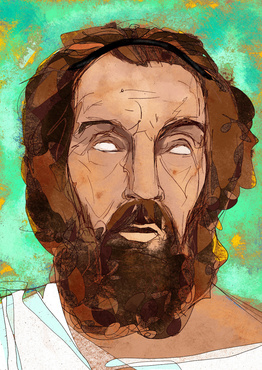
I will first attempt a general outline of the Homeric psychology:
- In part 6 of this series, I contended that, all else being equal, the Fi/Te axis has a reifying bias while the Fe/Ti axis has a holistic bias. In the Homeric writings, we repeatedly see the psyche portrayed as a semi-physical and discrete object which invariably leaves the body at death (Iliad IX, 409). The psyche is not open to merging, nor constituted mutually, but is rather a “zero-sum entity” which must belong to a specific individual at all times. This is seen, for example, when Achilles’s lust for vengeance (i.e. his urge to slay Hector) is described by Homer as a “contention” for Hector’s psyche. In Homeric psychology, insofar as the psyche should be dislodged from its original owner, it would not merge with the psyche of another individual, nor that of a “common realm” (as may have been the case with the Pythagoreans), but rather be lost by its original possessor and the narrative repute of having bested it would be bestowed on its vanquisher. To Homer, the psyche is not some sliver of a greater “world-soul,” the way we see it with Pythagoras, Plato, and Socrates.[2]
As I posited in part 6, the Fi type’s metaphysical bias is one that asserts that “I’m me and you are you – we are not each other,” and that is exactly how Homer appears to conceive of the psyche. An interesting aside in this regard is that while (Te/Fi) Aristotle set out from an intellectual background and a place in time that was much closer to Plato than to Homer, Aristotle nevertheless concluded in his philosophy that the psyche was not something shared, but a private and personal entity – a view that, at least conceptually, came burrowing back to Homer.[3] - While Te is perhaps the function that evinces the greatest overall prejudice in favor of actual materialism (or physicalism), Fi nevertheless follows suit in its own more shadowy manner. As argued in part 6, Fi naturally affords a greater role to the material than does Fe or Ti (although it does not do so directly). Since Western scholars have traditionally held the material to be in direct opposition to the spiritual, this covert and shadowy disposition in favor of materialism may often be difficult for modern readers to pin down. However, a fitting example that showcases how a materialist metaphysics may nevertheless form the basis of a spiritual and poetic – indeed magical – psychic constitution may readily be found in the Greek philosopher Empedocles (ca. 490-430 BCE). Indeed, as Nietzsche has said of him, “he hovers between poet and rhetorician … between scientific man and artist,” combining both of these roles in his character.[4] This fusion of materialism and mysticism has often caused scholars to recoil from his work, or alternatively to label it as either mystical or material when in fact it is plainly both. Indeed, it is consummately evident that Empedocles cared little for these intellectual divisions, imposed on his thought by the intellectual accountants of a later age. Yet because such constraints are unwittingly imposed on the sum-total of “serious” scholars today (and have been for over a thousand years), our modern age has been unable to produce another Empedocles (or indeed any other thinker like him).[5] However, this does not mean that the psychic disposition evidenced by his character has therefore died out, but simply that it has relegated itself to other, more free-spirited domains.
For his part, Homer is really no different from Empedocles, but since he is not a philosopher, the ontological assumptions underpinning his world-view are more implicit and require more artful manoeuvres to ferret out. However, with regard to the Homeric writings, it is nevertheless a matter of fact that there is no concept of the ‘ideational’ or ‘spiritual’ that is in any way conceived to stand apart from (or in opposition to) the material. Indeed, as A.W.H. Adkins has pointed out, even the constituents of mental life, such as the individual’s spirited desires (thymos), are implied by Homer to be some type of tenuous, second-order substance that is not quite matter of the first order, but nor something immaterial either. - In general resemblance to Fi, Homeric psychology regards the spirited and passionate desires (thymos) that register upon a person’s psyche to be amongst the highest and most important processes of psychic life. In the Homeric writings, it is neither intellect nor soul, but a person’s spirited and passionate desires that make him truly human. On this point, Homer is again quite far from the calm and holistic reflective states advocated by the likes of Pythagoras and Plato – NFJ philosophers whose precepts promote cognizance of the whole at the expense of the peculiar.[6]
- As Akinwande and I suggested in part 5, NFP and STJ types are characterized by what we have called divergent perception: Their Fi/Te axis couples with their Si/Ne axis to equip them with the most multifarious mental landscape of all the types. As we said in that piece, since their Si-Fi coupling takes note of every tree in the forest, without detaching to see those trees as interchangeable, the entities of their cognition are more narrowly partitioned than is the case with other types. This is likely one reason why in the Homeric (NFP) psychology, the parts are mentioned more frequently than the whole, and their relation to the whole is never made clear: There is simply little need for such ‘wholes’ in the NFP and STJ psychology. Indeed, according to Adkins, Homer has no conception of ‘wholes’ that does not stand in some direct relation to the personal subject and the wholes are only of interest insofar as they can be coupled back to the personal. However, as Adkins also points out, this absence of a supra-personal ‘whole’ is not in any way experienced as a deficiency or lack in Homeric man (as a Ti/Fe type may be tempted to construe it). On the contrary, Homeric man is thought completely capable of accounting for the sum-total of man’s experiential and psychic needs by reference to his own viewpoints, values, and interests. Certainly, from the Homeric point of view, it might even be argued that it is exactly this absence of cognitive attention expended on such diffuse, supra-personal ‘wholes’ that enlivens, deepens, and intensifies the individual’s capacity to experience his own affective states in full – to be a cosmos onto himself, as it were.[7]
It should hopefully be easy for the reader to discern how the psychological dispositions outlined above apply to those Fi/Te types where Fi is stronger. However, in the first paragraph of this piece, I pledged to illustrate how the Homeric psychology applies to the whole of the Fi/Te axis, and not just to Fi. In what follows, I shall therefore attempt to demonstrate the ways in which Homeric psychology is also reminiscent of Te.
- To Homeric man, the primary social organization was the extended household or clan (the oikoi); the famed Greek institution of the city-state (the polis) had not yet taken hold. In these extended households, there was a definite hierarchy of leadership, where the supreme leader or chieftain (the agathos) was he who consistently managed to manifest the virtues of bravery, strength, and success (in battle and in management) to the highest degree. Within these households, it did not matter how the leader had managed to procure these qualities; all that mattered was that he possessed them while being able to consistently and continually express them in such a way that the extended household was led to success. This observation forks to provide us with two equally cogent points:
- In Homeric psychology, it is objective reality (not principles or abstractions) that forms the bedrock of cognition: Within the extended household, the agathos may have had great advantages over his peers in how he came to be the leader: He may have been the son of affluent parents whose wealth gave him the ability to procure a full set of armor, superior horses, weapons, and a chariot. By way of these “undeserved” advantages, the agathos may have be able to best poorer (but equally talented) rivals, but in the Homeric social order, there is no point in attempting to go back in time in the venture to create some idealized playing field; what matters is who can display results in the actual now. Homeric man does not follow Rawls on his spiritual journey to meet the ‘whole’ that lies beyond the Veil of Ignorance, but looks to reality as it actually exists: Anyone can see that the agathos is more effective in battle and it is therefore natural that he should rule. However, the agathos must continually deliver such superior results or he would soon find himself demoted. (If the reader were to object that the disparity between Homer and Rawls was really temporal, and not psychological, consider that Plato also arranges for an outside political scheme that rearranges the lot of the individual according to his abilities in Republic 414e-415c.)[8]
Hence, Homeric man does not expend himself griping over whether this or that occurrence was really “fair” or “deserved” according to some principle or abstraction, but looks directly to objective reality as it lies before him. The assertion of John Rawls – that no one “deserves” the talents and endowments that he is born with and that these should therefore be evened out before a fair competition could take place – would have been utterly foreign to him.[9] The Rawlsian process of going “behind the Veil” to arbitrate and mediate every step of the process by which one man becomes different from another is an Fe/Ti want: As Akinwande has argued in part 3, those differences are not an indiscretion to Fi/Te types: To them individual differences more often just are.[10] They exist as natural facts that, on the Fi end of the axis, it is not our prerogative to judge and that, on the Te end of the axis, there is no expediency in attempting to judge anyway. Hence, compared to his Fe/Ti counterparts, Homeric man has both fewer illusions about the way the world works and a heightened capacity for experiencing passionate depths of Feeling. - Homeric culture is a results-oriented culture where good intentions and dormant virtues matter little: In the philosophy of Immanuel Kant, it is famously the intention that determines the moral value of a given action, not its actual outcome.[11] Similarly, in the philosophy of Plato, we are continually met with the “Socratic paradox,” namely that the strongest is he who does not allow himself to be acknowledged as such.[12] Both of these philosophies may easily be taken to be reminiscent of the Fe/Ti outlook, and both of them would have been utterly foreign to the psychology of Homeric man. To the Homeric psyche, a disposition that exists as mere potential, without ever amounting to something, is often no better than if that disposition had not existed to begin with. In general resemblance to Te, it is the results (and not the potentialities or intentions) that matter to Homeric man. For example, in the Iliad, when Agamemnon admits to wrongdoing after having deprived Achilles of his spoils of war (the slave-girl Briseis), his wrong does not consist in having infringed on Achilles’s rights, or the intention or non-universality behind his action: As Akinwande has argued in part 3, one premise of the Te/Fi mindset is that we all have our personal interests at heart, and Agamemnon is merely looking out for his own interests, the way every Homeric man is expected to do. No; the error of Agamemnon’s ways is not that he deprived Achilles of his prize, but that his action had the result of making the mighty Achilles abstain from the fighting, thus causing the Greeks to be pushed back to their ships. Had the result of that day’s fighting been different, the worth of the action would have been different too. As agathos, Agamemnon must take responsibility for his miscalculation.
In this installment, I have tried to show how the psychology found in the Homeric writings evinces an Fi/Te bias that exists in stark contrast to the Fe/Ti bias of other Greeks like Pythagoras and Plato. On the Fi side of the axis, Homeric man was prone to psychic surges of great intensity and importance to him personally, giving him depth and intensity of Feeling. On the Te side, he was results-oriented, hierarchical, and realistic, taking objective reality as his basis and wasting little time on Platonic abstractions and “what-ifs.”
NOTES
[1] While I am aware that ‘Homer’ may really be a group or succession of bards, and not a single individual, I shall nevertheless speak of ‘Homer’ in places where this phrasing seems conducive to the overall meaning of the text, just like speaking of the orbital rotation of the earth in relation to its star does not always relay the same meaning as speaking of a sunset, even though we know that the sun does not actually ‘set.’
[2] Plato: Phaedo 83c
[3] Wariboko: The Principle of Excellence (Lexington Books 2009) pp. 50-51
[4] Nietzsche: The Pre-Platonic Philosophers (University of Illinois Press 2001) p. 119
[5] Kingsley: Ancient Philosophy, Mystery, and Magic (Oxford University Press 1996) p. 16
[6] Guthrie: Orpheus and Greek Religion (Princeton University Press 1993) p. 220
[7] Indeed, according to the German classicist Bruno Snell, Homeric man does not have much use for rational deliberation, preferring instead to let himself be steered by his spirited desires (thymos). As Snell points out, Homeric man is not so much ‘making decisions’ as he is prompted by his passions and desires to live out his authentic self, as when Achilles vows to slay Hector on the grounds that his thymos bids him not to live or exist among men until Hector has lost his life on his spear (Iliad XVIII, 90 ff.).
[8] As Plato would have it: “Though for the most part [people] will breed after [their] kinds, it may sometimes happen that a golden father would beget a silver son, and that a golden offspring would come from a silver sire. … If sons are born to [gold or silver parents] with an infusion of brass or iron, they shall by no means give way to pity in their treatment of them, but shall assign to each the status due to his nature and thrust them out among the artisans or the farmers [i.e. the brass and iron people]. And again, if from these there is born a son with unexpected gold or silver in his composition they shall honor him and bid him go up higher…”
[9] Rawls: A Theory of Justice (Harvard University Press 2005) p. 102
[10] Aristotle also acknowledges that there exists a curious breed of people whose conceptions of justice are determined by contemplative, non-results-oriented parameters. But he finds them difficult to understand and does not count himself among them. Aristotle: Nicomachean Ethics 1102b
[11] Kant: Critique of Practical Reason §5:143
[12] For an uncharitable exposition of how the Fi/Te axis’s more straightforward conception of virtue may appear from the Fe/Ti point of view, see Alcibiades’ speech in Plato’s Symposium (231a ff.).
***
Image of Homer in the article commissioned from artist Francesca Elettra.