“The Boundless is the first principle of things that are. It is that from which coming-into-being takes place, and into that which things return when they perish by mortal necessity, giving satisfaction to one another and making reparation for their injustice, in accordance with the order of time.” – Anaximander: Fragment DK12 B1
By Ryan Smith
From the get-go, our conception of function axes has been imbued with a Heraclitean scaffolding, akin to the one foreshadowed by Jung.[1] However, as I have pointed out in previous articles,
To understand the distinctions, we should delineate two approaches to typology:
- The Heraclitean approach, which entails that everyone is necessarily and always a type and that the practice of typology should aim to describe those types as accurately as possible (and perhaps give tips to optimize the lot of the individual, given the inevitability of type).
- The Anaximanderian approach, which holds that though we are born with a disposition for developing a certain type, actually being such a type is something maladaptive; a transgression upon the whole; a “painful bias” that distorts our experience of reality, leading us to over- and underreact to reality, and to shut much of it out.[3]
While the Heraclitean approach holds that all typology can do is to describe the types as accurately as possible, given the inevitability of type, the Anaximanderian approach contends that the study of typology should eventually lead us to a negation of type, i.e. to becoming a type-less self, untroubled by the distortions of type.[4]
Of these two approaches, almost every author in the field has followed the Heraclitean approach. In fact, the only “Anaximanderian” theorists that I know of are James Graham Johnston and C.G. Jung himself.[5] However, even these two Anaximanderian writers seem to alternate between the two meta-approaches, and to make periodical and substantial concessions to the Heraclitean approach, while the Heraclitean authors make no such concessions to the Anaximanderian side.
For this reason, the thought of Heraclitus does indeed appear to be more appropriate as a default for explorations in typology; indeed it is in some ways a precondition for the Anaximanderian view (although historically speaking, Anaximander died when Heraclitus was about 11 years of age). However, given that the Anaximanderian conception is so under-developed and under-exposed, let’s explore it in more detail.
Heraclitus and Anaximander Compared
Our first task will be to compare the metaphysics of Anaximander and Heraclitus. The two are in fact substantially alike (which is one reason why Jung could mistake or intermix them as he did): Both hold that there is a unity of opposites, that is, a metaphysical interdependency among the empirical opposites through which we normally cognize the world. Like the cognitive functions, these opposites exist in a state of interplay, seeking in turn to supplant one another, and alternating, for example, between hot and cold, life and death, and coming-into-being and passing-away. However, while Anaximander and Heraclitus may agree on the metaphysical interdependence of opposites, they disagree as to its meaning:
- To Heraclitus, the alternation of the opposites has no normative status; it is neither good nor bad, but simply just is. Nor is there any corollary metaphysical principle to keep bounds on the process: There is no regularity to the quality or sequence in which the opposites will appear and disappear, save for the basic principle that each pair of opposites is somehow interdependent.[6] All of fire continually has the potential to turn into water (and vice versa), though there is nothing to necessitate when that will happen or how much of it will do so.
- To Anaximander, however, the alternation between opposites is not just descriptive, but has a normative aspect as well. The differentiation of Being into opposites is an injustice that flies in the face of the Undifferentiated, which is the first principle of reality. Since the Undifferentiated is truly without opposites, it is but another name for the Absolute, and is therefore sign-less and inaccessible to discursive thought (hence, perhaps, why almost no one has followed Jung on this point). To Anaximander, whatever comes into being must possess qualities, and whatever qualities it possesses it must have acquired from the storehouse of the Undifferentiated. However, the Undifferentiated is no willing lender, and demands reparation for the temporary existence of the opposites. Unlike with Heraclitus, there is a strict regulatory principle of the Undifferentiated demanding reimbursement for the opposites, according to the strict regime of A+ for A-, heat for cold, light for dark, or death for life.
Or as the British classicist Robin Waterfield has said:
“[To Anaximander] there is constant interplay between the opposite ‘stuffs’ of the world. Each is seen as giving offence to its opposite, and then as having to pay a penalty to it. … Neither is allowed … the injustice of going on for too long.” – Waterfield: The First Philosophers (Oxford University Press 2000) p. 6
***
As mentioned, Heraclitus is Anaximander’s junior by 75 years. He could well be read as correcting Anaximander, indeed as accepting Anaximander’s struggle of opposites, but rejecting the principle of reparations and evening-out over time.[7] Whereas Anaximander had said that there would be justice over time, Heraclitus professes that there will be “no justice but strife,” and indeed “no justice but the advantage of the stronger.”[8] By contrast, Anaximander holds, as we have seen, that the soaring of one opposite invariably coincides with a comparable demise of its opposite. There is no necessary ratio of compensation between the opposites – not even over time.
A further difference is that there is no absolute in Heraclitus. Heraclitus has the logos, but the logos is nothing but the principle of interlinked opposites (having itself, perhaps, some meager transcendent properties, but certainly being no absolute). To Heraclitus, there is no Undifferentiated absolute, standing ‘outside’ of the phenomenal world and providing some type of origin or reprieve from it. There is only this world, locked in perpetual antagonism, struggle and flux, and there is no escaping the opposites.[9]
The Anaximanderian Approach to Typology
In a Heraclitean world, there is no escaping the opposites, and the individual will therefore invariably be marked by them. Which is to say, in other words, that the individual will invariably have a type. But in an Anaximanderian world, on the other hand, insofar as the opposites can be resolved by melting into the Undifferentiated, so can the type. Thus, as we have said, whereas Heraclitean man will inevitably have a type, the Anaximanderian approach is chiefly interested in using typology as a psychic roadmap – a catalogue of his mental deficiencies and excesses, which can then be evened out in him, thus dissolving the differentiation of type and making him one with the Undifferentiated absolute.
Since so much of modern typology is built around self-help tropes which frame the type as something prearranged-but-positive, the Anaximanderian view that type is not an excuse for being a certain way but rather something to move beyond can often be quite upsetting to modern audiences. These days hardly anyone would agree that one can become type-less, and some typologists even get quite upset when the idea is suggested to them. But is it possible?
Well, all talk of the type-less self, like all talk of the absolute, is always “bound to be something in the nature of a hoax,” as Alan Watts has said, because it really does deal with a domain of experience that cannot be spoken about (the Undifferentiated being, by definition, unintelligible to ordinary thought).[10] On the other hand, there is little doubt that the prospect of the type-less self was in fact one of the main points of typology for Jung:
“[…Lao-Tse’s] Tao is the right way … the middle road between the opposites, freed from them and yet uniting them in itself. The purpose of life is to travel this middle road and never to deviate towards the opposites.” – Jung: Psychological Types §192
“…opposites can be united … irrationally [with] some new thing arising between them which, although different from both, yet has the power to take up their energies in equal measure as an expression of both and of neither. Such an expression cannot be contrived by reason, it can only be created through living.” – Jung: Psychological Types §169
“The opposites should be evened out in the individual.” – Jung, in Jung & Schmid-Guisan: The Question of Psychological Types (Princeton University Press 2013) p. 164
In these quotes, Jung not only confesses that he would ideally like to see the individual become type-less; he also pays homage to the peculiar method of identifying the absolute with the personal self, that is to say, to realize the ultimate truth about the world in one’s own being, as Lao-Tse had allegedly done. Anthropomorphizing the absolute, in other words. One must go out into the world and manifest the Undifferentiated absolute in one’s actions and words the way a Zen or Taoist master would. It is not enough to simply sit in a cave and meditate on the absolute, the way certain other Buddhists or Christian mystics do.[11]
Jung also tells us quite plainly (as really all mystics do) that it would be pointless to try to manifest the absolute (i.e. to rid oneself of the type) by way of ordinary mental life.[12] As the Undifferentiated is itself pre-conceptual, sign-less, and indeterminate, no machinations of the four functions can reach it. All functions are variants of cognitive discrimination which the Anaximanderian approach proposes to rid us of. Only a supra-mundane intuition of the real, which causes the mind to break through its own predicates and dissolve itself into the boundless, sign-less absolute, can make the individual transcend type.
That these discoveries are not merely personal idiosyncrasies on the part of Jung, but in fact well-known insights in many traditions that deal with the absolute, is amply illustrated by a classical Zen anecdote:
“One day the master took his seat in the lecture hall and said: ‘Over the bulky flesh of your empirical body, there is a True Man without any distinction.’ …
At that moment, a monk came forward and asked: ‘What kind of fellow is this True Man?’
The master … urged him: ‘Tell me, tell me!’
The monk thought for an instant.
The master immediately thrust him away: ‘Ah, what a useless shit-scraper this True Man is!’”
In this story, “True Man without any distinction” is the anthropomorphized absolute. When the master urges his student to speak, he is prodding him to break through the confines of his own mind and speak from the pre-conceptual, Undifferentiated absolute. Yet as soon as the monk pauses to think, the habitual machinations of ordinary mental life come splashing back into his psyche. In typological terms, he is consulting his functions again. Hence, the monk has failed to manifest the anthropomorphized absolute and to be “without distinction.” With his usual function-arrangement back at the helm, the monk’s bid for manifesting the absolute is truly no better than shit.[13]
As we started out by saying, according to the Anaximanderian conception of function axes, the type is something maladaptive, a transgression upon the whole, and a “painful bias” that distorts our experience of reality. Or as the Indian philosopher Shankara has put it, dualistic mental life is something that “by way of modification and distinction, applies falsehood to the One [i.e. absolute], draws distinctions [where there are none], and characterizes reality by way of imagined names, while in its true aspect it remains one.”[14] In other words, the type tacitly inserts itself as an unseen, and in itself uncognized, “Stage 0” of any ordinary mental operation, invariably determining certain aspects of what we see and how we react to it, without our willing or knowing. Hence it is a cognitive tyranny; a “painful matter,” which the Anaximanderian conception instructs us to overcome.
By withdrawing from our cognitive excesses, and finding indirect ways of engaging with our deficiencies, the man who walks the Anaximanderian path neutralizes the polarities of his axes. Bringing himself back to the undifferentiated bedrock of reality, he finally transcends his type.
***
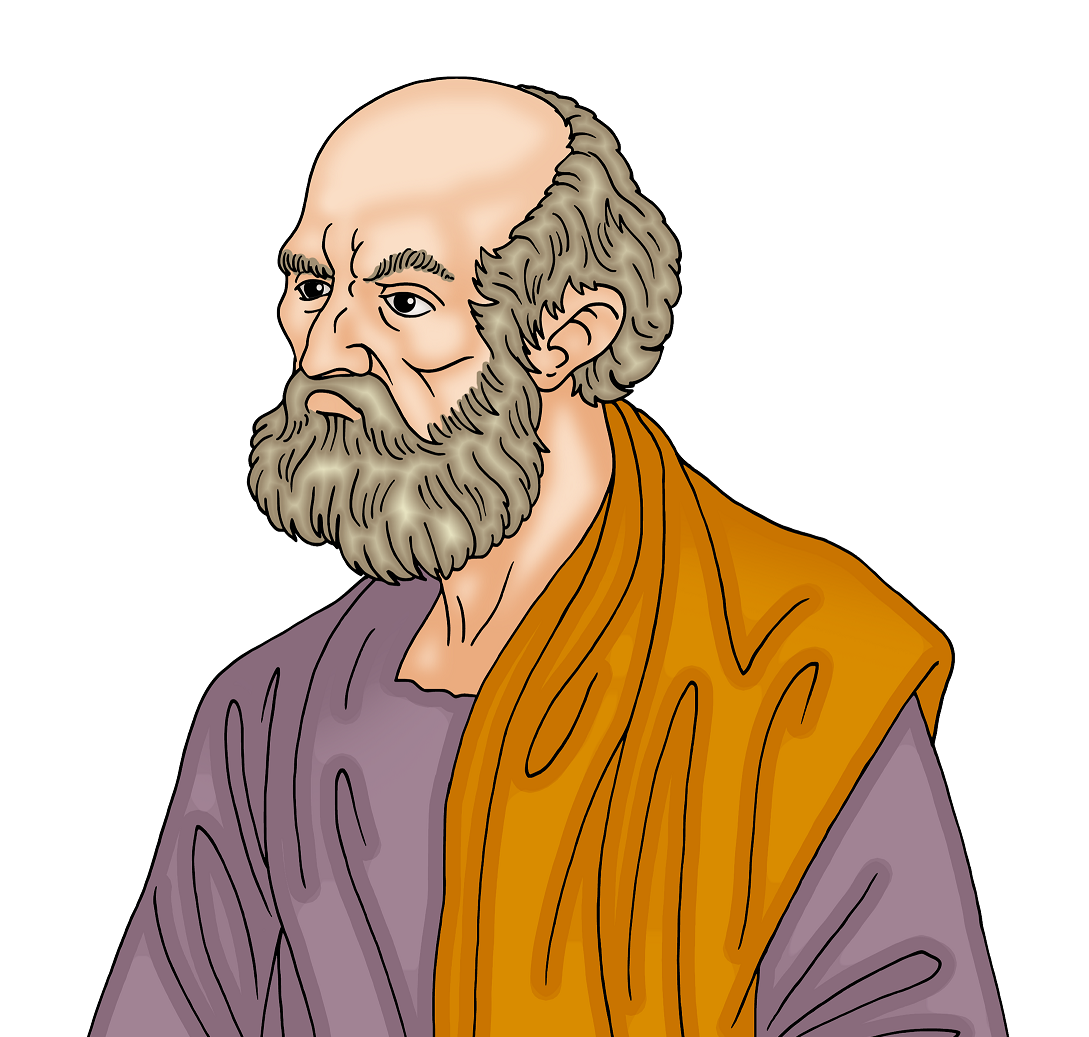
Image of Anaximander in the article commissioned for this publication from artist Georgios Magkakis.
NOTES
[1] Jung: Psychological Types §704
[2] E.g.: The Transcendent Function in Artists and Musicians (CelebrityTypes 2013)
[3] Jung: C.G. Jung Speaking (Princeton University Press 1977) p. 435
[4] Jung: Psychological Types §192
[5] For more on Johnston, see ‘Review of Jung’s Compass of Psychological Types’ (CelebrityTypes 2013)
[6] Guthrie: Orpheus and Greek Religion (Princeton University Press 1993) p. 225
[7] Vamvacas: The Founders of Western Thought (Springer 2009) p. 38
[8] Heraclitus: Fragment DK22 B30, cf. Plato: The Republic 338c
[9] Heraclitus: Fragment DK22 B54
[10] Roochnik: Retrieving the Ancients (Blackwell 2004) p. 24
[11] This doctrine of the anthropomorphized absolute is more Taoist than Anaximanderian, indeed I know of no Greek philosopher who has held a comparable doctrine (but the Eleusinian mystery cult probably did).
[12] Jung: Psychological Types §180
[13] Ironically, by assigning a distinct sense of value (or lack thereof) to shit, the master is speaking from a position of ordinary consciousness as well. But since the absolute is scarcely describable by means of ordinary language, Buddhists and Taoists often resort to paradoxes of this sort.
[14] Shankara: Brahmasutrabhasya II.1.14 (paraphrased)