DISCLAIMER
When I mention genders and cognitive functions in this article, I refer to them only in terms of the historical and metaphysical ways in which they were employed by Jung, Jungians, and the ancient world. The value judgments associated with these entities are invoked because they are relevant to my analysis of the Mithraic mysteries, and not because they reflect my personal views.
***
“Awe surrounds the [Mithraic] mysteries, particularly the mystery of deification. This was one of the most important of the mysteries; it gave the immortal value to the individual – it gave certainty of immortality. One gets a peculiar feeling from being put through such an initiation.” – C.G. Jung: Notes on the Seminar Given in 1925, Lecture 12
“To him they give the name Mithras, and celebrate his rites in secret caves…” – Firmicus Maternus: De Errore Profanis Religionis §IV
By Ryan Smith
Mithraism was an ancient mystery religion, practiced by the Romans from ca. 50 BCE to 400 CE, and centered around the worship of the God-man Mithras. Ostensibly, Mithraism grew from Iranian roots, which were much older than the Common Era, though the continuity between the two traditions is contested. (It is possible that the seniority of the Mithraic religion was exaggerated since the Romans, cultural upstarts that they were, loved religions with a long history.) At any rate, Mithraism was very popular in the Roman Empire during the aforementioned 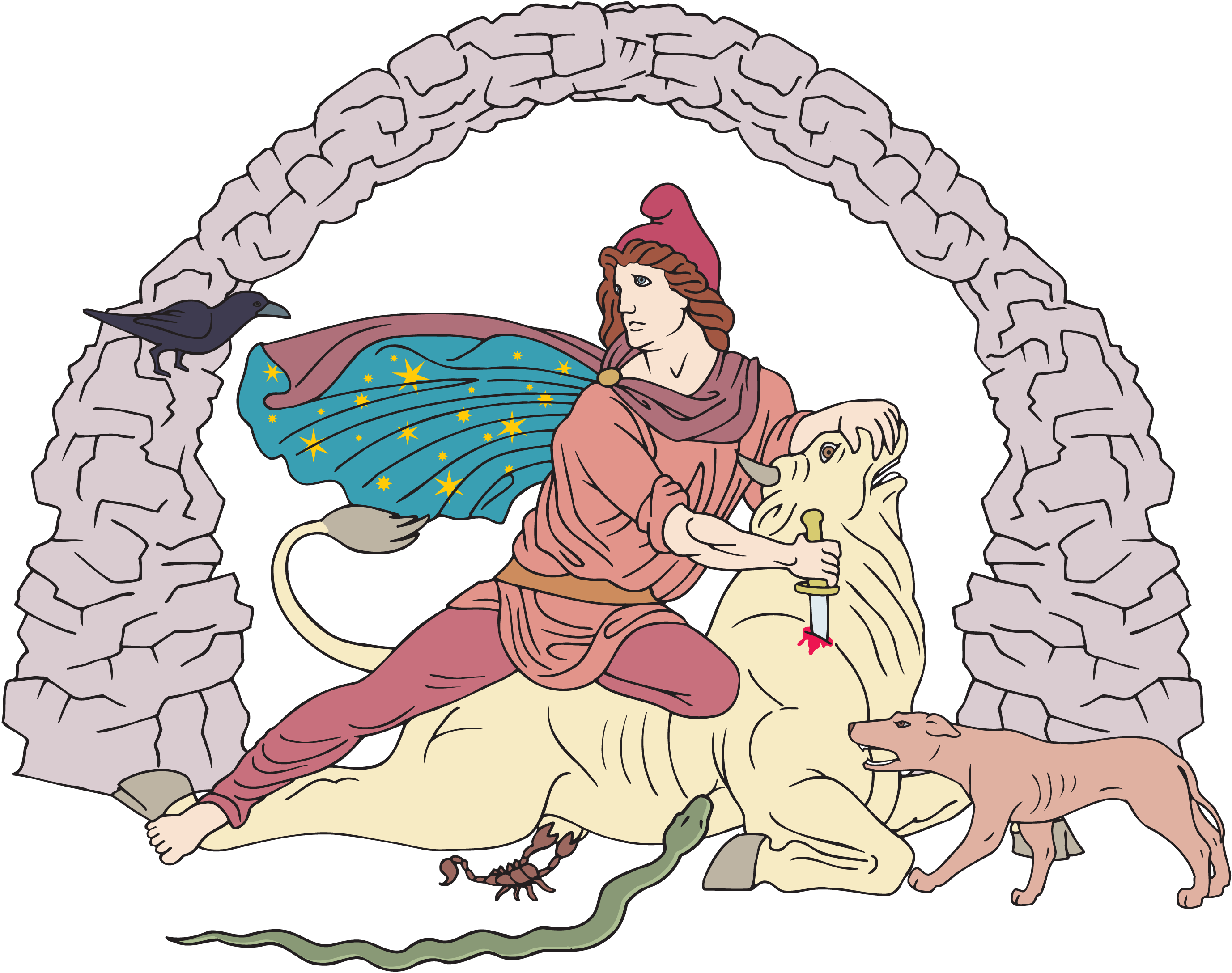
Whereas the path of Christianity essentially consists in repenting for one’s sins and accepting Jesus as Lord (Romans 3:23; 10:9-10), Mithraism, like many other ancient religions (and like the Freemasons today), consisted of a series of mysteries which were only unveiled to the initiate gradually, in accordance with his or her supposed spiritual development. Since the mysteries were essentially secret, almost no written records detailing their nature and meaning survive. On the other hand, we are blessed with a multitude of archaeological finds. In other words, to discern the meaning of the Mithraic religion, it is necessary to rely on interpretations of visual imagery contained in the artefacts that survive, and since imagery is notoriously open to interpretation, the meaning of the Mithraic mysteries is hotly contested.
No matter which understanding one adopts, however, these are the elements that every interpreter will have to make sense of: The waters (or river); the underground cavern (or rock); the tree and the winds; Mithras slaying the bull (while looking away); the bull beset by a scorpion, a dog, a snake, and a raven; Mithras banqueting with the Sun-God on the hide of the slain bull.
Freud famously adopted the interpretation that Mithras’ slaying of the bull represents the ego’s subjugation of the id (i.e. human consciousness reigning in its primitive drives).[2] Consistent with Freud’s overall psychophysical theory, the sacrifice is regretful but necessary: If we did not repress our animal side, we would not be able to function in civilization.[3] Thus civilized existence always entails a sense of regret and discontent on account of the instinctual gratifications that one has relinquished. Mithras looking away while slaying the bull is thus interpreted as an allegorical representation of repression.
Like Freud, Jung accepts that the bull is part of Mithras himself; that Mithras is both slayer and the slain. However, Jung does not agree that the sacrifice was voluntary: He sees a parallel to the sacrifice of Jesus which was (in his opinion) voluntary and involuntary at the same time.[4] Beyond that fact, however, Jung is not entirely clear in his understanding of the meaning of the killing of the bull motif, adopting multiple and contradictory interpretations, sometimes within the course of a single work.[5]
In this article, I will attempt a brief interpretation of (parts of) the Mithraic mysteries. My interpretation is not like Freud’s or Jung’s (though in some sense they were right), but inspired by Mithras scholars and esoterists, as well as my knowledge about Buddhism and the ancient world. As scholars often point out, there is a “multi-layered quality [in] Mithraic symbolism,” and so there is considerable disagreement about how to approach the study of the mysteries, as well as how to interpret them.[6] This article, as the title suggests, attempts to trace the path of spiritual development in Mithraism, that is to say, the spiritual meaning of the mysteries. For those who want a “just the facts, ma’am,” archaeological review of the evidence, I recommend Manfred Clauss’ measured book The Roman Cult of Mithras instead.
The Water (or River)
According to ancient Iranian myths, Mithras was born in a cave (a “rock”) near a river. The first symbol we must make sense of here is thus the river or water motif. While Mithraism is certainly no Western variant of Buddhism, I believe the best analogy for the Mithraic theme of the river is the Buddhist notion of samsara, that is, the cyclic change of the world, driven by mindless, aimless craving. In the Buddhist tradition, one awakens from samsara through the practice of meditation.[7] (Except where Buddhism uses the ‘cycle’ to signify ever-shifting cravings, Mithraism uses the river or ‘stream.’) First, the initiate becomes mindful of the ever-present cycle of cravings, and then, attaining a sense of mental distance and a clarity he did not possess before, he or she is set on the path to awakening (bodhi) and eventually liberation (nirvana) from the samsaric cycle.
In Mithraism, the birth of Mithras (which is also the birth of the initiate) occurs when one breaks away and is rescued from the samsaric waters. (It is also possible that the Christian miracle of Jesus walking on water [Matthew 14:22-33] was meant to signify the same kind of mastery, i.e. that Jesus had achieved mastery over the samsaric element of existence.)
The first step to initiation in the Mithraic faith thus involves the initiate being set on the path to recognize and eventually break free of the cycle of earthly cravings. To free himself, he must cross the river in order to “reach the other shore” (which is itself another Buddhist parable for one who has achieved liberation from samsara).[8]
The Rock (or Cavern)
If the waters (or river) correspond to samsaric cravings, the rock is to be identified with the body. Just as a stream can enter a cavern, so it is through the body that the cravings enter human consciousness. The Mithraic symbols of waters and caverns thus symbolize the onslaught of worldly desires filling up the body. This ontology is not Buddhist, since Buddhism does not disparage the body at the behest of the mind (indeed, Buddhism holds the mind to be no better or worse than the senses).[9] Rather, the Mithraic idea that the body is “lower” than pure spirit or idea is Platonic (although the exact relationship between Platonism and Mithraism escapes us).[10]
In Psychological Types, Jung discusses how in Platonic cosmologies, matter could be equated with Sensation, and in Archetype and Character, the Jungian analyst V.W. Odajnyk discusses how (in his opinion) matter is the metaphysical root of Sensation.[11] One could employ that same analysis here and say that in the Mithraic mysteries, we must equate the rock with Sensation. Mithraism is not as censorious of Sensation as Plato, however, but takes a more nuanced view: On the one hand, it is correct to say that the descent of pure spirit or idea (i.e. the metaphysical root of Intuition) into the realm of samsaric reality and the body is a misfortune that is to be rectified by treading the path of the mysteries. But on the other hand, the principle of Sensation is also indispensable since, to Mithraism, Sensation is the very thing that lends individuality to the actualized, spiritually liberated person. Without Sensation, there would simply be a blank, all-encompassing One (as seen in Parmenides and Plato), possessing no qualities, personality, or distinction.
Far from being something to be left behind, then, Sensation is very valuable in Mithraism because it is the prerequisite of all individuality. It is something to be integrated into the spiritual whole that one is to become (a whole that will eventually supersede the gods), not left behind as Plato had said (Phaedo §65ab). While Plato had said that Sensation is merely the epiphenomenon of Intuition, Mithraism holds that whatever exists as pure Intuition is universalized, devoid of all locality or distinction. Its potential cannot be actualized, since Sensation is no mere shadow-play, emanating from the realm of pure ideas (Republic §514a ff.), but a generative principle in and of itself.[12]
Already here, in these early steps of the Mithraic path of enlightenment, we see startling parallels to other religions: Mithras breaking free of the cavern’s womb and setting out to cross the waters in order to reach “the other shore” constitutes not just the miraculous birth of the God-man, but also the individual’s quest to be liberated from samsaric desire. Contrary to Judeo-Christian theology, however, the birth of the God-man is not just a point in (linear) time, but a symbol of eternal rebirth and beginning. The motif of the divine baby is found in many ancient mystery religions where it symbolizes “birth beyond death” and sets the individual free from the reins of his personal mortality. In the Eleusinian Mysteries, for example, the (re)birth of the divine child at the end of the mysteries was thought to confer a vision of eternity and a spiritual form of personal immortality upon the initiates.[13] In modern times, this trope is also the meaning of “the baby of light” hovering in orbit around a planet at the end of Kubrick’s 2001: A Space Odyssey.
The Tree and Wind
Once Mithras has crossed the waters, he comes upon a tree. Hungry and naked from his birth, he eats its fruit, and from its leaves he fashions a garment. As soon as he has done so, he is immediately beset by strong winds, which would have broken him, had it not been for his newfound garment. Here the tree symbolizes a deepening of the principle of Sensation as an individualization of the absolute that I have described above. But now, Sensation is mixed with the qualities of archaic Feeling, as found in the Homeric tradition, and which I have described in previous articles.[14] Interestingly, however, one cannot say that these “winds” are either Fi or Fe: Their passions are animating, spirited, and violent, as they are in the Homeric tradition, but at the same time, they are also a property of the cosmos, and not the individual, which is more indicative of a Platonic (Fe) style of metaphysics.[15] The same unison of Fi and Fe as the violent “winds of the world,” sweeping down in an attempt to break the spiritual strength of the individual, is found in Christianity. Here, however, the same motif is concealed in the practice of flagellation; the “pain of the world” which the Christian devotee must stomach while remaining upright, defying it with recourse to his piousness and dedication.[16]
Another Judeo-Christian parallel to the motif of the tree and the wind is of course found in Genesis where, eating from the Tree of Knowledge, Adam and Eve become self-conscious on account of their nudity (of which they had not been ashamed before) and start covering themselves with leaves from a tree. In the Jewish tradition, moreover, the eating of the fruit is what allows the factors of good and evil to intermix in the world (whereas prior to that time they had been separate). The Mithraic mysteries, too, refer to some cosmic mixture that occurs with the eating of the fruit; only here it is not good and evil that intermix, but individuality and the absolute. Even as he rises above samsara and primitive Feeling-Sensation in order to attain contact with the absolute, the initiate endeavors to hold on to those aspects of his individual personality that please him and are valuable to him, uniting the cosmic opposites through his own virile force.
Slaying the Bull
We now come to what is at once the most famous scene in all of the Mithraic mysteries, as well the one whose meaning is the most disputed: That of Mithras slaying the bull (while looking away) and the body of the bull being beset by a raven, a snake, a dog, and a scorpion.
One classical interpretation (supported by Jung, among others) holds that the slaying of the bull represents the creation of the world, as known from various Persian bull-sacrificing cults.[17] As a matter of historical continuity it is interesting to note, however, that there are no known Iranian sources pointing to a link between the Persian Mithras cult and the slaying of the bull. It appears to have been a Roman invention, retroactively inserted into the older Persian tradition.[18] Thus, to the extent that the slaying of the bull really was synonymous with the creation of the cosmos, it may well have been the result of some ill-informed Roman’s fanciful mixing up of Persian stereotypes.
It is possible that in the Roman version of the Mithras cult, the slaying of the bull was associated with the creation of the world in a mundane sense.[19] It is not, however, the spiritual meaning of the scene.
In many Eurasian spiritual traditions, such as the Bhagavad Gita, the Upanishads, Platonism, Hermeticism, Freemasonry, Tantrism, Sufism, and the like, man is thought to have a “lower nature” that must be shredded in order for him to ascend and make contact with his higher self. In Christian theology too, the doctrine of overcoming one’s lower nature is sometimes touched upon (as in e.g. Galatians 5:24: “Those who belong to Christ have crucified their lower nature with its passions and lusts”), although here the magical or supra-mundane properties of this doctrine are not very pronounced.
As we have seen, the “lower nature” is often identified with mindless bodily cravings, the gratification of which the spiritual traditions then seek to counteract. Usually the countermeasures of these traditions have consisted in either (1) “punishing” or “starving” the body of its sensory pleasures, as seen in Christianity or Platonism, or (2) cultivating a sense of “mindful awareness” in the practitioner that counterbalances the sheer ignorance of the bodily cravings, as seen in Buddhism or Jainism.[20]
A third solution to the spiritual problem of man’s “lower nature” involves the bestowal of initiatory grades – spiritual ranks that were thought to be vested with magical powers and properties. The magical nature of the grade or rank that the initiate had attained was believed to give him a new spiritual or otherworldly nature, alongside his purely mundane one, and this new nature was then thought to allow the initiate to better withstand his baser desires.
Speaking specifically of this “magical” solution vis-a-vis the merely mindful or ascetic ones, the Italian esoterist Julius Evola has referred to them as the “wet” and “dry” paths, respectively.[21] While they all share the aim of spiritual development, the “dry” path (such as the one found in e.g. Buddhism), which bases itself on meditation and analysis while downplaying miracles and magic, will not be suitable for all psychological temperaments. Thus more magical paths like Tantrism or Alchemy might achieve the same aims by anchoring the initiate’s spiritual strength not in intellectual analysis, but in mythology and magic.
As a doctrine of spiritual development, Mithraism is just such a “wet” path, operating with seven grades of initiation:
- Raven
- Husband-to-be
- Soldier
- Lion
- Persian
- Envoy of the Sun
- Father
With new each grade that is attained, new meanings of the mysteries are divulged to the initiate. His understanding deepens and his spiritual nature is honed further, thus allowing him to withstand or transcend the cravings of his lower nature.[22] As for modern parallels that make use of these same devices we may mention Freemasonry and the Hermetic Order of the Golden Dawn (and perhaps even Scientology too).
Before proceeding with our analysis of the bull-slaying scene, we must first point to another contrast: The ancient world was famously syncretistic, with religions of every stripe being worshipped side-by-side. Within this plethora of deities and traditions, a contrast was sometimes drawn between the feminine “lunar” traditions and the masculine “solar” ones. In compliance with the cultural views of gender prevalent in the ancient world, the practitioner’s aim in following a “feminine,” “lunar” tradition would be that of complete submission to the deity, as he sought to make himself the deity’s humble servant and to gain the deity’s favor by making himself an instrument of its will.[23]
The Romanized cult of the Egyptian goddess Isis was just such a feminine and lunar path: Isis is the moon and the mother of the world, and she wears a crown consisting of a lunar disc nested between two cow’s horns.[24] In Mithraism too, the bull is associated with the moon. In fact, the exact same contraption of the moon being nested between the bovine’s horns is also found in Mithraism.[25] As the fifth or sixth century commentator Lactantius Placidus says: “[Mithras] grips the bull’s horns with his two hands. The interpretation of this concerns the moon.”[26] By contrast, we might take the Egyptian god Horus or Ra as an example of the solar and masculine path. Here, the practitioner is no servile underling but a virile and fiery hero who, rather than submitting to any deity, transcends all obstacles by his own masculine force. Submission being foreign to his nature, he is determined to reach the highest rungs of existence; he will become unparalleled in prowess or die trying.
Given these contrasts, along with what we have said so far, it will not be hard to locate Mithraism in our little typology of ancient religions as a “wet” and “solar” path: Mithras is INVICTVS (invincible) and rather than prostrating himself before the gods he is fully intent on ascent.

We come now to the meaning of the bull-slaying scene and also to the way in which Freud and Jung were right: By slaying the bull, Mithras is indeed slaying part of himself (as both Freud and Jung had conjectured), and this part is the “lower nature” which we discussed above. From the standpoint of Freud’s philosophical cosmology, one would probably be justified in associating this “lower nature” with the id and its unruly, unlawful desires.[27] However, in assuming the equivalence of all lower drives with man’s lower nature, Freud misses most or all of the spiritual significance of the scene. This subtle yet profound difference can be seen in how Freud interpreted Mithras looking away as a sign of regret, that is, Mithras’ remorseful anguish at having to give up sensory gratification as called for by the id. But in fact, the slaying of the bull is entirely voluntary and does not represent a “giving up” of something coveted, but a transcending of it: From the standpoint of the initiate’s new higher nature, the sense-gratification he craved before now seems pointless and trite. Hence, Mithras is not looking away, but upwards, that is, towards the next steps that lie before him on the solar path. On this path, he yields to no god. As we quoted Jung to say at the beginning, the Mithraic mysteries are “the mystery of deification” of the individual. Set on the masculine solar path to becoming a deity, Mithras rids himself of his lower, feminine, servile, and lunar nature by thrusting his blade into the bull. This magical transformation of his personal identity paves the way for his further ascent.
The scorpion, serpent, and dog are not witnesses, but active participants in the scene. On most of the surviving Mithraic artefacts, these three animals are shown assaulting different parts of the bull’s corpus, with the scorpion assailing the seed, the snake going for the blood, and the dog setting itself upon the hide of the bull. One popular interpretation holds that the scorpion and snake represent the advent of “evil,” storming in to profane the purity of the newly created world, while the dog, symbolizing “good,” does its best to ward them off. However, one problem with this interpretation is that the dog is not depicted as fighting the scorpion and snake as much as they all appear to be besetting the corpus of the bull. Furthermore, another problem here is that the ancient Romans and Greeks did not associate scorpions and snakes with “evil,” the way modern audiences do.[28] As far as the mundane interpretation of the three animals goes, it is more reasonable to follow the suggestion of the German historian Manfred Clauss who has asserted that these animals represent some kind of life force or “life-potential” which is given nourishment by the bull’s blood, seed, and hide, thus giving life to vegetation and Animalia in the world.
Such an interpretation would be well in line with the older Persian tradition of which the Roman Mithras cult was ostensibly an outgrowth. If we are to trace the spiritual significance of the scene by way of reference to other spiritual traditions employing similar motifs, however, we would be unlikely to settle for this view. Rather, in keeping with what I have said above, by slaying the bull, Mithras embarks on a path of magical transformation, where he resolves to give up his lower nature in favor of the deification that lies ahead. When viewed in the context of the wet and solar path, then, the animals represent the lower bodily cravings. These cravings can only assail the initiate through his own lower nature, that is, through his mortal body that fetters him to samsara. By giving up his lower nature, the initiate deprives the animals of the one point of contact that would give them power over him. The animals are firmly intent on the body, but Mithras is looking upwards, towards the ascension yet to come. He has set himself beyond them.
***
In Mahayana Buddhism, the bull (or rather ox) is also a symbol of the spiritual journey, although since Buddhism lies at the extreme of the “dry” path, the Buddhist variation focuses almost exclusively on the mind seeing deeper into itself and deprives the motif of its magical and somatic characteristics.[29] Another difference is that, while original Buddhism was a “solar” path, Mahayana Buddhism contains many “lunar” elements, and so the bull is not slain, but tamed to the point where consciousness goes beyond the duality of subject and object, initiate and bull, and the two move as one.[30]
Banqueting with the Sun God
It is now time for the apex of the spiritual journey undertaken in Mithraism: The scene of Mithras banqueting with the Sun God. Once again, we must provide some general background before proceeding with a description of the scene.
First, we must recall the opposition between “solar” and “lunar” traditions: On the lunar path, it is expected that the initiate should submit unconditionally to the deity and seek to make himself an instrument of its will. One example of this tradition can be found in the biblical account of the Binding of Isaac, where God commands Abraham to slaughter his son, seemingly for no other reason than to see if he would be willing to do so (Genesis 22:2-8). In accordance with the lunar approach to spirituality, Abraham’s willingness to kill his own son for the deity merits blessings and praise. This type of religiosity is arguably the most familiar to modern audiences, since Judaism, Christianity, and Islam are all lunar paths.
In the ancient world, however, “solar” traditions were a natural element of religious life and they effortlessly existed side by side with the lunar ones. As we saw earlier, if the goal of the lunar traditions is to bring about a “feminine” surrender to the deity, the solar traditions revolve around a “masculine” and virile ascent that proposes to make the initiate an equal of the gods. For this reason, the solar traditions were often quite popular among the warriors and soldiers of the ancient world: In ancient Egypt, for example, Horus had the dual aspect of sun-god and warrior-god, and the warriors of Egyptian society were sometimes referred to as “the followers of Horus.”[31] With regards to early Buddhism, the Buddha was originally a Kshatriya (i.e. from the warrior caste), and though the Buddha never advocated violence, the language of the earliest Buddhist discourse is nevertheless filled with analogies to war chariots, war elephants, banners, fortresses, archers, arrows, and so on.[32] And the quest for enlightenment is described as a “battle,” where one must seek “victory” through determination, sacrifice, courage, and conquest.[33] As for the Roman cult of Mithras, it is known to have been favored by the military, and Mithras sometimes served as a role model for the legionaries.[34]
The Mithraic mysteries, then, propose to set the initiate on a path that will make him the equal of the gods. It is in this light that we must understand the meaning of Mithras banqueting with the Sun God: Having risen from the lower world and defied the rock (generative Sensation), the waters (samsara), and the wind (primitive Feeling), the initiate now reaches the threshold of a higher order of reality. Shrouded and frozen in time, he stands halted at a point of complete darkness and silence. Suddenly, gates swing open to reveal a new realm, as the initiate finds himself surrounded by a pantheon of gods. All are staring sternly at him, and in pride of place he sees the Sun God, whose scorching stare threatens to overcome him. But Mithras does not avert his eyes. In a terrible instant, he meets the Sun God’s stare head on. Face-to-face, man-to-man, his determination denies any vestige of sacrilege or hubris. Sensing the initiate’s determination and might, the Sun God yields and asks Mithras to seal a pact of mutual friendship with him. Mithras accepts, and the two share a banquet of wine and bread on the hide of the slaughtered bull. Mithras is now the equal of the gods.
***
Though Christianity is evidently a lunar path, the similarities between the scene of Mithras banqueting with the Sun God and the Sacrament of the Last Supper are too obvious to ignore. Certainly, the early Christians thought that the devil was responsible for this imitation or “mockery” of their tradition.[35] Though many writers have postulated routes of appropriation either way, I agree with Manfred Clauss that direct borrowings between the two religions seem unlikely and that the similarities are more likely due to an older body of miracles and legends that was prevalent all over the ancient world and which every religion drew upon and appended to its own dogma.[36] To give but one example, many of the things we read about Jesus in the Bible were also attributed to the Buddha at the beginning of the Common Era (or perhaps even before that).[37]
Speaking of the Buddha, it seems fitting to end our exposition with a final comparison: We have said that the point of the solar traditions was to make the initiate an equal of the gods. We have also said that original Buddhism was just such a “solar” path. However, where Buddhism is quintessentially “dry” (that is, intellectual and analytical), Mithraism was “wet” in the sense that it achieved the same ends through mysteries, rituals, and magic. At the end of the day, though, just as the culmination of the Mithraic journey sees Mithras as an equal of the gods, so the Buddha, upon having achieved enlightenment, would declare that: “In all the world of angels, demons and gods … I do not see … anyone whom I should respectfully salute, nor anyone before whom I should rise for him to be seated.”[38] Like Mithras, he had attained a level of spiritual development that is the rival of the gods and which is beyond the powers of the gods to destroy.[39]
REFERENCES
[1] Armstrong: A Compulsion for Antiquity (Cornell University Press 2006) p. 237
[2] Freud: The Freud/Jung Letters §199a F
[3] Elsewhere in his oeuvre, Freud also attempted the less fortuitous interpretation that Mithras killing the bull was an Oedipal motif, namely that of the son killing the father. Freud: Totem and Taboo (Vintage 2001) p. 153
[4] Jung: Symbols of Transformation §668n66
[5] See for example: Jung’s comments in Jung: Nietzsche’s Zarathustra (Routledge 1989)
[6] Clauss: The Roman Cult of Mithras (Routledge 2001) p. 67
[7] Smith: Psychology in Hinayana Buddhism (CelebrityTypes 2016)
[8] Alagaddupama Sutra §13
[9] Majjhima Nikaya §137; 148-149
[10] Smith: Why Plato is INFJ (CelebrityTypes 2014)
[11] Jung: Psychological Types §14, cf. Odajnyk: Archetype and Character (Palgrave McMillan 2012) p. 207
[12] Evola: The Path Of Enlightenment According To The Mithraic Mysteries (The Alexandrian Press 1993) p. 13
[13] Wasson et al.: The Road to Eleusis (North Atlantic Books 2008) p. 59
[14] Smith: Determining Function Axes, Part 7 (CelebrityTypes 2015) cf. Smith: Jung in Plain Language: Fi (CelebrityTypes 2015)
[15] Plato: Plato: Symposium §211ae, cf. Smith: Why Plato is INFJ (CelebrityTypes 2014)
[16] Evola: The Path Of Enlightenment According To The Mithraic Mysteries (The Alexandrian Press 1993) p. 14
[17] Jung: Nietzsche’s Zarathustra (Routledge 1989) p. 157
[18] Hinnells: Mithraic Studies (Manchester University Press 1975) p. 291
[19] Clauss: The Roman Cult of Mithras (Routledge 2001) p. 84
[20] Dhammapada §287
[21] Evola: The Doctrine of Awakening (Inner Traditions 1996) p. xiii
[22] Cumont: Mysteries of Mithra (Cosimo Classics 2007) p. 145
[23] Evola: The Path Of Enlightenment According To The Mithraic Mysteries (The Alexandrian Press 1993) p. 16
[24] Alvar & Gordon: Romanising Oriental Gods (Brill 2008) p. 49 Furthermore, it is interesting to note that Isis is also frequently able to transform into a cow; is accompanied by cows; and sometimes bestows the gift of fecund cows upon her followers.
[25] Clauss: The Roman Cult of Mithras (Routledge 2001) p. 82
[26] Lactantius Placidus: Thebais §1.719-720
[27] Smith: Freud and Empedocles (CelebrityTypes 2014)
[28] Green: An Archaeology of Images (Routledge 2004) p. 231
[29] Suzuki: Essays in Zen Buddhism (Grove Press 1949) pp. 370-371
[30] Suzuki: Essays in Zen Buddhism (Grove Press 1949) pp. 373-374
[31] Budge: From Fetish to God in Ancient Egypt (Dover 1988) p. 243, cf. Moret: The Nile and Egyptian Civilization (Routledge 1996) p. 465
[32] Thomas: The History of Buddhist Thought (Routledge 1989) p. 198
[33] Muller: Sacred Books of the Buddhists vol. 3 (Oxford University Press 1951) p. 295
[34] Hinnells: Mithraic Studies (Manchester University Press 1975) p. 265
[35] Clauss: The Roman Cult of Mithras (Routledge 2001) p. 109
[36] Clauss: The Roman Cult of Mithras (Routledge 2001) p. 169
[37] Smith: Jesus and Eastern Influences (CelebrityTypes 2016)
[38] Anguttara Nikaya §8.11
[39] Majjhima Nikaya §47