
By Ryan Smith
With regards to Nietzsche’s aesthetics, you probably already know his opposition between the Dionysian and the Apollonian, as featured in The Birth of Tragedy. (Jung examines this same opposition in Psychological Types, identifying the Dionysian with inferior Se, bound up with tertiary Feeling [§235], while the Apollonian is “a state of introspection … a state of introversion … intuition” [§236-8].)
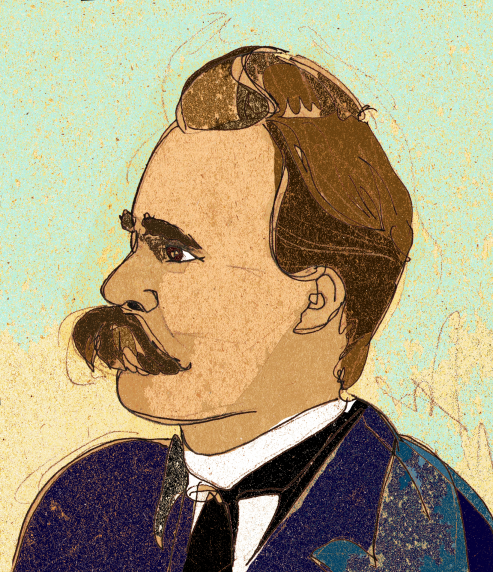 But what I want to do in this article is reach back to Nietzsche’s earlier aesthetics, to what could be called his Aesthetics of Night. This aesthetic was crafted by him before he made the opposition between the Dionysian and the Apollonian the pivot of his aesthetical thinking. While the Aesthetics of Night can be seen as a forerunner for his eventual aesthetics in The Birth of Tragedy, the two are also divided by some important differences, and on the whole the Aesthetics of Night seem far more personal to Nietzsche than his eventual aesthetics in The Birth of Tragedy.
The Aesthetics of Night
The central premise of Nietzsche’s early aesthetics is that true aesthetic enjoyment must come from a mysterious somatic power, pulsating below the threshold of consciousness. It is when we engage this dark and bodily impulse that we step out of our private, rationalizing selves and come really close to the aesthetic.
As a classical philologist, Nietzsche had read about the rowdiness that took place during Ancient Greek theater festivals and it is here that he finds the historical precursor to his own Aesthetics of Night. Looking at French art of the 1700s and 1800s, Nietzsche finds that his contemporary French aim merely for elegance. In typological terms, they had plenty of Fe and Ne but no sustained intensity or personal depth in their arts. It is an impersonal elegance, enjoyed at arm’s length and primarily through the mind, not with the whole body.
This is art enjoyed on the conditions of civilization and not on the conditions of art itself. If a play is bad, the audience is not affronted or outraged with the actors, as Nietzsche thinks they rightly should be. Nor are they lifted into an ecstatic state of exuberance if the play was good. It is merely “a good play” or “a bad play” – something that one talks about “from a distance” in the polite conversation of the coffeehouses afterwards.
Nietzsche also looks at the Florentine scholars of the 1600s who tried to reconstruct the musical dramas of Ancient Greece, thereby inventing opera as we know it today. To Nietzsche, this intellectually driven attempt to reconstruct something that made sense to another people at another point in history by way of the intellectual examination of ancient, dead sources is not a genuine aesthetic endeavor: For it cuts off the unconscious somatic force that engages us to enjoy directly and not just through the mind.
To Nietzsche, the highest aesthetic enjoyment can only come through art that is capable of producing an un-belabored and naive sense of exuberance on its own terms. “Under the bad influence of modern aesthetics” there have grown forth pieces of art that only make sense on certain self-referential premises. To Nietzsche, this is a foul mistake.
Bach speaks only to the man who can enjoy the elegant density of counterpoint in his music, and the listener must engage with the civilizational mind to do so. But Wagner speaks to the whole human being. So much so and so loudly that “good civilized people” – so used to keeping their instincts under lock and key – are frightened of Wagner and find feeble excuses to shy away from confrontation with his art, such as calling it “too much” and “too loud.”
To Nietzsche, art can only be enjoyed through the certainty that arises when one enjoys something without reference to the intellect. Should a “good civilized man” of modern times be transported back to a Greek Dionysian festival, he would be shocked and affronted by the barbarous spectacle that took place before his eyes, finding the Greeks completely devoid of the critically distanced and self-aware aestheticizing mode of us moderns.
Today we are weary, knowing well what the senses can do and the various ways in which they can stimulate us. Every possible experience that the senses can provide us has been delineated and standardized; “a good movie,” “a good concert,” “a good sexual encounter” – but when we standardize and commodify, we also engage the self-distancing, civilizational mind and we are no longer present in the aesthetic experience the way Nietzsche wants us to be.
To Nietzsche, the Greeks had freshness of sense and a non-distanced attitude to the aesthetic that allowed them to be uplifted and transformed by the aesthetic and which dissuaded them from approaching the aesthetic with a critical and examining mind. Indeed, it is when we do not entertain the aesthetic as we would a mere hypothesis, but feel it so deeply that its effects become physiological in us, that we are moved to step out of ourselves, overcome ourselves, and to participate positively in life.
Anti-Humanism in the Aesthetics of Night
To Nietzsche, we must learn to enjoy art on our own terms and as complete human beings. In his view it is the critical and distanced mind that stands between us and the enjoyment of the aesthetic. As the Nietzsche scholar Jill Mardsen has pointed out, when Nietzsche incites us to “enjoy as complete human beings”, the injunction is not to become more human but to enjoy more completely.
In Nietzsche’s view, the herald of the critical, ‘civilizational’ mind to Western culture was Socrates. Before Socrates the dark somatic force of unconscious creativity was collectively felt and expressed in the orgies of antiquity. After Socrates, the body is privatized, individualized. A barrier is created between us and other people, between ourselves and the aesthetic.
Under this mode of thinking, the villainy of Socrates is precisely that he prompts us to consider existence rationally; to self-question, to be rational, to be individual and to be good, according to an impersonal, civilizational standard. As Nietzsche points out, this self-questioning and uniform ethic is precisely the tenet upon which humanism and respect for individual rights is built. But humanism must go because it hinders the complete enjoyment of life. Humanism is the light and true aesthetics come out of the night.
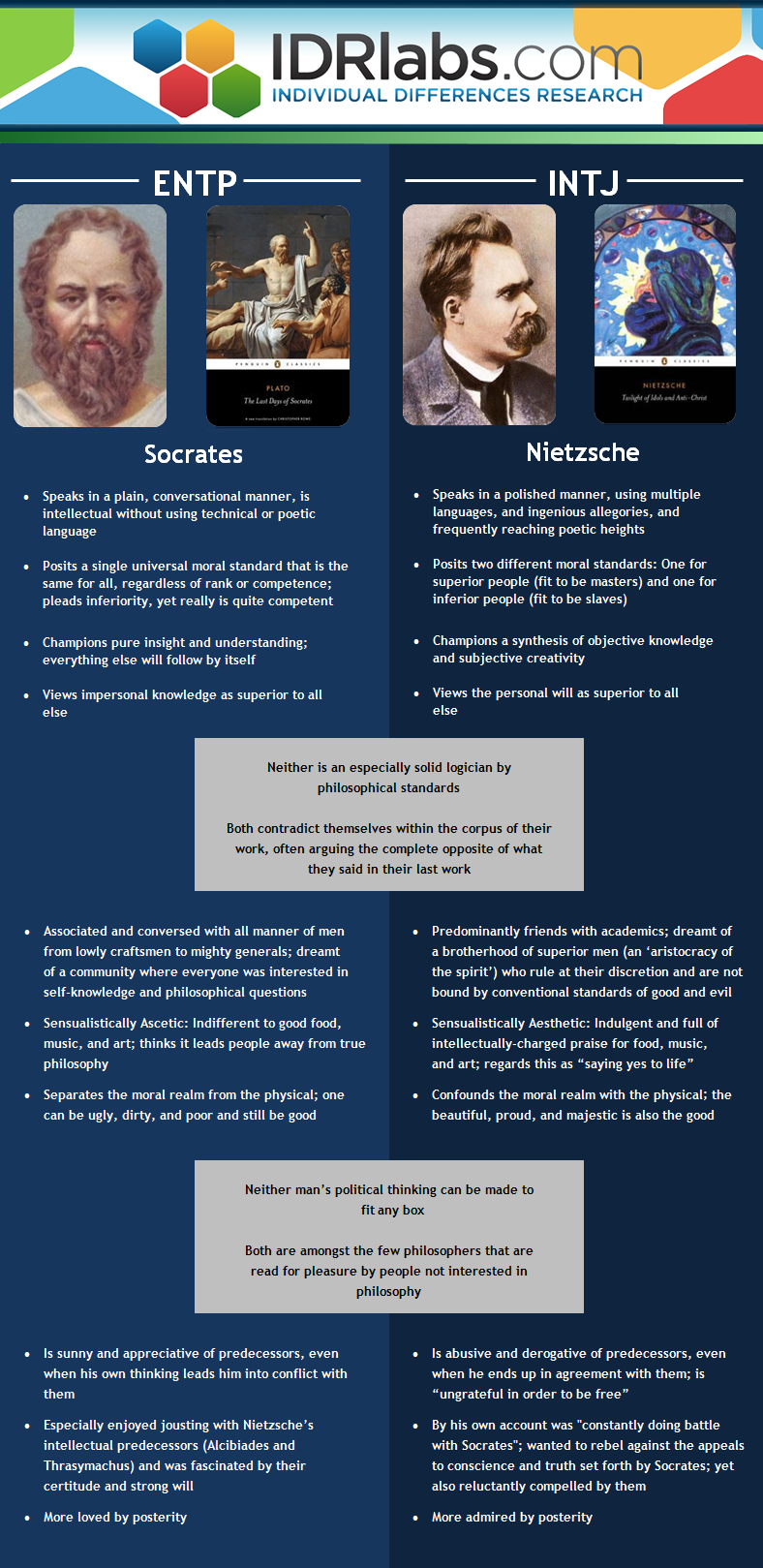
This article is the first of a two-part series on Nietzsche, Hume, and their types. Part II of this series, dealing with Hume and the psychological types of Nietzsche and Hume, may be found here.
***
Nietzsche’s Aesthetics of Night may be found in his lecture ‘Greek Music Drama.’
Image of Nietzsche in the article commissioned from artist Francesca Elettra.
For more on INTJ aesthetics, see also AndrahilAdrian’s excellent comments here.