
By Ryan Smith
What would you say if I told you that Einstein, Darwin, Bohr, Popper, Heisenberg, and Hubble (of Hubble Telescope fame) were all part of the same stageplay some roughly 2500 years ago? You would think it was impossible because these people weren’t even born back then. But then, maybe it is possible. At any rate, that is the impression that forces itself upon the mind after having studied the earliest Greek philosophers – the fascinating story of the Pre-Socratics, now to be told as a philosophical play in six acts.
Overture – the Curtain Rises
The stage is set, the curtain rises, and in comes Thales from the Greek city of Miletus. Just yesterday, Thales had bought some Babylonian scrolls at the town square and now he is giving a public performance by predicting the coming solar eclipse. Thales declares that we must do away with the old mythology – away with its hogwash and muck! Away with all claims that the earth is created by gods! Away, away, away! “No,” says Thales, and shines a light: “The earth must have come into being from natural causes, and these 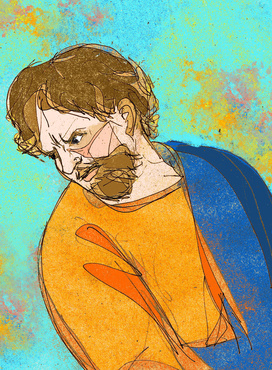 causes must be decipherable to reason!” “After all,” runs his thought, “if there are rational reasons for the solar eclipse, why should there not also be rational reasons for the existence of the earth? There are – indeed there must be!”
What are the rational causes? “Water,” says Thales, “it all has to do with water. The earth is not flat as my fellow Greeks think. If they knew what I know, they would see that our planet is semicircular, like an egg, halfway submerged in a basin of water.”
Not content with having conquered the minds of Miletus, Thales feels the allure of Africa. He samples the attractions of spices, incense, and gold. He travels to Egypt where he is awestruck by the majesty of the pyramids. Undaunted, he sets himself the task of measuring their height. These ancient pyramids, shimmering before him with their even-featured ivory surfaces of smoothly polished limestone – how does one scale that which is unscalable?
Thales remains impervious. He solves the problem by waiting – he waits until that time of day when shadows are exactly as long as the objects that cast them. Then he measures – not the pyramids, but their shadows. As Thales conquered the men of Greece, so he charmed the sons of Egypt.
Before slipping off the stage, Thales summons his Milesian progeny, Anaximander and Anaximenes. He asks them to equal his accomplishments. He dares them to explain the phenomenon of thunder and they pithily oblige: Slinking their heads together, they whisper in secrecy until they emerge with an answer: Proudly, elatedly, they declare that thunder is caused by air pressure accumulated in clouds. With the aid of his industrious gnomes, Thales laid the groundwork for the field of thermodynamics.
Herald to Heisenberg
A new and groundbreaking endeavor, such as the one Thales undertook, is difficult to be sure. It is a slow and torturous process wrought with uncertainty, perhaps even with suffering and ridicule. But in the case of Thales, the men who were to succeed him were by no means content to set more menial tasks before themselves. Next in line enters Heraclitus. This shadowy figure grits his teeth in anticipation of the laborious thoughts that his mind is to grapple with – long, hard, torturous thoughts that were by no means meant for the common man.
Thales had laid the foundation for a new species of knowledge; dispassionate, transparent, and clear. But now the robed figure of Heraclitus skulks onto the stage. Heraclitus the dark, Heraclitus the forbidding, Heraclitus the obscure: This arrogant misanthrope and philosopher of the mind’s eye whose teachings were incomprehensible even to his contemporaries. “All is fire!” he exclaims. “Everything flows!” he declares with a dash of his robed arm. “Everything is like a sea of fire, constantly roaring around us in a storm of constant change,” he proclaims. “You may well think that a river is just a river, but change is so ubiquitous that you can never step into the same river twice – not only will the river not be the same river from moment to moment, but nor will the foot!” Indeed, Heraclitus is right: Blood, germs, and skin cells – these are not constant from moment to moment, but always in flux. Think deeply and you will see that there is no foot. Nothing is static, nothing at all. Everything is process without substance and nothing is ever at rest. Reality is relative and mass is energy. “The physicists of a later age will bow to me!” Heraclitus cries out. And so they did and do. And so Bohr’s student, the physicist Werner Heisenberg, would willingly prostrate himself before Heraclitus, murmuring pleas of allegiance in incredulous acknowledgement that one can read the teachings of Heraclitus as a verbatim explication of the concepts of modern physics.
But Heraclitus is far from done: He also sets before us the transcendental logos – a concept that is to grow in importance until it rings out as indispensible to the intellectual life of Stoics and Christians. Not without recourse to Heraclitus, John 1:1 states: “In the beginning there was Logos, and Logos was with God, and Logos was God.”
Heraclitus has one final act of conjuration left in store for us. He tells us of the dialectic of the enantiodromia – the “law of running counter to” which unveils hidden harmonies in the midst of obvious strife. A law, no less, that would become the methodological motor in Hegel, Lenin, Marx, and even in Jung’s typology. All of this, before the philosopher of flame goes dark and exits the stage.
Einstein in Sandals
Heraclitus had set the theater aflame, but Parmenides now enters the stage. This proud figure, venerable and awesome, sternly takes stock of the audience before pouring the cold ice of logic on the smoldering embers left by Heraclitus. With fixity and precision, Parmenides lays down the law: Everything is the same, movement is impossible, time and change are illusions, and there is only one thing. There is no difference or variation, multiplicity is misapprehension, time does not pass, and all reality stands still, absolutely still. The universe is really an immovable four-dimensional block with time as the fourth dimension. But since you are a silly three-dimensional being, you fail to see that time does not progress. Which is why, upon hearing Einstein uttering those same truths in the twentieth century, Karl Popper took a long hard look at Einstein before exclaiming in disbelief: “You are Parmenides!”
Parmenides’ Einsteinism will be hard to surpass, and members of the audience have already started uttering their concerns – “Will it be possible to outdo him at all? Will it not be more prudent to end the play on a high note?” they murmur from their seats along the dimly-lit rows. But our next man is not one to let himself be intimidated: “Whenever something is born,” begins Empedocles, “it is born in two respects: First as its very own self and second as a representative of its kind.” Or as modern biologists would say, it is born as phenotype and genotype. “Furthermore,” continues Empedocles, “the species that we know today were not formed at one point in time: They developed, gradually, from preceding and more primitive life-forms. Life as we know it was born in the oceans and then moved inwards onto land, and the first species that lived on this planet are now extinct. I put it to you, therefore, that when some species persevere and others do not, it is no doubt because some are better at adaptation than others. Quite simply,” he asserts, “it is all about the survival of the fittest.”
Atoms and Primordial Soup
Before the curtain drops, the story calls for Anaxagoras to make an appearance along with the remarkable idea that since humans emerge from little sperm cells and trees sprout from little seeds, then it follows that not just trees and humans, but the universe itself must have originated from infinitely small building blocks. As Anaxagoras would have it, the universe was once nothing but a cup of infinitely compressed primordial soup, containing everything that we know in the world today. The soup grew white-hot, and with a cosmic bang it splattered in all directions, which is why we now have distance and empty space in the world.
“Since everything that exists in the world today was part of this soup before the bang,” continues Anaxagoras, “I put it to you that our Earth is just one planet among many. There must be other planets out there, separated from us only by emptiness – infinite, incredible emptiness.” Confident in his own performance, Anaxagoras raises his spear and slams it into the floor before taking a bow and disappearing from sight.
But not even the big cosmic bang can stand triumphant for long among the republic of geniuses that is the Pre-Socratics. Enter Democritus, laughing philosopher and father of modern science. Resolutely, he retrieves the spear from the floorboards. Fearlessly, he hurls it towards new horizons: “Nothing is as we perceive it; all is made of smaller components. The smallest of these are called atoms, too small to be visible to the naked eye,” he asserts. And Democritus has a reproach for Anaxagoras up his sleeve as well: “It may well be that the entire universe was once compacted into an infinitely dense primordial soup,” he says. “But what you call ’emptiness’ is actually also a form of matter: Everything is made of atoms, and ’emptiness’ is just lighter matter, which disperses when it comes into contact with heavier atoms. Even the human soul is material, and hence there is no excuse for separating rulers from subjects: We are all cut from the same cloth, and since we are, the natural form of government is democracy, in which we humans are one.”
Curtain Fall
Democritus’ performance is nothing less than the final act of the play. Before Democritus, philosophers were interested in stones, fish, fires, and flashfloods – geology, biology, physics, and chemistry. After Democritus, all boldness fades. As he delivers the last lines of his speech, the philosophy of his day has already begun to slosh and diminish. Decadent theologians and opulent rhetoricians soon set their sights upon a new kind of non-learning that is to crowd out the achievements of the old philosophers. Our play grinds to a halt. Darkness settles over the theater as the audience readily discerns the contours of a tragedy before their inner eye.
***
Image of Parmenides in the article commissioned from artist Francesca Elettra.