
By Eva Gregersen and Ryan Smith
Of all the function slots, the tertiary function is perhaps the most overlooked and least understood. The dominant function is fairly self-explanatory as the prime determinant of conscious orientation; von Franz has done good work on the inferior; and van der Hoop did his part to flesh out our understanding of the auxiliary. There are, however, still some observations that may be elaborated concerning the tertiary. But before we proceed with elucidating the puerile nature of the tertiary function, we must first address the matters of (1) the threshold of consciousness relative to the functions and (2) our debt to John Beebe.
1. The Threshold of Consciousness Relative to the Functions
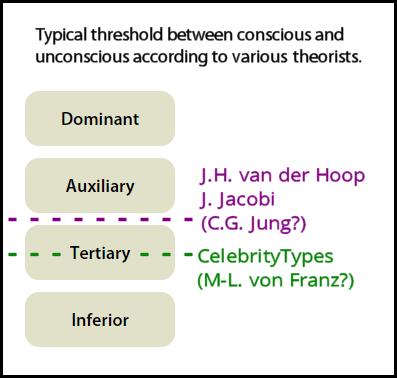 The “standard” threshold of an individual’s consciousness in relation to the functions may be said to lie between the auxiliary and the tertiary: A person’s two uppermost functions are considered conscious and a person’s two lowermost functions are considered unconscious. This is the view of Jacobi and van der Hoop, and possibly also of Jung.[1] However, in contrast, von Franz has offered some remarks which may be interpreted as saying that the threshold of consciousness is situated so as to slice right through the tertiary function, thus making the dominant and auxiliary conscious; the inferior unconscious; and the tertiary itself semiconscious.[2] This latter view is also the view we follow on CelebrityTypes (prior examples of us propounding it may be found here and here).
2. Our Debt to John Beebe
Concerning the puerile nature of the tertiary function, we must acknowledge a debt to the Jungian analyst John Beebe who (to our knowledge) was the first to have postulated the link between puerile qualities and the tertiary function.[3] In other words, credit and scholarly priority for this discovery belong to Beebe and not to us.
If our understanding is nonetheless different from Beebe’s, however, it is in no small part because Beebe’s model insists on wedding the functions of consciousness to the broader Jungian framework of archetypes and the collective unconscious. For our part, we do not follow John Beebe in any of his other innovations in typology (indeed we are critical of them).[4] We prefer to approach Jungian typology as a general psycho-dynamic theory of personality and consciousness. The reader may then decide for himself whether to accept the broader Jungian metaphysics or not. But with our approach, the acceptance or rejection of this metaphysic simply has no bearing on the mechanics of typology as such.
Let us now go on to examine the tertiary function itself.
The Puerile Nature of the Tertiary Function
A puer aeternus, or eternal child, is an archetype popularized by Jung and von Franz, though it was already well known to the Greeks.[5] The puer is also well represented in mythology, such as Baldr in Norse mythology or Adonis and Icarus among the Greeks.
Psychologically, the puer never aspires to maturity, but remains an optimistic adolescent, showing off to impress parental figures with impossible feats of ingenuity all his life – feats so impossible, in fact, that the puer invariably dies a premature death in the various mythical representations of this figure that have been handed down to us (Adonis, Icarus, Baldr). Analytically we may say that the puer’s untimely death represents his precarious existence; always balancing on the threshold of consciousness, his presence is necessarily short-lived before his participation in conscious life is annulled and the tertiary function sucked back into the womb of the unconscious.[6]
Where the dominant and auxiliary will, in the case of a normal individual, be perennially present in consciousness (indeed define the individual’s conscious orientation), the inferior function will, as a rule, be present only indirectly, as an inaccessible counter-pull upon the conscious personality.[7] But the tertiary is different from either of these: It is not a conscious process, nor an unconscious pull, but rather something like a psychic event. The British historian R.G. Collingwood has famously defined the distinction thus: “Processes are things which do not begin and end but turn into one another. Events have a clear start and end.”[8]
That is to say, the tertiary function episodically darts through to consciousness, and when it does, its incurrences will be accompanied by the optimism and youth of the puer, as well as the hitherto unconceived or rejected possibilities of the unconscious. Possessed of youthful ardor, the puer dreams with an otherworldly optimism, believing the impossible possible on account of his innocence and naivete. His thinking is primitive but holds the promise of future genius – a promise invariably cut short by the puer’s own premature death, his retraction into the unconscious being never far away and always looming on the horizon.
The dominant and auxiliary functions are the parents of conscious life: Theirs is the obligation to guide the individual responsibly through adult life. The tertiary function, on the other hand, remains free to dream. It may keep dreaming, and many of its dreams will likely fail as it keeps suggesting the impossible. But it “dies” and goes back into the unconscious to be reborn, arising again with a new and impossible impetus, each time having no recollection of the last.[9]
Thus, the tertiary function is the perennial beginner, and as the Zen master Shunryu Suzuki has said, “In the beginner’s mind there are many possibilities, but in the expert’s mind there are few.”[10]
NOTES
[1] Jacobi: The Psychology of C.G. Jung (Routledge & Kegan Paul 1968) p. 13, cf. van der Hoop: Conscious Orientation (Routledge & Kegan Paul 1939) p. 286, and Jung: Personal Letter to Anonymous, March 1939
[2] Von Franz: Psychotherapy (Shambhala 1993) p. 53
[3] Beebe, in Cambray: Analytical Psychology (Routledge 2004) p. 103
[4] For example, Beebe believes that the whole type has eight functions (we say four); Beebe believes that the threshold of consciousness relative to the functions is between the fourth and the fifth function (we believe it cuts the tertiary down the middle), and so on.
[5] Plato: Symposium §193e ff., cf. Aristophanes: Women in the Assembly §90 ff.
[6] Segal, in Jones: Jung and the Question of Science (Routledge 2014) p. 87
[7] Von Franz: Lectures on Jung’s Typology (Spring Publications 1984) p. 17
[8] Collingwood: An Autobiography (Oxford University Press 1982) p. 97
[9] Segal, in Jones: Jung and the Question of Science (Routledge 2014) p. 88
[10] Suzuki: Zen Mind, Beginner’s Mind (Shamhala 2011) p. 1