
By Ryan Smith
When talking about Buddhism, we must first ask: Which version of Buddhism? In this article, the answer is going to be ‘original Buddhism’: We are going to base our answer on the earliest Buddhist texts, that is, from the time when Buddhism was not yet a religion, but a matter of philosophy and existential consummation.
In original Buddhism (and Vedanta before that) the mind in its untrained state is a source of peril. According to the earliest Buddhist sources, without the proper and regular exercise of meditation, the mind will be of a constitution where it controls your mental processes, instead of you controlling them. Thus the Anguttara Nikaya says that there is “nothing which, when unbridled, uncontrolled, unwatched, untamed, brings such ruin as mental processes.”
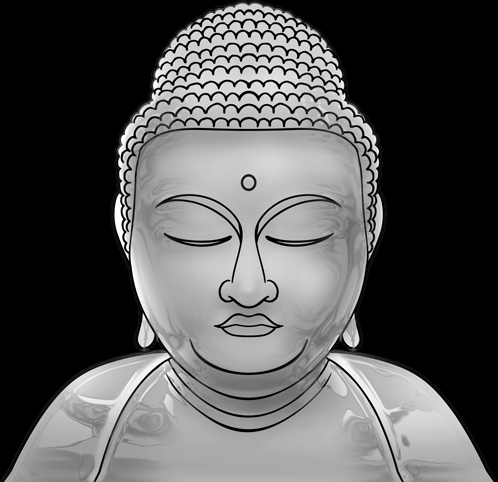 Though we usually speak of “my thoughts,” “my feelings,” “my mental processes,” or even “my cognitive functions,” most Buddhist schools hold that such impulses can only be said to be “ours” to a very small degree. This insight, of course, is also what lies at the heart of Freud’s and Jung’s theories of the unconscious, but to their credit, the Buddhists had this basic point figured out some 2300 years before Freud or Jung. According to early Buddhist phenomenology, it would be more correct to say that thoughts think themselves, automatically, or that thought takes place against the backdrop of cognition, without one’s personal volition playing much of a role in that process. Again, in the Anguttara Nikaya, it says that “thoughts run by themselves and charge here and there like an untamed bull.” Or, in another Buddhist simile, mental processes are compared to a monkey who progresses through the forest by seizing one branch after another, grabbing and letting go, grabbing and letting go, in a never-ending torrent of stimulation that controls the subject more than the subject is able to control it.
Buddhism teaches the importance of taming the mind in order to arrest this torrent of automated and involuntary processes that dominates the mind without consent. The goal of this exercise is to reach a state of mental discipline in which one is capable of arresting the current with a single act of volition, as a mahout holds back his elephant in harness with but a simple tug at his goad.
The mind, however, does not want to be tamed – at least not at first. It needs training and conditioning to build up the capability for longer attention spans, akin to those cultivated by Buddhists. While this difficulty in cultivating longer attention spans is often ascribed to the workings of modern society, the tendency has – individual differences notwithstanding – probably always been close to humanity’s natural state. Thus the earliest Buddhist sources compare the mind’s first encounters with meditation to a fish that “flutters and flaps when taken from the waters and thrown onto dry land.” Indeed, it is a common discovery among those practicing meditation that conditioning the mind to meditation is not entirely unlike conditioning the cardiovascular system to run long distances without giving in to exhaustion, or training the muscles to lift heavier weights.
However, while this predilection in favor of short attention spans has probably always been there, there is reason to believe that the cultivation of long attention spans is faced by a number of special challenges today, since email, Twitter, Facebook, and popular psychology websites all seem to encourage a type of behavior that leaves you excessively checking for updates. I’m not the only one saying that – neuroscientists such as Susan Greenfield, Gary Small and others have written books and papers on it.
Our present-day materialist metaphysics do not help either, suggesting that everything must be reduced to what is sensible and that that which is not sensible must be discredited or dismissed. The world of matter and things reigns supreme as in few previous epochs of history and the production of a particular type of personality – the action-oriented empiricist – has been heightened accordingly. To be sure, we need that kind of personality, but they also need more noetic people in their lives to balance out their psychological one-sidedness. It is no secret that from a Buddhist perspective, these “action empiricists” can sometimes resemble those shellfish that are hard-shelled on the outside, but wobbly and squishy within.
A variant of this point is also seen in Jungian typology, where the types who are the most in touch with the external environment are also the types who are the most susceptible to internal manias, paranoias, and depression. Their unconscious mental processes “walk by themselves,” as the Buddhists say, and increase in strength until they have attained mastery over the conscious psyche.
***
According to Buddhism, a very large part of our normal psychic life is actually parasitical and counterproductive. When Western psychologists teach the importance of “taming your internal monologue,” “taming your inner chatter,” or “taming your gremlin,” they are essentially teaching brushed-up Buddhism, though not all of them are wont to admit it. It is the same with the teaching of “mindfulness,” meditative exercises, or the metacognitive awareness of one’s mental processes in conjunction with Western psychotherapy. These disciplines are often hailed as grand scientific innovations, but for the most part, their basic premises are simply copied over from various schools of Buddhism. To give but one example, the professor of medicine Jon Kabat-Zinn, who is often hailed as the instigator of mindfulness-based stress reduction – a Zen Buddhist by his own account – has learned most of what he knows from Zen teachers. In one interview, Kabat-Zinn has plainly said that it was only because he was able to use his credentials as a professor of medicine that he was able to get his peers to accept the studies he had done on meditation. In other words, had other Buddhists submitted the same data, their studies would probably not have been accepted.
A point where Western psychology has not (yet) moved closer to Buddhism, though, is that Buddhism goes deeper than psychology in its attempt to make the individual the master of his own mind. Unlike Western psychology, Buddhism holds that with sufficient dedication and practice, it is possible to penetrate into the unconscious and subdue it. Once this mastery is achieved, mental processes will not arise unless allowed to arise, and the flapping and fluttering of the mind will mute. From a Buddhist perspective, Western psychology has started dipping its toes in the shallow end of the waters, but the cavernous depths of the wide open sea still lie before it, uncharted and as yet untouched by it.
The earliest Buddhist manuals describe how, as more and more of the conscious and unconscious mind is brought under the cognitive agent’s control, one eventually reaches a state in which one catches sight of the void, that is, the cognitive canvas upon which the colors of mental life splash and swirl. Most people catch sight of this canvas maybe once or twice in their lives, and when they do, the occurrence is only a brief one, and most tend to be inapprehensive about what they have seen. But with Buddhist practice, it is possible to reorient one’s mental life so that the void becomes one’s stable companion. When this state is attained, the Buddhist sources purport that the cognitive agent becomes like a farmer who crushes the eggs of parasites and pests before they hatch to threaten his crops. That is – all the negative thoughts, involuntary allures, and purposeless internal chatter can be taken stock of and quashed even before these activities arise in the mind.
It goes without saying that to reach this state requires a sense of discipline that lies beyond the scope of what most Westerners are capable of mustering or willing to commit to. In fact, it lies beyond the scope of what most Easterners are capable of mustering or willing to commit to. Indeed it is no coincidence that the earliest Buddhists mostly addressed themselves to monastics and that it was only with a certain loosening of its standards around the beginning of the Common Era that Buddhism became accessible to all. We see this same tendency play out today where many of the familiar excuses we hear from Westerners about why they cannot meditate are also to be found among the common populace in countries that are nominally Buddhist.
In other words, while the later schools of Buddhism are prone to stress universal compassion and forgiveness, and to “assert that everyone is already a Buddha” or primordially endowed with “Buddha-Nature,” there is evidence to suggest that original Buddhism was an elitist and discriminatory path that held no hopes (or even desired) that “ordinary people” should ever be able to master its teachings.
As such, the earliest Buddhist discourses report how “ordinary people” were frightened when they heard the Buddha’s teaching. And among the people who did embark upon the Buddhist path, we find accounts of how, when finally coming face to face with the void after many years of training, certain people would “break” and go insane, since they did not have the spiritual strength to carry the brunt of such a vision.
When viewed from the perspective of the void, the world becomes a mirror image of the transcendental Being that is stressed by Vedanta. Beings, states, and things become signless, that is to say, they lose their individuality when viewed against the ontological backdrop of the void. When one still perceived reality through one’s normal empirical consciousness, all things existed of their own accord, and existed in a relative and dialectical relationship to the personal standpoint. When the world is revealed in its true Doric bareness, its undisguised nature, free of burning appetites and continual self-binding, value and distinction are lost along with all feeling of personality and homeliness, and traditional reference points are shattered, leaving nothing to grasp hold of. It takes an inner strength to bear such a vision. Even in comparison with related doctrines, such as the Vedantic doctrine of transcendental Being which is also held to be the self, it will be seen that the Paleo-Buddhist vision is a merciless and dismal one. As opposed to the spiritual elevator music peddled by many modern Buddhists, the virile, aristocratic, and heroic nature of Paleo-Buddhism can be seen precisely in the admonition that the true Buddhist should possess the strength to bear this vision devoid of all consolation, and to elevate it to the highest truth about the cosmos.
ACKNOWLEDGEMENTS
I am indebted to Heinrich Zimmer for his discussion of Indian thought and Julius Evola for his discussion of early Buddhism. The expression “spiritual elevator music” was invented by Brad Warner.
***
Image in the article made by artist Georgios Magkakis.