
Word Use Quiz
Are you using these common English words correctly?
Language is a living, breathing thing, but that doesn't mean we aren't getting it wrong on a daily basis. From words that have completely flipped their original meanings to terms we confidently drop into conversation without realizing their true definitions, English is full of traps. This quiz challenges your understanding of everyday vocabulary by testing you on false friends, surprising etymologies, and commonly misused phrases. Whether you are a grammar enthusiast or just someone who loves a good linguistic plot twist, you might be surprised by how many words you have been misusing your entire life.
Answer the questions below to see how well you really know the English language.
Question 1 of 20
The word 'egregious' used to mean 'remarkably good.' What does it mean today?
BACK NEXT
The psiandme “Common Knowledge” English: Words We Use Wrong quiz was created by psiandme.
The English language is notoriously complex, shaped by centuries of invasions, migrations, and cultural shifts. Because it borrows heavily from Latin, Greek, French, and Germanic languages, it is filled with linguistic quirks that can trip up even the most educated native speakers. Over time, the meanings of words naturally drift, a process known as semantic change. What meant one thing in Shakespeare's era might mean the exact opposite today. This constant evolution is what makes English so rich and adaptable, but it also creates a minefield of commonly misused words that persist in everyday conversation.
Many of the words we use incorrectly sound like they should mean something else entirely. Take the word "enervate," for example. Because it sounds so similar to "energize," people frequently use it to describe feeling invigorated or pumped up. In reality, to enervate means to drain of energy or vitality. Similarly, the word "peruse" is often used to describe casually skimming a document or browsing a magazine. However, its traditional definition is to read something thoroughly and with great care. These subtle misunderstandings spread quickly, eventually becoming so common that dictionaries are forced to update their entries to reflect popular usage.
Etymology, the study of the origin of words, reveals fascinating histories behind terms we take for granted. The word "decimate" is a perfect example of a term with a highly specific historical origin that has been broadened over time. In ancient Rome, decimation was a brutal military punishment where one in every ten soldiers in a mutinous cohort was executed. Today, we use it to describe absolute destruction or wiping out a vast majority of something. Another fascinating evolution is the word "terrific." Originally derived from the Latin word "terrificus," it meant something that caused terror or fear. It wasn't until the late nineteenth and early twentieth centuries that it morphed into an enthusiastic expression of something being excellent or wonderful.
One of the most common battlegrounds for grammar pedants is the distinction between "disinterested" and "uninterested." While they are frequently used interchangeably in casual speech to mean someone who is bored or doesn't care, they have distinct and important meanings in formal contexts. To be uninterested simply means you lack interest in a subject. To be disinterested, however, means you are impartial, unbiased, and have no personal stake in the outcome. A judge in a legal dispute, for instance, should absolutely be disinterested, but you certainly wouldn't want them to be uninterested. Losing this distinction robs the language of a highly specific and useful concept.
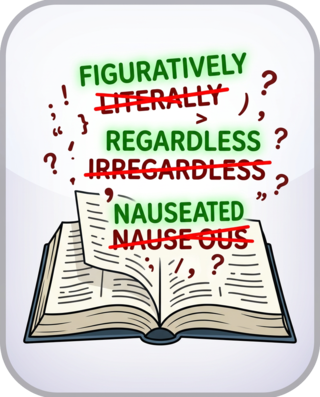
No discussion of misused words is complete without mentioning the word "literally." For decades, language purists have bemoaned the use of "literally" as an intensifier for figurative statements, such as saying, "I am literally dying of laughter." The traditional definition demands that the word be used only for things that are actually, factually true. However, the figurative use has become so pervasive that major dictionaries have added secondary definitions acknowledging its use for emphasis. This sparks an ongoing debate between prescriptivists, who believe language should follow strict rules, and descriptivists, who believe dictionaries should merely record how people actually speak.
Why does it matter if we use these words wrong if people still understand what we mean? While language is undeniably fluid, precision in communication remains incredibly valuable. Using words according to their traditional definitions allows for clearer, more nuanced expression, especially in professional, legal, or academic writing. Furthermore, understanding the roots and original meanings of our vocabulary connects us to history and the generations of speakers who came before us. Taking the time to learn about false friends, semantic shifts, and etymological surprises doesn't just make you a better writer; it deepens your appreciation for the messy, beautiful, and endlessly fascinating tool we use to share our thoughts with the world.
For more information about our online tests and quizzes, consult our Terms of Service.
Why Use This Quiz?
1. Sharpen Your Communication Skills. Taking this quiz is an excellent way to identify blind spots in your everyday vocabulary. You will learn the true definitions of words that are frequently misused in professional and casual settings alike. By mastering these tricky terms, you can communicate with greater precision, clarity, and confidence.
2. Discover Fascinating Word Histories. English is full of hidden stories, and this quiz unlocks the surprising etymologies behind common phrases. You will explore how ancient Roman military tactics and Latin roots shaped the words we use today. It is a fun, engaging way to connect with the history of language while testing your trivia knowledge.