
Food Quiz
Can you separate culinary fact from delicious fiction?
We all have our favorite international dishes, but what if the stories behind them are completely wrong? From supposedly Italian classics that were actually born in Mexico to iconic French pastries with Austrian roots, the history of global cuisine is full of delicious deception. This quiz will challenge everything you thought you knew about where your favorite meals really come from. Get ready to uncover the surprising geographical origins and fascinating cultural exchanges that shaped the modern menu.
Test your culinary knowledge by answering the trivia questions below to see how many food myths you can bust.
Question 1 of 20
Which of these popular 'Chinese' dishes was actually invented in New York City in the late 1800s?
BACK NEXT
The psiandme Food Origins & Fake Food Stories quiz was created by psiandme.
When we sit down to enjoy a meal at our favorite ethnic restaurant, we rarely question the authenticity of the dishes on the menu. However, the concept of culinary authenticity is often a modern invention, shaped more by marketing and migration than by ancient tradition. Many of the foods we strongly associate with specific nations were actually created by immigrants adapting to new environments, or by clever chefs looking to appeal to foreign palates. Understanding the true origins of these dishes reveals a complex history of global trade, colonization, and cultural blending that is far more interesting than the simplified stories we are usually told.
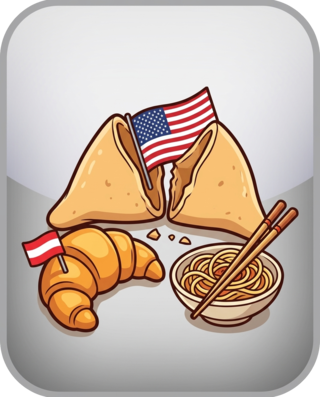
Take, for example, the quintessential symbol of French baking: the croissant. While it is impossible to imagine a Parisian cafe without these buttery, flaky pastries, their true birthplace is actually Austria. The ancestor of the croissant is the kipferl, a crescent-shaped baked good that has been documented in Central Europe since at least the thirteenth century. It was not until the nineteenth century, when an Austrian artillery officer named August Zang opened a Viennese bakery in Paris, that the French were introduced to the treat. French bakers eventually adapted the recipe using puff pastry, creating the modern croissant, but the original credit belongs firmly to Vienna.
North America is a massive melting pot, which has led to the creation of numerous dishes that masquerade as foreign imports. The Caesar Salad, a staple of Italian-American dining, was actually invented in Tijuana, Mexico, in 1924 by an Italian immigrant named Caesar Cardini. Facing a rush of American tourists escaping Prohibition, Cardini threw together what he had left in his kitchen, creating a legendary salad. Similarly, the fortune cookie, universally served at the end of meals in Chinese restaurants across the United States, is completely unknown in mainland China. These crisp, folded cookies trace their roots back to Japanese immigrants in California during the early twentieth century, who adapted a traditional Kyoto cracker to American tastes.
The story of Chicken Tikka Masala perfectly illustrates how food evolves through cultural intersection. Widely considered a national dish of the United Kingdom, this creamy, tomato-based curry is a prime example of British-Asian fusion. While the exact origins are hotly debated, the most popular origin story claims it was improvised in the 1970s by a Bangladeshi chef in Glasgow, Scotland. A customer allegedly complained that his chicken tikka was too dry, prompting the chef to whip up a sauce using a can of tomato soup, yogurt, and spices. Today, it stands as a delicious testament to the profound influence of South Asian immigrants on British culinary culture.
Pizza is undeniably Italian in origin, tracing its roots back to the bustling streets of Naples. However, the toppings we put on it have sparked international controversies and created entirely new regional styles. The most polarizing of these is the Hawaiian pizza, famous for its combination of savory ham and sweet pineapple. Despite its tropical name, this controversial pie was actually invented in Ontario, Canada, in 1962 by a Greek immigrant named Sam Panopoulos. Inspired by the sweet and savory flavor profiles of Chinese cuisine, Panopoulos decided to experiment with canned pineapple on a traditional cheese pizza, inadvertently launching a global culinary debate that continues to rage today.
Studying the origins of our food does more than just provide fun trivia for dinner parties; it offers a unique lens through which we can view human history. Every bite we take is the result of centuries of agricultural development, international trade routes, and human migration. When we learn that tomatoes did not exist in Italy until the Columbian Exchange, or that chili peppers are not native to Thailand or India, we begin to appreciate the interconnectedness of our world. Food history breaks down borders and shows us that our favorite traditions are often the beautiful result of diverse cultures colliding and collaborating.
For more information about our online tests and quizzes, consult our Terms of Service.
Why Use This Quiz?
1. Discover the Hidden History of Your Diet. This quiz takes you on a fascinating journey across the globe, revealing the true birthplaces of some of the world's most famous dishes. You will learn how migration, trade, and even pure accidents shaped the menus we know and love today. It is a perfect way to expand your cultural knowledge while satisfying your intellectual appetite.
2. Bust Common Culinary Myths. We all carry assumptions about where certain foods come from based on their names or where they are served. By taking this quiz, you will challenge those preconceptions and learn how to separate historical fact from clever marketing fiction. You will walk away with a fresh perspective on global cuisine and plenty of surprising facts to share at your next dinner party.