
FreeCell Solitaire
Welcome to FreeCell Solitaire
Welcome to FreeCell Solitaire, the classic card game where nearly every deal can be solved through skill and strategy. Unlike many solitaire variants, FreeCell places all cards face up from the start, allowing you to plan ahead, manage available space, and work methodically toward victory. With minimal reliance on luck and a strong emphasis on logical thinking, FreeCell remains one of the most rewarding solitaire games ever created.
FreeCell Solitaire is a popular solitaire variant played with a standard 52-card deck. The objective is to move all cards to the four foundation piles, building each suit in ascending order from Ace to King.
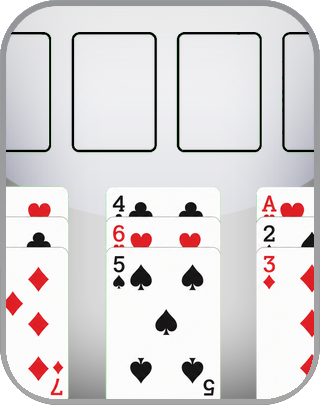
At the start of the game, all cards are dealt face up into eight tableau columns. Because every card is visible from the beginning, players have complete information about the layout and can plan their moves strategically.
Above the tableau are four foundation piles and four free cells. The foundation piles are where cards must ultimately be moved to win the game. The free cells serve as temporary storage spaces that allow players to move cards around the tableau more effectively.
Cards in the tableau are built in descending order and alternating colors. For example, a black 8 can be placed on a red 9. By carefully rearranging cards and utilizing the free cells, players gradually uncover pathways to move cards onto the foundations.
Unlike many solitaire games, most FreeCell deals are solvable. Success depends primarily on strategy, planning, and efficient use of available space.
How FreeCell Changes Gameplay
FreeCell differs from other solitaire variants because all cards are visible from the beginning. This removes much of the uncertainty found in games that rely on hidden cards and shifts the focus toward problem-solving and optimization.
This creates several important strategic effects:
- Complete information: Every card is visible, allowing players to plan multiple moves ahead.
- Greater emphasis on skill: Success depends more on decision-making than luck.
- Space management matters: Free cells and empty columns become powerful strategic resources.
- Long-term planning is rewarded: Efficient sequences often require careful preparation several moves in advance.
Strategy Tips for FreeCell Solitaire
Success in FreeCell often depends on maintaining flexibility and preserving available space:
- Keep free cells open whenever possible.
- Prioritize creating empty tableau columns.
- Move low-ranking cards to the foundations early when it is safe to do so.
- Avoid filling all free cells unless absolutely necessary.
- Think several moves ahead before committing to large card movements.
Difficulty and Appeal
FreeCell Solitaire is widely considered one of the most skill-based solitaire games. Because nearly every deal can be won with correct play, players are rewarded for careful analysis, planning, and efficient execution.
Many players enjoy FreeCell because it offers a strong sense of control. Instead of relying heavily on favorable card draws, success comes from finding the right sequence of moves and making the most of available resources.
In short, FreeCell Solitaire is about solving a visible puzzle through logic and strategy. Its combination of transparency, depth, and high solvability has made it one of the most enduring and respected solitaire games in the world.
FreeCell Solitaire gained widespread popularity through early computer implementations and remains a favorite among players who enjoy thoughtful, skill-based card games. Unlike many solitaire variants that involve hidden cards and uncertain outcomes, FreeCell challenges players to solve a fully visible puzzle.
The game uses a standard 52-card deck distributed across eight tableau columns. Four free cells provide temporary storage, while four foundation piles serve as the destination for all cards. The game is won when every card has been moved to the foundations in suit order from Ace through King.
A key aspect of FreeCell strategy is managing available space. Empty free cells and empty tableau columns dramatically increase mobility, allowing larger groups of cards to be repositioned. Learning how to create and preserve these spaces is often the difference between success and failure.
While the rules are straightforward, FreeCell offers significant strategic depth. Every move affects future possibilities, rewarding patience, foresight, and efficient planning. This balance of accessibility and challenge has helped FreeCell remain one of the most popular solitaire games ever created.
Why Play FreeCell Solitaire?
Free. FreeCell Solitaire is available online at no cost, making it easy to enjoy a classic card game anytime.
Skill-focused gameplay. Most deals can be solved through careful planning and correct decision-making.
Complete visibility. All cards are visible from the start, creating a true strategy experience.
Highly rewarding. Every victory feels earned through logic, problem-solving, and efficient play.