

Based on the research of Jerry S. Wiggins of the University of British Columbia.
Friend Color Test
What role do you play in your group?
Friend groups often develop recognizable social roles: one person takes charge, another keeps everyone laughing, another notices when someone is struggling, and another quietly sees dynamics that everyone else misses.
The Friend Color Test is an informal, partly-for-fun adaptation of ideas from interpersonal psychology. It draws particularly on the interpersonal circumplex tradition associated with personality psychologist Jerry S. Wiggins of the University of British Columbia, whose work organized interpersonal tendencies around broad dimensions such as dominance and warmth.
Take the test, then send your group link to your friends: everyone's colors show up side by side on one page.
What color are you in your friend group? To take the test, enter your input below.
Question 1 of 40
Belonging to the group is more important to me than doing things my own way.
| Disagree | Agree |
BACK NEXT
Friend groups rarely function as collections of interchangeable people. Over time, different members tend to become known for different contributions. One person organizes the plans, one brings energy, one keeps everyone laughing, one offers emotional support, and another may be quieter but unusually good at noticing what is happening beneath the surface. These patterns are not fixed jobs, and the same person can behave differently across groups, but recurring interpersonal tendencies often shape how people experience one another.
The Friend Color Test was developed to describe these differences in a simple, highly visual format. Its conceptual foundation is informed by the interpersonal circumplex, a long-standing framework in personality and social psychology that maps interpersonal behavior around broad dimensions such as agency and communion. Circumplex research shows that social styles can be organized into related but distinct positions rather than treated as a single scale from “good” to “bad” at relationships.
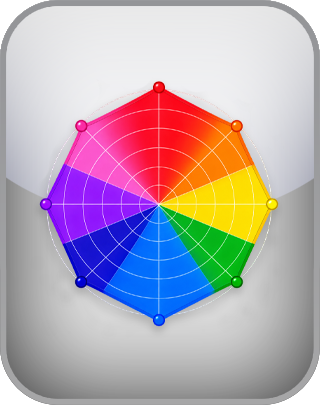
This test presents eight friendship tendencies as colors: Red (Leader), Orange (Energizer), Yellow (Entertainer), Green (Caregiver), Blue (Stabilizer), Indigo (Observer), Violet (Individualist), and Pink (Connector). These color labels are original descriptive categories used to make the profile intuitive and shareable; they are not themselves established psychological types. Each score reflects a recognizable way of contributing to, responding to, or positioning oneself within a social group.
No color is inherently better than another. A group may benefit from a decisive Red when nobody can choose what to do, a Blue when tensions are rising, a Green when someone needs support, or an Orange when everyone has been discussing plans for an hour without leaving the sofa. The same tendency can also become less useful when overused. Leadership can become controlling, caregiving can become overinvolvement, independence can become detachment, and entertainment can crowd out quieter members.
For this reason, results are shown as a profile rather than as a claim that every person belongs to one rigid category. Your highest color represents the role or style that appears most characteristic of you, but secondary colors may describe important parts of how you behave with friends. Two people with the same dominant color can still differ substantially in the rest of their profile.
The Friend Color Test is intended for self-reflection and social comparison rather than clinical assessment. Friendship behavior is influenced by culture, personality, group composition, context, and the particular people involved. The results should therefore be understood as a structured description of interpersonal tendencies, not a diagnosis or permanent identity. The most interesting use of the test may be comparing how you see yourself with the role your friends believe you actually play.
References
- Wiggins, J. S. (1979). A psychological taxonomy of trait-descriptive terms: The interpersonal domain. Journal of Personality and Social Psychology, 37(3), 395–412. https://doi.org/10.1037/0022-3514.37.3.395
- Horowitz, L. M., Rosenberg, S. E., Baer, B. A., Ureño, G., & Villaseñor, V. S. (1988). Inventory of interpersonal problems: Psychometric properties and clinical applications. Journal of Consulting and Clinical Psychology, 56(6), 885–892. https://doi.org/10.1037/0022-006X.56.6.885
- Wiggins, J. S., Trapnell, P., & Phillips, N. (1988). Psychometric and geometric characteristics of the Revised Interpersonal Adjective Scales (IAS-R). Multivariate Behavioral Research, 23(4), 517–530. https://doi.org/10.1207/s15327906mbr2304_8
- Gurtman, M. B. (1992). Construct validity of interpersonal personality measures: The interpersonal circumplex as a nomological net. Journal of Personality and Social Psychology, 63(1), 105–118. https://doi.org/10.1037/0022-3514.63.1.105
Frequently Asked Questions
What does the Friend Color Test measure?
It maps recurring interpersonal tendencies in friend groups onto eight color-coded friendship styles drawn from interpersonal circumplex research.
How are the eight color-coded styles presented?
Your profile shows scores across all eight styles so you can see the mix of roles you tend to play and compare them with friends' patterns.
Is the test based on established psychological research?
Yes, it draws on the interpersonal circumplex tradition associated with personality psychologist Jerry S. Wiggins at the University of British Columbia.
Do the results assign permanent roles or diagnoses?
No, the styles are recurring tendencies rather than fixed jobs, and the same person can behave differently across groups.
Why can you share a group link to view everyone's colors together?
The test is designed so friends can see their eight-style profiles side by side on one page, highlighting how different roles complement one another.
Why Use This Test?
1. Free. This Friend Color Test is free to take and offers immediate, detailed scoring without requiring registration.
2. Research-informed. The test is informed by interpersonal circumplex research, a well-established tradition in personality and social psychology for organizing recurring patterns of social behavior.
3. Readable results. Your profile shows scores across eight color-coded friendship styles, making it easy to see the roles you naturally play in a group and compare your pattern with those of your friends.