

By Eva Gregersen, Ryan Smith, and Sigurd Arild
Disclaimer: Any type can have Narcissistic traits, and not all INTJs are Narcissistic. A Narcissistic personality style has both good and bad sides to it, but this article predominantly deals with the interpersonal problems that are caused by a Narcissistic style. If you do not like reading about the 'negative' side of psychology, you should skip this article.
On CelebrityTypes we have frequently been careful to separate personality types from personality styles. As such, it is perhaps ironic that this article will deal with the interrelation between a specific type (INTJ) and a specific style (Narcissism). To be clear, a Narcissistic style can be a functional element of any of the 16 personality types; theoretically speaking, it is not directly dependent on the type in any way, and on the main site we have identified Narcissists of almost every Jungian type.
Still, it would seem that the Narcissistic personality style is especially prevalent amongst people of the INTJ type. Our critics have sometimes remarked that this coupling of INTJs with the Narcissistic personality style seems to be an invention of our own, and in broad strokes our critics are correct. We have done more than previous authors to link INTJs with the Narcissistic personality style on account of our research in psychology. Yet it must also be noted that we are not entirely without precedent in doing so. The always insightful van der Hoop also noted a link between Narcissism and INJs in one of his works on types (namely Conscious Orientation, Routledge 1999 ed. pp. 186-187).
The Narcissistic Personality Style
The foremost feature of the Narcissistic personality style is a grandiose sense of self-worth. As such, INTJs who are affected by this personality pattern will frequently be led to utter statements along the lines of themselves being "higher natures," being worth more than "the herd," and being singled out for "a greater destiny" than others. Given the impressive cerebral ability that is the natural endowment of many an INTJ, it is not entirely unreasonable that INTJs would begin to think along such lines.
It must also be said that in spite of the name, a Narcissistic personality style is not entirely a bad phenomenon in that it is a personality style that also brings with it the qualities of certitude, buoyancy, and self-assurance. These qualities are very frequently helpful with regards to committing to a long-term plan and also for the purposes of convincing others to go along with that plan. And the undaunted self-confidence that is the mark of a well-adjusted person with a Narcissistic personality style also tends to lend an increased aura of leadership and competence to an individual's communication style.
Yet although it has its good sides, a Narcissistic style also tends to create problems for the person who is affected by it. In INTJs, these problems will typically manifest themselves along two specific lines:
- In the interpersonal domain, where others can be put off by what they perceive as an inconsiderate haughtiness in the INTJ.
- With regards to their self-image, INTJs can sometimes internalize the belief that they are special and that they don't have to make an effort in order to be successful the way others do. Over time, this identification with being special can lead to a sense of their own entitlement where one grows to believe that the world owes one special treatment, special terms, and an unending stream of free-flowing recognition. For example, many INTJs pass through school and high school with flying colors, observing how the other children have to work, while they can simply lean back and still collect straight A's. In this way the school system's failure to provide adequate challenges for gifted students unwittingly helps create an undesirable psychological template for adult life, namely the template of entitlement.
Do you have a Narcissistic personality style? If you find the following beliefs to be provocative or hogwash, then there is a good chance that you have at least some elements of the Narcissistic personality style:
- There are rewards in being a team player.
- I can enjoy being like others, rather than having to excel.
- Other people's opinions are just as reasonable as my own.
- Doing menial and routine work carries with it its own satisfaction.
- I have to inconvenience and strain myself to get results, just as everyone else does.
- I have to follow the same social rules as everyone else does.
If you are not provoked by these beliefs - if you find them self-evident or uncontroversial - then you probably do not have any elements of the Narcissistic personality style and hence this problem area that otherwise tends to affect a lot of INTJs is probably not relevant for you.
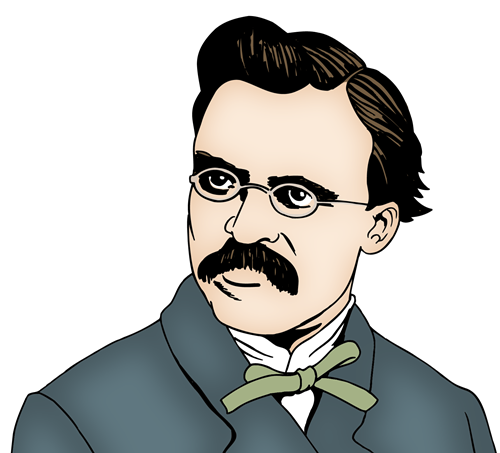
But nonetheless, many prominent INTJs areprovoked by such beliefs. To give but one example, the philosopher Friedrich Nietzsche once characterized such beliefs as a "slave morality" - beguiling talk to fool "the weak" into accepting the trifling conditions of their insignificant lives.
As already mentioned, the Narcissistic personality style has both good and bad elements to it. Narcissists frequently appear to be sure of themselves, and because certitude is intimately connected with self-regard and respect from others, having too little certitude can be just as bad as (if not worse than) having too much.
There are variations upon the Narcissistic pattern which express themselves differently according to type. In the case of Narcissistic INTJs, most of the challenges that arise from their style can be traced back to a sense of their own entitlement. For INTJs who are affected by the downsides of a Narcissistic style, the following patterns will usually appear:
- Routine work appears to be "below" one's dignity.
- Other people accuse one of being "selfish" and unconcerned with their needs.
- Others are offended by the INTJ's feeling unbound by the same social rules that other people feel they have to abide by.
Of course, one may ask whether the fault in these cases can really be said to lie with the Narcissist. After all, if a person can meaningfully arrange his existence so that he does not have to do menial work, and he furthermore abhors having to do it, then why shouldhe do such work? Likewise, if other people don't like the way that the Narcissist deals with social situations, then no one is forcing them to stick around. So even though other people may feel indignant at the Narcissist's behavior, it is important to understand that in matters such as these there is no objective truth as to who is wrong and who is right: There are only different people with differing viewpoints and conflicting expectations.
Even so, Narcissistic INTJs may at times find themselves in situations where they wish to modify their personality style. For example, it may be necessary to appease a superior in the workplace for a time, or a loved one that is otherwise cherished may threaten to leave the relationship because she feels put off by the natural tendencies of the Narcissistic pattern. To those ends, clinical psychologists have proposed that the following steps are generally effective with regards to minimizing the bad effects of the Narcissistic style and optimizing the good ones.
1. Reverse Contempt of Striving for Small Goals
While most of the MBTI-style descriptions of the INTJ type describe them as hardworking, the more classically Jungian portraits tend to mention how INJs may find it hard to discipline themselves to do menial and routine work. As with all dominant intuitive types, such detail-oriented work will often fail to kindle their enthusiasm. Only very rarely does fact-laden work with little room to maneuver and re-think the essentials carry the same stimulus to the intuitive type as synthesizing large bodies of information in their heads and mapping out grand prospects for the future does.
After the fundamental commitments to strategy and choice of theory have been made, it is often too easy for Ni types to regard the rest of the process as merely "grunt work," to be delegated to some "mere worker" whose job is not to question or understand, but rather to bring the plan to fruition, in accordance with the wishes of the one who conceived it. Viewed from the vantage point of the intuitive psyche, the organizational work required to transform ideas into practice is all too often underestimated as a mere immaterial toil. For these reasons it is especially easy for INTJs with a Narcissistic personality style to neglect crediting those who actually do the "grunt work" required to bring their ideas into practice. But nevertheless, "the toilers" are often held responsible when things go wrong.
All four of the Intuitive types (i.e. INJs and ENPs) tend to exhibit a characteristic boldness and buoyancy with regards to bringing new ideas into practice. They have confidence in the novelties that they have gleaned, and they tend to grossly underestimate the practical side of a problem.
What further complicates the matter in the case of Narcissistic INTJs is that their characteristic visionary certitude all too easily fuses with their Narcissistic grandiosity. The result is an unwavering belief in their own talent and intelligence as well as a daunting ambition and a natural air of authority. Their decisiveness rarely fails to convince, and they effortlessly assume the role of leader, as if they fully expect others to defer to them. Beyond mere self-confidence, they also exhibit a tenaciousness that sways others to their cause.
At times, however, this otherwise enviable audaciousness may lend itself to a sense of entitlement: A partly unconscious feeling in the mind of the Narcissistic INTJ that he or she is a very special being and therefore entitled to special treatment, breaks, and opportunities in life. As with Narcissists of other types, Narcissistic INTJs can sometimes be identified by the way in which they speak about their plans and ideas: They speak as if they are letting the other party in on a special and exciting endeavor that the other party should be grateful to be allowed to share in. The Narcissist speaks as if they fully expect others to simply abandon whatever they are doing on account of the Narcissist's superior wisdom and automatically start dedicating themselves to "putting their muscle" behind the INTJ's plan.
As mentioned, all of the four Intuitive types are prone to underestimate the amount of sheer work and effort that is required to bring a complicated idea into practice. But in the case of INTJs, who seldom place a premium on conventions of emotional warmth and approval, the risk of seeming downright ungrateful is palpably present.
As such, Narcissistic INTJs can frequently derive great utility value from learning to acknowledge the toil that is connected with the parts of a process that the INTJ is bound to regard as menial. Though fact-laden routine work may not count for much in the mind of the Narcissistic INTJ, the effort required to do the work still represents a sacrifice of manpower and determination on the part of the one who does it.
As the psychologists Jeffrey Young and Janet Klosko have said, aim toward reciprocity, fairness, and equity as principles to guide your interactions with others. Learn to tolerate your own frustration when working on things you perceive to be small and menial.
2. Practice Accurate Decipherment of Other People's Emotions
Another typical problem area for Narcissistic INTJs pertains to empathizing accurately. While INTJs can be surprisingly warm and loyal when it comes to their closest intimates, they are frequently bad at deciphering the emotions and internal states of people who are not of emotional importance to them. Frequently, they are just not that interested.
INTJs with a strongly pronounced Narcissistic style may be perceived as aloof and thus breed resentment whenever they try to implement a plan that implicates others. Therefore it will often be a sound investment for such INTJs to devote at least some resources to stepping out of their own bubble and trying to empathize with the other person - "to put themselves in the other person's shoes," as it were.
As we mentioned earlier, a Narcissistic INTJ that is enchanted with his own latest scheme may often - somewhat unconsciously - expect others to be equally enchanted and to drop whatever they are doing to help execute the will of the INTJ. As such, it frequently happens that Narcissistic INTJs think that they know what is going on in the minds of others when they are really just perceiving their own mental processes. (Jung also hinted at this in Psychological Types §656.) In other words, a Narcissistic INTJ is quite likely to believe that he is able to accurately read others, when in fact his empathy is a warped one, coming from within his own head, rather than by way of a genuine emotional bond with the other.
For example, a Narcissistic INTJ named Gerald we once knew was convinced that the reason his co-workers were antagonistic to him was because they were envious of his competence and success. But once we finally got to speak with his co-workers, it turned out that they were not envious at all - they knew they could never do what Gerald was able to do. Rather, what they resented was the way they felt that Gerald was treating them like peons. They simply wanted Gerald to act more respectfully around them. But because Gerald had not made an effort to verify whether his empathic perception was accurate or not, he would go on believing that his co-workers' resentment was really caused by their envy and wish to undermine him - a conception that came from Gerald's own mind and not from his co-workers.
Another facet of the Narcissist's defunct empathy is the cold irrelevancy with which the agendas, wishes, and dreams of others are perceived. In the words of the psychologist Theodore Millon, the Narcissist perceives the aspirations of others with indifference, except where they might provide a stepping stone for the Narcissist's own ambitions and schemes. Again, with people whose empathic capacities are functioning normally, the emotional bond between two people also transmits a degree of identification between one person's wishes and the next. But in the case of the Narcissist, their empathic faculties are not normally concerned with reciprocity and mutuality. It is not that the Narcissist chooses not to empathize with others because he is a bad person. Rather, he has never learned how to naturally empathize with others (and most Narcissists probably never will). The history of psychology is fraught with close partners of Narcissists whose emotional lives have been destroyed by always being perceived as instruments and objects to further the Narcissist's own wishes and never as individuals to be known for who they really are.
The Narcissist who wants to better these patterns in himself should concern himself with demonstrating concern for others and interpersonal empathy. He should endeavor to take a genuine interest in the ideas, wishes, and feelings of others. He should actively and non-combatively seek to verify that his empathic perceptions are accurate by asking for feedback. He should remind himself that a whole aspect of normal human relatedness is likely missing from his psyche.
3. Avoid Drifting Too Far from Immediate Realities
Whether they are Narcissistic or not, it is quite evidently a fact of Jungian typology that Ni types have a tendency to withdraw from immediate reality and enter into a world of fantasies and remote mental possibilities. In the case of the Narcissistic INTJ, these reveries of remote possibilities are bound to mix with personal fantasies of unlimited power, wealth, beauty, and/or brilliance.
If the Narcissist has poor impulse control, the imagined grandeur and innovation that is fantasized to come in the long term is at the same time also a source of resentment and hurt feelings in the short term. One feels that one is not in one's rightful place, that one's abilities are not recognized by the world, and that one's superiors at work should really step down and offer their position to the Narcissist as their abilities are clearly inferior.
All of the personality styles have a mode of defense that enables the condition to perpetuate itself when challenged. For example, a Paranoid person uses projection to perpetuate his own condition, meaning that he ascribes his own thoughts and feelings to others. So if other people were to tell the Paranoid person: "Look around you - there is no conspiracy!" the Paranoid person may look around and indeed see a conspiracy because he projects his own sinister thoughts of conspiracies onto others. In that way the mechanism of projection can keep the Paranoid person thinking that everyone is conspiring against him.
As may be clear from our discussion of the Narcissist's defunct empathy above, projection is also an element of the Narcissistic personality style (i.e. the Narcissist thinks that his co-workers are envious and sabotaging him when they are really just offended that he treats them so rudely). But the Narcissist's primary mode of defense is not projection, but rationalization. By rationalization we mean that the person is quite skilled at devising plausible but over-reasoned explanations that aim to present his or her own self-centered or inconsiderate behavior in the best possible light. The intriguing thing about rationalization is that the Narcissist is not consciously out to trick others - since he lacks the ability to see himself from the outside, he tends to believe in his own facile reasons for why what he did was really okay. In this way, rationalization enables the Narcissist to keep on acting inconsiderately because the shame associated with his self-centered behavior is quickly concealed beneath a blanket of fraudulent explanations and forgotten.
Here is a simple example of rationalization: A professor unknowingly creates an exam that is much too difficult for any students to pass. At first he feels ashamed of his mistake, but the shame quickly gives way to a new internal state: Confidence. He did it because the students were getting lax. For their own sake it was necessary to shock them into taking their studies seriously again. That he even felt ashamed for a brief moment is now long forgotten. Our professor is now sincerely convinced that shocking the students had been his intention from the very beginning. The mistake has been rationalized away. The act has been transformed so that it now appears in the best possible light.
Of course, we all rationalize our actions from time to time because we don't like to admit to ourselves how selfish some of our actions are. But in the case of a full-blooded Narcissist, a pervasive pattern of exploitative behavior and rationalizing excuses is often present. If nothing else, most Narcissists know that they sometimes get accused by others of rationalizing.
In the case of the Narcissistic INTJ, the natural stream of internal fantasy that is the endowment and resource of many an Ni type also has the adverse effect of lending itself extremely well to fantasy-driven alterations of what has really taken place. Though all Narcissists are prone to rationalization, an Ni type's propensity to perceive reality in terms of his own unconscious, rather than in terms of the naked facts, will often shape his rationalizations to seem especially plausible or compelling.
C.G. Jung, who was himself no stranger to rationalization, has explained the shifting nature of the Ni type's internal psychic landscape as follows:
"[Nietzsche's] main function is surely intuition ... Nietzsche as an intuitive simply touches upon a thing and off he goes. He does not dwell upon the subject, though in the long run one can say that he really does dwell upon it by amplification. But he doesn't ... [go] into the intellectual process of elucidation; he just catches such an intuition on the wing ... going round and round amplifying, so that in the end we get a complete picture, but by intuitive means, not by logical means."
- C.G. Jung: Nietzsche's Zarathustra, Princeton University Press 1988 pp. 1082-1083
Intuition is an unconscious process. It is perception via the unconscious (Psychological Types §951). An Intuitive type could spend his whole life trying to analyze, map out, and predict exactly how his Intuition functions, and he would still be none the wiser with regards to the ultimate nature of Intuition. In Ne types this tendency is counterbalanced by a preference for introverted judgment - they don't expect the outer world to make sense. But the Ni types do. And so is it really any wonder that when the Ni types come across an element in their own behavior which puzzles even themselves, an explanation is constructed after the fact to justify and make sense of their actions?
Though Ni is quite evidently a celebrated function, realize that the expansive cognitive approach that comes with Ni is both a blessing and a curse. Though abstracting from the factual details of the here and now can have the positive effect of allowing grand innovations to come through to consciousness, the same tendency to abstract can also prevent the effective reassessment and readjustment of undesirable Narcissistic behavior. Solicit reality checks from people who will be honest with you.
Case Study: Steven's Story
This is a case study of a talented INTJ who sought to modify his Narcissistic personality style because it was not functioning optimally in his present environment.
Steven was obviously very intelligent, having achieved two academic degrees by the tender age of 26. Still in his mid-twenties, Steven had now embarked upon a career as a research officer in a major market analysis firm.
From the get-go, Steven's powers of reasoning and his manner of carrying himself in conversation was impressive to us. In exchanges with Steven, it quickly became clear that his reported problems all revolved around the fact that he was ill-suited to hold subordinate, entry-level positions in the workplace. Even though he was still in his mid-twenties, Steven was already plotting to position himself for an executive-level position in the firm. "Anything else is a waste of my time," he said.
Steven had grand goals and he fully intended to realize them: He found that when he was thinking over the conditions in the workplace, he simply couldn't help but come up with "more efficient" ways of doing things. Sometimes it seemed hard for him to come to terms with the fact that he did not already wield executive power: His schemes tended to revolve around grand innovations on the organizational level, and on that scale they necessarily implicated his co-workers. But Steven's co-workers did not always appreciate being told how to improve by someone who was their junior in both position and years. Some felt he was a bit out of line.
When we asked Steven about his co-workers, his attitude appeared to be that they were tolerable: "They are pleasant enough as long as they do not get in my way," he told us. But he also said that it was important that the other employees remembered that they were there to do a job and not to uncritically repeat the old ways over and over again. "That is an irresponsible attitude because it leads to inefficiency in the long run," he said.
What struck us about Steven's way of describing his co-workers was that he described them more as cogs in a machine than as actual human beings. We wondered if perhaps Steven was inclined to see his co-workers as means to realize his own ends rather than as ends in themselves. Maybe Steven did not always take care to acknowledge his co-workers as much as he should?
When we asked him about it, Steven confirmed that this was so. A gifted INTJ with a Narcissistic style, many of Steven's long-range plans seemed to him to be more real than the immediate realities of the here and now. Due to his young age, Steven was still in an entry-level position, but he nonetheless found it easy to block out the groans of his co-workers who did not always appreciate being ordered around. In fact, their exasperation did not affect his own emotions much.
Because Steven's co-workers had started to think of him as "too assertive," they would sometimes resist his ideas, no matter how right he was on the intellectual level. From time to time, Steven would even end up fighting the other people in the workplace, and although he didn't let the conflicts get to him, it nevertheless frustrated Steven'spreference for Te that his ideas were not put into action. Just like the other employees had started to resent him, he had started to resent them as well.
Steven Optimizes His Confident Style
When we told Steven that there was a way he could optimize his personality style without being worse off himself, Steven was skeptical, but he wanted to hear us out.
Realizing that we were dealing with a critical listener, we started out by explaining that modifying one's personality style is a personal choice and not a demand that others can place on you. We also took care to point out that in matters such as these, there really is no "right" and "wrong" but only people failing to meet each other's expectations on the interpersonal level.
Once Steven had decided to work on his style, a good starting point was for us to go over his past accomplishments with him. His two degrees and considerable academic success were impressive feats in their own right. Yet Steven was not able to derive much satisfaction from them. He told us that he had a habit: When a conflict in the workplace came to an impasse, he would bring up his former accomplishments as if to say, "Well, all else being equal, this is what lies behind my word." In Steven's mind, the co-workers would then be free to point a similar degree of success (or even a greater degree of success), but of course they couldn't.
To Steven, comparing each party's prior achievements was simply the rational thing to do once the initial arguments concerning the case had been presented. But his co-workers didn't see it that way: They felt that he was strong-arming them and being condescending. So Steven decided to experiment with a more mild-mannered attitude to see how that would work out.
Steven experimented with this new attitude for a while. As he did so, he started to see that once he assumed a level playing field where others were his equals (instead of assuming a natural superiority over them), his contributions to the case at hand were actually able to stand out more clearly than before, when he had jumbled them up with references to past accomplishments. He also found that his co-workers started to respect him more. One co-worker told Steven that the old attitude, where Steven didn't take the time to carefully explain his ideas, but simply put them out there as if they were orders, had felt to him like Steven was entitling himself to unearned respect.
Although being touchy-feely would never be Steven's natural strong suit, he also found that by consciously taking the time to be understanding of others, it was much easier for him to get other people to go along with his plans and ideas. Of course, the ideas that he was presenting had not changed one iota. But simply by being warmer and giving others the time to digest his schemes properly - indeed by allowing others to see their own ideas mirrored in the overall solution - Steven began to find his colleagues much more receptive.
Of course, Steven did not magically become somebody else by opening himself up to these alternative ways of conceiving of the disputes in his life. He is still an INTJ, and he still has obvious Narcissistic elements in his personality style. Steven will probably always remain that way and be characterized as a "confident personality" wherever he goes. But by opening himself up to optimizing his style, Steven now has more tools at his disposal with which to resolve disputes and negotiate conflicts, and this flexibility helps him achieve more of his goals in life.
***
INTJ and the Narcissistic Personality Style © Eva Gregersen, Sigurd Arild, Ryan Smith and CelebrityTypes International 2014.
Cover art and image of Friedrich Nietzsche in the article especially commissioned for this publication from artist Georgios Magkakis