

By Ryan Smith
Disclaimer: This article deals with the 'negative' side of psychology. If you do not like reading about such matters, consider skipping this article.
Like the Narcissistic style, the Borderline personality constitutes one of the 15 personality styles that may mix with any of the psychological types. Whereas the Narcissistic style has both good and bad sides to it, the Borderline style is one of the more severe personality styles and it tends to impair and disable the person far more than it enables them. Any type can have Borderline traits, and it is possible for a given type to have more than one style. In this article, I will give a brief primer and case study, detailing the overall workings of the Borderline personality style.
Overview
The Borderline personality is characterized by intense, shifting, and variable moods which are only marginally related to outside events. The emotional life of the Borderline personality is inherently unstable and may suddenly erupt in any direction without any system or warning to it. Unlike the Histrionic personality, the Borderline's susceptibility to sudden change is not an affectation or a coordinated means to attract attention. Indeed, it is not just others but also the Borderline themselves who may experience their emotional life as unpredictable and capricious. As a consequence, Borderlines are often said to "lack an inner defining core." However, Borderline personalities are not psychotic; they are still in contact with ordinary reality and do not hear voices, struggle with delusional hallucinations, or exhibit other such symptoms of derangement. Their basic sense of reality has been preserved intact.
Nevertheless, Borderlines still lack the inner cognitive faculties that give structure and continuity to their understanding of the world. Hence it has often been said that Borderlines are "empty inside," since they are incapable of reasonably moderating their moods or remaining affectively stable for long periods of time.
Identity Diffusion and Splitting
One of the major problems for the Borderline personality is their marked difficulty in forming and maintaining a fixed self-image that will allow them to "keep their grounding" in the face of developments as they take place. As noted above, the Borderline is often unable to maintain a stable impression of both themselves and others, thus making their affections extremely volatile and making them prone to "ride the waves" of the most recent development in their life all the way to its emotional maximum. Thus to others, Borderlines may appear to suddenly lash out in all kinds of different directions and to change states and moods far more often than could be considered the norm. Severe examples of the Borderline personality may thus run through a succession of seemingly discontinuous states, such as love, hate, anger, insecurity, idealization, and blame, all within the hour. Since they have no fixed self to anchor them and keep them grounded, they are frequently at the mercy of their environment and their own insecurity.
As noted, Borderline personalities do tend to form images and impressions of themselves and others, and these images do tend to stand in some relation to objective reality (even though their impressions will frequently be found to be delusional, the Borderline is disturbed, not insane). However, the images that are formed in the Borderline psyche tend to be excessively fluctuating and short-sighted: Since the immediate images are only fleetingly integrated with past impressions of self and other, they tend towards exaggeration and one-sidedness, filling up the cognitive attention of the Borderline to an excessive degree: A small amount of success may set the Borderline on the path towards delusions of grandeur, leading them to feel uniquely gifted, superior, and entitled, until a minor setback pops the balloon and sends the Borderline wailing in a struggle to make sense of a new influx of violent emotivity, prompting the Borderline to feel worthless and incapable of fending for themselves.
In such situations, it is not that the previous success has suddenly been forgotten: Most of the time, the Borderline will remember it perfectly well. Rather it is as if the past experience has lost all cognitive and emotional value, and the Borderline is unable to fall back on it to moderate his present distress. Like water being poured through a sieve, the Borderline is unable to capture and hold on to what took place. Thus, past successes cannot be drawn upon to moderate present failures and vice versa. For the same reason, it will often be seen with Borderlines that even if they are of normal or superior intelligence, they will frequently be unable to learn from their mistakes the way others do, and they may end up committing the same mistakes many times over.
Since the Borderline has no inner anchor by which to counterbalance what is happening in the now with what happened in the past, the psychic organization of Borderlines tends to conform to a pattern known as splitting. Splitting refers to a cognitive tendency to separate or exaggerate value judgments into "all good" and "all bad"; all black and all white.
In psychodynamic theory, the function of a stable self is to moderate and synthesize past and present experiences into a continuous understanding of reality through which new experiences are cognized without the stressful dealings of being completely filled up and thrown about by every new development. By synthesizing judgments over time, the mature individual reaches a worldview characterized by shades of grey, where everyone contains some good and some bad. But since the Borderline personality lacks such a self, their judgments will frequently remain on the level of "all good" and "all bad," and they will frequently be unable to react in a measured manner to outside developments.
An analogy to the split ego-structure of Borderlines can often be observed in immature individuals such as children and young teens: In such individuals, their relative lack of maturity means that they have not yet accumulated sufficient experience to synthesize their value judgments in a nuanced way. Hence, they will often judge their parents to be either all good or all bad. Even the same parent may be all bad for dragging the child to the supermarket, only to suddenly become all good when the parent indulges the child with an ice cream.
Normally, this rather primitive mode of cognition will come to be replaced by more sophisticated means as the person matures, but in the case of the Borderline, these undifferentiated ego-structures tend to endure throughout their entire lives. They may learn to mitigate it somewhat through therapy and stress relief, but in most cases the tendency will always be there.
Ego-weakness and Lingering Aggression
According to psychodynamic theory, people mature by experiencing setbacks. A fair amount of setbacks gives rise to a healthy dose of frustration. Feeling this frustration, the child sets out to master his environment and to develop himself so that he will become capable of avoiding similar frustrations in the future, since gaining new skills will allow him to handle similar situations in a productive way. The crucial agent in this process is thus the self, as it allows for critical reflections on past experiences, thereby allowing the child to learn from his frustrations and grow. But since the Borderline personality lacks such a defining core, the Borderline will frequently be unable to put their frustration to good use. Instead the frustration lingers on, eventually turning into aggression - an aggression that, like the frustration that gave rise to it, is unable to find its proper outlet.
Thus, psychoanalysts often speak of Borderlines as characterized by un-neutralized or residual aggression, meaning that a surplus of aimless aggression is sitting on the cusp, constantly ready to discharge itself in impulsive outbursts which ride the emotional currents of the immediate situation to their affective maximums (love or hate, delusions of grandeur, feelings of worthlessness, etc.).
Idealization and Pseudo-Dependency
The Borderline's tendency towards splitting may be seen in almost all areas of their life: Just as a child may idealize or devalue their parent as "all good" or "all bad," the Borderline will frequently split their affections towards others into all good and all bad. Crucial in their socialization and self-understanding is their tendency to idealize a certain other - a relative, friend, therapist, or lover who is exalted beyond proportion and idealized as almost omnipotent. (Again the theme of omnipotence suggests a childish psyche and an exaggeration of good and bad towards their maximum extremes.)
Because Borderlines often have a checkered personal history, they tend to unconsciously know that "they are trouble" and also that indeed they will have trouble making it on their own. As a consequence, Borderlines often try to form bonds with others, seeking a close relation which can then serve as a guarantee of some safety and sanity in their lives. Typically, the Borderline will idealize the other beyond all reasonable measure and seek to enter into a dependency relation with this other who is then cast in the role of mentor or guide. Frequently, it will appear as if the Borderline is lost head over heels in admiration of the idealized other, but in fact the other is to a large extent idealized on the basis of what the Borderline needs them to be - on the basis of the Borderline's own needs, and not on the basis of what the idealized other actually is like as a person.
In Freudian terms, the idealized other will often be experienced as an extension of the Borderline's sense of self: An idealized personalization of what the Borderline wishes their Super-Ego to be like. With regards to Freudian theory, it is important to note that the Super-Ego is not just some harsh voice telling the person what to do, but a dynamic agent that grows and matures out of the child's initial and most primitive longings: The wish to have omnipotent and infinitely benevolent parents, capable of catering to the child's every need, and the need for safety and the alleviation of the hapless and insecure child's fear of being destroyed. Since the Borderline's sense of self is not able to grow in the normal manner, this primitive state of the Super-Ego typically remains with them throughout their lives. And because the Borderline's proclivity towards splitting similarly endures into adulthood, the wishful part of it is typically attributed to the idealized other who, as we have seen, is often exalted to the point of omnipotence. The bad Super-Ego, in turn, is often repressed from consciousness (thus contributing to the Borderline's lingering anxiety) or smugly attributed to distant acquaintances with no real power to hurt the Borderline and perhaps nothing to offer them.
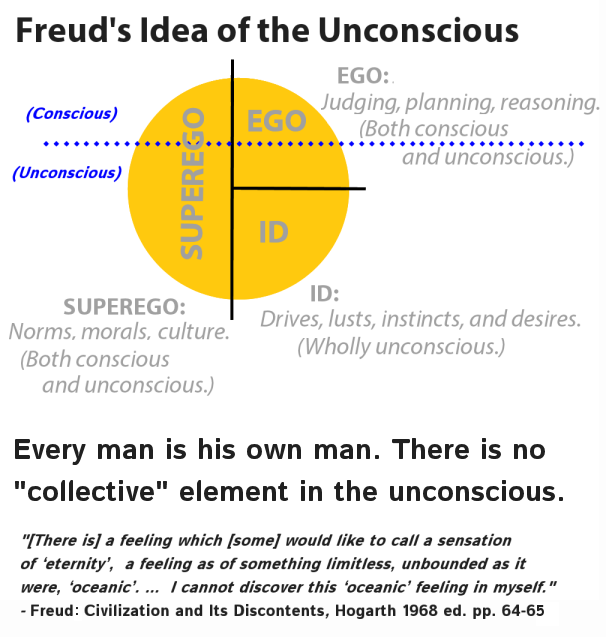
Once a bond with the idealized other has been formed, the Borderline will typically seek to enter into a dependency relation with the other. However, unlike the Dependent personality, who truly seeks to submit themselves to the will of another, the Borderline is not temperamentally servile so much as they simply need someone to ground them. For this reason, Borderlines in dependency relations are really only submissive some of the time and might equally be rebellious and "push against" their self-constructed authority at other times. In reality, the Borderline is unconsciously using the other as an object by which to test their own capricious and fragile grasp of reality. Thus the Borderline's true attitude towards their idealized other has often been summed up as "I hate you, don't leave me!" - they need to idealize the other person and to regard them as near-perfect, but they also need to push against the wishes and needs of the other person in order to discharge their forlorn frustration and avoid feeling anxious and empty inside. As such, it is really an open question who is the stronger party in such relations: The "powerful" other, without whom the Borderline would be lost, or the "hapless" Borderline, who has somehow succeeded in getting the other to accept the role that the Borderline needed them to play.
Having established this type of dependency relation with the idealized other, the Borderline will often treat their omnipotent "idol" in a quite ruthless and possessive manner, frequently taking them for granted and placing demands on them with abandon. Since the Borderline perceives themselves as insecure and powerless - as a child when compared to the majesty of the idealized other - the Borderline naturally feels that their testy behavior and "pushing against" the other cannot possibly hurt them (the idealized other being almost omnipotent after all). This emotional stance then provides the semiconscious justification for the Borderline's self-centered and shameless conduct, leveled at the person for whom they ostensibly feel nothing but love and admiration. Like the Narcissist, it is in the nature of the Borderline personality to effortlessly assume that the other is simply there to cater to their needs, and also like the Narcissist, the history of psychology is fraught with the close partners of Borderlines whose emotional lives have been destroyed by being perceived as such instruments and objects to further the Borderline's wishes rather than as persons in their own right.
Projection and Projective Identification
Unlike the Antisocial or Histrionic personalities, the Borderline personality is not some social mastermind who is purposefully out to trick and manipulate people into complying with their wishes. So how does the Borderline, who is genuinely internally confused and cognitively weaker than the other styles, manage to persuade others to enter into such dysfunctional relationships with them? According to psychodynamic theory, the answer is found in the term projective identification, which is a pattern of behavior that the Borderline utilizes to great effect.
To understand the concept of projective identification, it will first be necessary to explain the workings of primitive projections. A primitive projection tends to run somewhat like this: A person harbors undesirable thoughts and intentions that they do not like to think of themselves as possessing. Therefore the person unconsciously externalizes these elements of their own psyche so that they experience them as the attributes of others, rather than as belonging to themselves. For example, let us say that Joe, Ben, and Sue work together in the same office. Ben never liked Joe, but at the same time, Ben always thought of himself as someone who sees the good in everyone and doesn't have any enemies. One day Joe gets fired, and Ben feels happy about that. But it would be unacceptable to Ben's self-image to consciously cognize that this was how he felt. Instead he unconsciously attributes the elation that he is feeling to Sue, so that he genuinely believes that it is Sue who is so happy about Joe being let go, even though it is really Ben's own emotion that he is attributing to Sue.
As one might suspect, primitive projections constitute a very basic type of psychic defense. But as we have noted, the Borderline personality is also very primitive and immature, so it should come as no surprise that Borderlines often make use of such simple projections to keep their worldview from falling apart. Thus the blameworthy acts of the Borderline are often attributed to others in a way that will keep the Borderline seeming childlike and pristine or at worst seeming like a hapless victim acting in self-defense against the all-powerful "adults" who unfairly sought to assert their will over the Borderline. In order words, Borderlines do have an inclination towards playing the victim, but unlike the Histrionic, Masochistic, or Negativistic styles, it is not so much a conscious ploy as an extension of their own inner helplessness and confusion.

With regard to projective identification, the Borderline personality does not merely attribute momentary states and thoughts to the other, but rather forms a persistent bond with them where portions of the Borderline's own self are continually attributed to the other. As noted, projective identifications aim at keeping the other in a state that is conducive to the psychic life of the Borderline. In other words, the Borderline unconsciously manipulates the other in order to get that person to be what the Borderline needs them to be. Since the process of projective identification is both more advanced and further extended in time than a primitive projection, it will not be as easy to give clear-cut examples of its mechanics as it was in our example with Ben, Joe, and Sue.
The typical pattern of a projective identification will start with the Borderline seeking to bond with someone to whom they attribute various desirable competencies and qualities. Let us say, for example, that the Borderline is very indecisive when it comes to making decisions. The Borderline then finds some close other - a relative, a friend, or a lover - who has shown some willingness and competence in talking these things over with the Borderline and functioning as a guide or sounding board. In reality, the other person only has a limited amount of patience with the Borderline, but because the Borderline interacts with them not as they truly are, but as a dramatized, exaggerated version of their actual qualities, they become confused about their own emotions and willingness to help and are thus led into taking part in the dependency relation.
I have already mentioned how the Borderline is not a "social mastermind" and how Borderlines tend to sabotage their own long-term goals on account of their capriciousness. Indeed, the Borderline is not consciously exploitative, but nevertheless the Borderline may be said to possess some unconscious facility for selecting suitable targets for their idealizations and for keeping the self-other bond going by continually reinforcing in others the images that they have projected onto them, akin to a kind of psychic ventriloquism.
For example, Miranda and Dylan both had executive responsibilities at the same company. Miranda had a high activity level and was constantly instigating new initiatives and policies within the office. When Miranda had first joined the workforce, her superiors had been very harsh with her and treated her as little more than a disposable pair of hands. Now, 10 years later, Miranda hit upon the idea that her office should be characterized by a respectful and kind entry program where the new employees would be treated respectfully and made to see the logic of what they were doing through patient and open-ended discussions with the higher-ups. However, a few months into the lifespan of this new regimen, and faced with the very real trade-off between completing more projects on time and taking the hours needed to sit down with her subordinates in order to respectfully discuss the intricacies of the work, Miranda soon found herself back to barking orders. But because she had proclaimed the "respectful and open-ended" approach to be official office policy, she could not merely pretend that it had never happened, and the entry-level employees were still there, expecting to be mentored and coached. As a response, Miranda attempted to delegate all of the responsibility for "mentoring and coaching" her subordinates to Dylan. In terms of Jungian typology, Miranda was a TJ type and Dylan was an FJ type. Miranda liked to think of herself as a decisive "big picture" decision maker who excelled at calling the shots, while Dylan, for his part, liked to think of himself as a natural empath and teacher. Miranda proclaimed that it was therefore natural for Dylan to take care of the coaching and mentoring. "You have such unique and extraordinary abilities in that field and we just work so well together - we're the Yin and Yang of this company," she said. Dylan had never wanted to adopt this policy of "mentoring and coaching" - he knew that it would mean a lot of extra work on both their hands. But because Miranda attributed this adulatory and vitally important status to him (and because they were already in a protracted dependency relation), Dylan was unable to access his irritation with, and disapproval of, Miranda's course of action. On some level, he knew he was annoyed with her, but it was hard for him to break the spell. He was blocked from exploring his own feelings and emotions because he was locked up in Miranda's psychic ventriloquism, split between his own feelings and Miranda's exaggerated projections.
Again, it is important to stress that this process happens unconsciously in the Borderline, and that the projected images are really parts of the Borderline's identity.1 And of course Dylan would not be a suitable target for Miranda's projections if Dylan did not also harbor some uncertainties about his self-image and possess a somewhat weak sense of self (even though Dylan was not by himself as disturbed as Miranda). Instead of Dylan being his own person and Miranda being her own person, Miranda had succeeded in breaking down the barriers between self and other, so that both Dylan and Miranda were caught up in Miranda's projections. In relaying this example, it is also important to note that one cannot do justice to the process of projective identification in such short snippets. Truly fleshing out the mechanics of the projective identification process would require a text of novel or short story length. Hence the story of Dylan and Miranda cannot in itself be taken to definitively suggest that Miranda has a Borderline style, but must be taken in conjunction with the total picture of symptoms and personal histories. For example, if we followed Dylan and Miranda over time, we should also expect Miranda to attack and devalue Dylan from time to time, treating him as "all black" and accusing him of needless aggression and unfair attempts to control her. Should this fail to occur, it would be possible that Miranda was acting in this manner for different reasons.
In sum, projective identification refers to advanced forms of projections where not just momentary feelings and states are projected onto the other, but where entire parts of the Borderline's own sense of self is attributed to the other. While in a relation characterized by projective identification, both the Borderline and the other will be caught up in facets of the Borderline's own identity, which the Borderline continuously manages to reinforce and nurture in the other. Rather than each person being their own subject, the relation is characterized by what psychologists call inter-subjectivity, meaning that both of them experience themselves through the Borderline's unconscious promptings. In this way, the Borderline actually manages to exert a considerable measure of control over the other, even though on the surface of things the Borderline is merely a child.
Kernberg on the Borderline Personality
The Austrian-American psychoanalyst Otto Kernberg has offered a number of pivotal insights on the Borderline personality. Knowing what we now know of the Borderline, squaring our knowledge with Kernberg's points will allow us to reiterate our insights from a slightly different perspective. According to Kernberg, Borderlines have:
- Low tolerance of anxiety and poor impulse control: Borderlines cannot neutralize their own aggression and anxiety because they lack the inner cognitive structures needed to do so. As a consequence, the Borderline personality resorts to starting fights or making scenes in order to resolve their tension by making other people in their environment aggressive and tense, so that they might see their inner state reflected in others. For this reason, Borderlines will often blame others for their own failures, attribute their own negative emotions and moods to others, or otherwise react outwardly and point fingers at others in response to the internal anxiety that is really the Borderline's own affair.
- A limited or disturbed capacity for empathy: Because the Borderline struggles with a surplus of inner anxiety and a weak sense of self, the Borderline has a hard time experiencing others as they truly are. This means that, like the Narcissistic personality, the Borderline will frequently feel that they know exactly what is going on in the mind of another while at the same time being profoundly wrong about it. As a rule, what the Borderline is really experiencing when they are so sure of the motives and states of another is really their own unintegrated moods, desires, feelings, and fears.2
- Lack of Super-Ego development and integration: In normal people, the Super-Ego is a dynamic agent that learns and grows along with the ego, but in the Borderline, the Super-Ego remains relatively static and fixed. This means that expectations that are placed on the Borderline are experienced as excessively critical, rigid, and strict. As a result, the Borderline will often feel that it is impossible to live up to the demands of what they "should" be able to do, and they may therefore quit and run away from the challenges or attempt to place the responsibility on the shoulders of others instead of making an effort to rise to the occasion themselves. For the same reason, many Borderlines fail to complete their education or hold demanding jobs, even in cases where their IQ or the socioeconomic status of their parents would suggest that they ought to be able to do so.
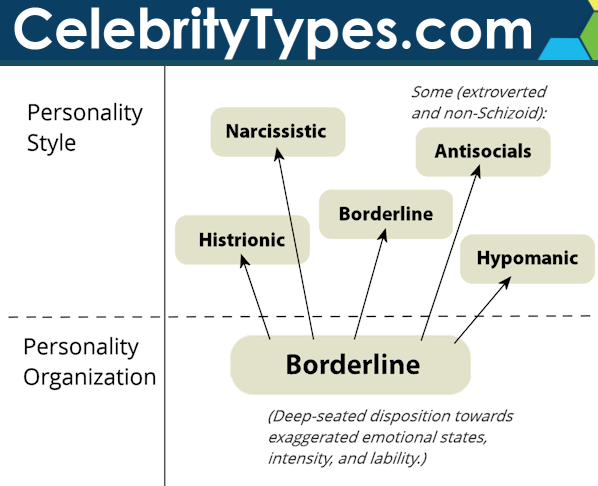
While these points are all very insightful, I would contend that Kernberg's most significant contribution to the study of the Borderline lies elsewhere: Throughout this piece, we have alluded to several points of similarity between the Borderline and the Narcissistic personality. In his work, Kernberg goes further and suggests that at its core, the Borderline personality is actually the same as the Narcissistic one. According to Kernberg, while the personality styles are different, the underlying personality organization is the same: The Narcissist may also struggle with a lack of perseverance in the face of hardship, delusions of grandeur, and limited empathic faculties. But unlike the Borderline personality, the Narcissist has typically managed to develop more stable coping mechanisms and a stronger sense of self. For example, while the Borderline tends to ride the currents of their present situation towards their affective maximums ("I'm a genius!" / "I'm a failure!"), the Narcissist typically resembles the Borderline in being filled up by the positive ("I'm a genius!") while having developed the psychic resilience and defences to repress or rationalize away the bad. Indeed, while Narcissists often do better than their IQ or the socioeconomic status of their parents would suggest, Borderlines tend to do worse. Thus we now see why the Borderline personality style is more uniformly negative than its Narcissistic counterpart, which tends to have both good and bad sides to it.
The Dos and Don'ts of Interacting with Borderlines
Finally, to end this article we should note that living in close proximity to someone with the Borderline personality style or even just interacting with them in a semi-close friendship or as co-workers will almost always prove trying. Professional psychologists have devised certain practical tips for how to behave when interacting with the Borderline personality, but even so it should be noted that while "revolutionary breakthroughs" in how to deal with Borderlines are routinely announced in the media (and even in scientific psychology journals), many professionals consider the Borderline personality style to be essentially irredeemable. Insofar as the Borderline individual is given intensive psychotherapy and provided with a nurturing and patient environment as described in the guidelines below, it will in many cases be possible to stabilize the Borderline and to mitigate their most tempestuous excesses. But taken as a whole, the history of psychology suggests that it will almost always be impossible to 'heal' the Borderline personality and to help the person 'get over' their style. In many cases, the attention and efforts expended on the well-being of the Borderline are best thought of as akin to the warmth that a freezing person receives from a fire: Once the fire dies out, it will not be long before the person starts freezing again. Thus, a Borderline individual may appear stable and "over their symptoms" for months or even years at a time as long as extraordinary care and attention are afforded to them. But once the supply of empathic and stabilizing attention runs out, many Borderlines will be likely to regress to their prior condition and many old symptoms are likely to rear their head again. Hence the commitment to aid the Borderline by providing this kind of attention is not so much an investment as it is a running expenditure. This may sound like a harsh formulation, but in my experience it is better to be clear about the prospects up-front. By avoiding unrealistic expectations from the start (such as the expectation of "curing" the Borderline), one can more easily avoid ending up disgruntled with the Borderline's lack of progress or feeling that the Borderline has ungratefully gobbled up one's help without making a serious attempt to get better.
What to Do When Interacting with Borderlines
As mentioned, Borderlines tend to push against others and to attempt to feel out their weaknesses as a way to obtain feedback on their own fragile grip on reality. As a result, there are many pitfalls that must be avoided when interacting with the Borderline, and successfully navigating such relations is certainly no easy task. Nevertheless, insofar as one endeavors to make the attempt, the American psychologist Jeffrey Young has developed the following guidelines for interacting with the Borderline personality.
- View the Borderline as a vulnerable child: When interacting with Borderlines, it is easy to view them as egotistical and trying; as purposefully overdramatic and willfully immature. In many cases, the Borderline can be quite quick-witted, and so it may seem as if the Borderline could easily put their dramatics behind them if only they resolved to make an effort. However, that is precisely what Borderlines cannot do: While Borderlines may have moments of lucidity where it seems as if though they grasp the wider implications of their behavior and the mechanics that drive it, they nevertheless lack the cognitive structures to retain that understanding over time, and so the Borderline cannot simply resolve to be their own conscience or maintain the lessons learned any more than a young child could resolve to be its own parent. By viewing the Borderline as a vulnerable child, it will become easier to empathize with their plight and to remind oneself that their continued mischief and shenanigans are not done on purpose.
- Re-channel their angry impulses by prompting them to express their emotions and needs in an appropriate manner: As already discussed, Borderlines struggle with a surplus of aggression and anxiety that they can find no proper way to address. As a result, Borderlines will often attack or accuse their surroundings and place unreasonable, self-centered demands on others in an unconscious attempt to rid themselves of their anxiety. For the person interacting with the Borderline, the challenge will be to look beyond the unreasonableness and angry format in which the need is being expressed and instead look at the underlying need itself. Insofar as the need is legitimate, reaffirm that the Borderline has rights just as any other person and that you empathize with the need, but not with the manner in which it was expressed. Insofar as the need is not legitimate, reaffirm that you have rights too and that, although you want to help them, their request is over the top. A great deal of equanimity and judiciousness is required here: You must apply the same standard to your own needs as you would to those of the Borderline. If you allow yourself to play by a double standard (e.g. by being more charitable to your own needs), you end up perpetuating the hapless child / idealized other dynamic. Hence you will not be helping the Borderline, but confirming to them that others are unfair and must be raged against in order for the Borderline to affirm their basic rights.
What NOT to Do When Interacting with Borderlines
Conversely, what follows are the things to avoid when interacting with the Borderline personality:
- Don't avoid enforcing limits and don't avoid confrontation: As already mentioned, much of the Borderline's interpersonal conduct is aimed at fostering a dependency bond between the Borderline and the other (what psychologists call inter-subjectivity). In order for the Borderline to successfully form such bonds, it is necessary for them to engage in behaviors that aim to undermine the boundaries between self and other. In other words, both the Borderline's idealizations, as well as their angry accusations, tend to come from a place that seeks to conflate their affairs with the affairs of the other party. In such situations it is therefore vital that you remind both yourself and the Borderline that while you are willing to help them, you are nevertheless your own person; that they cannot take you for granted and that they are not entitled to the unlimited use of your time and resources.
When faced with the unreasonable demands of a Borderline personality, most people actually avoid confronting the Borderline in this manner. They know that the Borderline is emotionally volatile, and so they fear what might happen. For example, in our scenario with Dylan and Miranda above, Dylan did not confront Miranda with the full repercussions of her "mentoring and coaching" ploy, but silently attempted to make the best of a bad situation. He failed to convey to her how this policy had really been her decision and so she should be the one who was responsible for it. Instead, Dylan had gotten himself mixed up in Miranda's inter-subjectivity and ended up bearing the brunt of her affair. By giving Miranda what she wanted without confronting her, Dylan was tacitly confirming to Miranda that he was someone whose assistance she could take for granted with impunity. Perhaps Dylan thought that by playing along so as to make this whole ordeal easier on her, Miranda would eventually realize that Dylan was magnanimously helping her out of a bind that was really of her doing. However, while such unstated expectations govern the give and take of many adult relations, it will typically be futile to expect such reciprocity from the Borderline. - Don't allow their projections to make you feel inadequate: As we have seen, Borderlines often possess an unconscious ability to activate the weaknesses of others through their projections. These weaknesses may pertain to simple issues, such as insecurities over body weight and image, physical attractiveness, intellectual self-confidence, or social popularity and acceptance. But they may also be more advanced, such as in the case of Dylan and Miranda, where Miranda had accurately (but unconsciously) discerned that Dylan could be made to feel inadequate as an empath if he did not take on the extra coaching tasks that Miranda wanted him to bear. As a rule, Borderlines will ferret out some of your weaknesses if you interact with them for prolonged periods of time, but the feedback that you get from them will typically be mixed with exaggerated dramatizations and plausible-but-spurious conjectures that the Borderline has mixed into the narrative as well (see the point about their disturbed capacity for empathy above). Consequently, you should vow to yourself from the start that you will not let the Borderline become a legitimate source of feedback for your self-understanding (which is easier said than done). In the course of their pushing against you, it is of course possible that the Borderline will at some point be justified in pointing to a weakness on your part. But as I have said, their feedback is most likely going to be blurred and disturbed (and often unconsciously designed to make you feel inadequate so as to bind you to them). For this reason you should not allow a Borderline's feedback on your self-image to have a serious say over you, any more than a parent should allow a young child to have a serious say in their parenting. With the Borderline, as with the child, the proof will be in the pudding in the sense that it is the other person's reactions to your conduct over time that reveal the merits or faults of your stance and not whether they immediately challenge you and push against it.
- Don't become angry or resentful: As we have seen, Borderlines will often form relations with others in which these others are first idealized as endlessly competent and good and then villainized as needlessly controlling and aggressive. One way the Borderline unconsciously perpetuates this dynamic is by creating chaos and confusion around them and by luring others into dire situations where the Borderline then leaves them to deal with the consequences. For example, had Dylan had a more aggressive temperament, he might have confronted Miranda in the following manner: "Miranda, I warned you that this 'training and mentoring' stratagem of yours would mean a lot of extra work added to our already busy workdays and I told you that I was not particularly interested in undertaking this task. But you went ahead and instigated this decision anyway, and now we're stuck with the consequences. This is so typical of you, Miranda - always barging through, never listening, and then leaving others to clean up after your mistakes!"
Now it might be argued that Dylan would be entirely justified in confronting Miranda in this manner. But insofar as Dylan knew in advance that Miranda had a Borderline style, such a reaction would really be quite unreasonable. Instead, Dylan should have been thinking of Miranda as a vulnerable and confused child, incapable of assuming responsibility for her actions in a mature manner. It is therefore not Miranda, but Dylan who is behaving inappropriately in this situation; he is holding her to an adult standard when he should have known better. At some level, Dylan probably does know better, and he is most likely overcome with feelings of regret for having let Miranda 'trick' him into this kind of situation even though he knew she was capricious and unstable. But instead of staying with the feeling of remorse, Dylan gets angry with Miranda. Most likely, Dylan will also exaggerate his anger with Miranda in this situation because deep down he is also angry with himself for having trusted Miranda when he should have known better. In psychological parlance, Dylan is overcompensating for his prior lenience by getting extra angry with Miranda. And by getting extra angry, he is confirming the Borderline's belief that others invariably contain an element of "all black," needless and exaggerated aggression. Even though Borderlines may often orchestrate situations that infer considerable negative effects on you, it is therefore important that you resolve not to get angry with them: Instead, remind yourself that this type of fallout and confusion was part of the deal when you made the decision to be close to the Borderline. Endeavor to speak to them calmly, maintain an equitable pose, and avoid voicing anger or blame. - Don't encourage them to make good on their threats: When interacting with Borderlines, they will often appeal to drastic, overly black and white outcomes, or even put ultimatums to you, such as "If you don't do as I ask, I'll hurt myself!" or "If you don't help me, we're no longer friends!" In such situations, it can often be temping for the exasperated other to take the unreasonable and self-centered Borderline up on their offer ("Fine, then do it!"). However, to do so will only serve to increase the Borderline's despair and confusion. Worse yet, it will also confirm to them that even their closest relations contain a malicious streak where they are suddenly "evil" and do not care about the Borderline. Therefore do not indulge such momentary vexations and do not allow yourself to be provoked. Instead, understand that their threats and ultimatums are coming from a place of desperation and that what they really want is for you to alleviate their fears and make them feel safe. Affirm that you want to help them, but remind them that their conduct is making it difficult for you.
As you can see, keeping up with the machinations of the Borderline is no easy task, but more like an act of psychic tightrope walking where one is constantly in danger of falling off and coming down on the side of either deference or blame. The rather bleak prospects of "bettering" or "curing" the Borderline mentioned earlier in this article bear repeating, and on the whole, you should think seriously about whether you are really capable of devoting so much time and attention to benefit another human being – most people tend to think that their own lives are hard enough to begin with. Finally, if you have read these points and are thinking to yourself that "this doesn't sound that bad" and that maintaining such a countenance as a way to get close to the Borderline may even be exciting, it is possible that you yourself have some weakness in relation to your self-image and some areas where you can easily be made to feel inadequate – just like Dylan, who had originally been drawn to form a bond with Miranda for the same reasons.
Notes
- Someone who consciously managed to manipulate others by attributing idealized characteristics to them would be far more likely to be Histrionic or Antisocial.
- Indeed, the psychiatrist Simon Baron-Cohen has done a study on empathy, measuring people's ability to (a) intellectually discern other people's emotions, (b) affectively discern other people's emotions, and (c) discern the right course of action in order to help another person in distress. Borderlines were found to be weak on all three parameters.
***
Primer on the Borderline Personality Style © Ryan Smith and CelebrityTypes International 2015.
Cover art especially commissioned for this publication from artist Georgios Magkakis.
This article provides educational information on the Borderline personality style for educational purposes only. The information is provided "as-is" and should not be construed to constitute services or warranties of any kind. For more, please consult our Terms of Service.