
Suika Fruit Game
Can you reach the watermelon?
Suika is an addictive physics puzzle where you drop fruits into a container and merge matching ones into larger fruits. Two cherries become a strawberry, two strawberries a grape, and so on up the chain toward the coveted watermelon. The catch: every fruit stacks up with real weight, so let the pile overflow the top and the game ends. How big can you grow your fruit before space runs out? Start dropping and find out.
Suika Game is a modern physics-based puzzle game that gained widespread popularity through its simple premise, tactile simulation, and emergent gameplay. At its core, the game belongs to the “merge puzzle” family, but it distinguishes itself by using real-time physics, gravity, and spatial stacking rather than grid-based movement. This gives it a more chaotic and organic feel compared to earlier puzzle titles in the same conceptual lineage.
The central idea of Suika Game is straightforward: players drop fruit into a container, usually a box or well-like playfield. When two identical fruits touch, they merge into a larger fruit, progressing through a predefined evolution chain until the largest fruit type—typically a watermelon—is formed. The word “suika” itself means watermelon in Japanese, which reflects the end goal of the progression system. Despite this simplicity, the game becomes increasingly complex as the container fills and physics interactions create unpredictable outcomes.
A defining feature of Suika Game is its reliance on soft-body-like physics simulation. Fruits are not static tiles; they roll, bounce, compress slightly, and settle based on weight and contact angles. This introduces a layer of unpredictability that forces players to think in terms of momentum and spatial planning rather than fixed patterns. A carefully placed fruit can trigger a chain reaction, while a poorly placed one can destabilize the entire stack and end a run prematurely.
The game’s origins are closely tied to Japanese digital puzzle design trends and casual gaming platforms. While inspired by earlier merge-style mechanics seen in titles like 2048 and various mobile puzzle hybrids, Suika Game’s approach feels closer to toy-like experimentation than strict puzzle solving. It emphasizes emergent behavior—situations where simple rules produce complex and often unexpected outcomes.
One of the reasons for its popularity is its accessibility. There are no complicated controls: typically, players only aim and drop fruit. However, this simplicity hides a high skill ceiling. Advanced play involves predicting how fruits will roll, anticipating pressure points in the stack, and deliberately setting up merges that trigger beneficial cascades. Small mistakes can accumulate quickly due to the confined play space, making each decision feel significant.
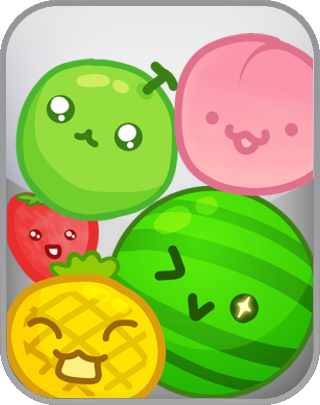
Visually, Suika Game uses a soft, colorful aesthetic that enhances its approachable tone. The fruit designs are rounded and expressive, which helps players easily distinguish types while reinforcing the game’s playful identity. The sound design also plays a key role, with gentle impacts and satisfying merge effects that provide immediate feedback for successful actions.
From a design perspective, Suika Game represents an evolution of the merge puzzle genre into physics-driven systems. Unlike grid-based predecessors, it removes strict spatial constraints and replaces them with continuous motion and collision-based logic. This shift creates a more dynamic and replayable experience, as no two sessions unfold in exactly the same way.
The game also became a cultural phenomenon in streaming and short-form video spaces. Its unpredictable moments—sudden collapses, near-perfect merges, and last-second saves—make it highly engaging for spectators. This visibility contributed significantly to its rapid spread beyond its original audience, turning it into a recognizable casual gaming trend.
Ultimately, Suika Game stands out because it transforms a minimal set of rules into a deeply reactive system. By combining simple merging mechanics with real-world physics simulation, it creates a puzzle experience that is as much about intuition and adaptability as it is about planning, making each session feel like a small, self-contained experiment in controlled chaos.
Why Play This Game?
1. Free and easy to start. The Suika Fruit Game can be played instantly in your browser or app versions without complex setup.
2. Relaxing physics puzzle. It combines simple mechanics with satisfying chain reactions as fruits merge and grow.
3. For entertainment and light challenge. The goal is to enjoy casual problem-solving rather than competitive play or formal skill testing.