This article is a companion to the article on Nietzsche’s Aesthetics of Night. While this article can be read on its own, we recommend that you read the article on Nietzsche before proceeding with this one.
By Ryan Smith
In my article on Nietzsche’s Aesthetics of Night I reached back to Nietzche’s early aesthetics, from before he crafted The Birth of Tragedy. Similarly, in this article I shall attempt to describe Hume’s aesthetics – not on the basis of his famous essay Of the Standard of Taste, which is so often taken to be the whole of his aesthetic – but on the basis of his thoughts on the aesthetic as they appear in his Treatise of Human Nature and other early writings.
In philosophical matters, Hume is usually considered a skeptic: When one billiard ball smashes into another, how can we really be sure that it was the force of the first billiard ball that caused the other to move? All that happens is that we regularly observe that the two steps always occur together; we cannot know that step 1 caused step 2.
But Hume isn’t a skeptic in aesthetical matters. To Hume, aesthetic enjoyment arises within ourselves as a matter of sentiment and though “the human mind holds many secrets,” we can acquaint ourselves with our sentiments and reason about them even while we are unsure of their ultimate nature or causality.
At first glance it may seem as if Hume is an aesthetic relativist. If we cannot find any ultimate justification for aesthetic judgments, then Hume would seem to agree with the postmodern view that there is no objective basis for beauty. But Hume isn’t a postmodernist after all. For while he agrees that we have no ultimate justification for aesthetic judgments, he nevertheless maintains that there are things that are intrinsically aesthetic to us as humans.
Thus, while we cannot justify our belief that a well-tended garden is more beautiful than a junkyard in any ultimate or objective sense, we can still say that it is a hardwired property of human aesthetics that we prefer the garden to the junkyard. As such, Hume would find himself in full agreement with modern-day cognitive scientists like Steven Pinker who argue that the evolutionary process has dictated a series of hardwired preferences for our species and that good art elicits aesthetic enjoyment from us by catering to those preferences.
Hume’s Civilizational Aesthetics
However, unlike Steven Pinker, who argues that landscapes and sunsets are more intrinsically aesthetic to our species than man-made art, Hume would not accept that natural phenomena are really the crux of the aesthetic.
Natural objects may have beauty, but if they do not immediately strike us as beautiful, we can never be made to see them as beautiful. According to Hume, we cannot be reasoned into enjoying a sunset that we did not find captivating on our own. Not so with fine paintings and classical music. The merits of these objects can be elucidated through education and reasoning. According to Hume, it is only the man who has developed these faculties in himself of whom we may speak as having aesthetic taste; the man who merely enjoys a sunset has only an inborn disposition.
Thus we can see that Hume’s aesthetics may be called ‘civilizational’: Where Nietzsche champions an unapologetic and immediate approach to the aesthetic, Hume’s aesthetics cannot be separated from the erudition and book knowledge that must precede it; a honing of aesthetic receptivity and a fine-tuning of taste is required. To Hume, taste is something impersonal; an impartial aspiration to something outside of oneself, something reasoned, polite, and mediated.
To Hume, it is exactly this type of critical and detached attitude to one’s own enjoyment that fosters civilization because that is the type of stance that underpins our moral judgments as well: A man who feels hunger may be tempted to snatch a hot pie from a window sill, but through education and detached reasoning he learns that the basic sociality of civilization would not endure if everyone behaved in this way. By contrast, if he used the same type of immediate and unmediated approach that he used to enjoy the sunset, he’d snatch the pie without further ado. Thus a cultured approach to the aesthetic, where we condition our enjoyment upon learning and where we connect our gratification with our critical faculties, is not just conducive to art, but also to civilization.
In Jungian typology we take great care to separate emotion from sentiment. Emotion is an instinctual and primitive response to something, and the emotion can usually be clearly identified as one of six to eight basic emotions. But sentiment is something refined, amorphous, and of a higher cognitive order. With regards to this division, Hume clearly thinks that aesthetics is a matter of refined sentiment, whereas to the early Nietzsche, it is a matter of raw emotion. In the same vein, intellectual book knowledge is an enabler to Hume and a disabler to Nietzsche, as we shall shortly see.
Education and Imagination in Hume’s Aesthetics
In our essay on Nietzsche’s aesthetics, recall that Nietzsche faulted the 17th century Florentines for attempting to rediscover the ancient Greek music drama of the past. As Nietzsche saw it, Greek music drama could only make instinctive sense to the ancient Greeks, and no amount of scholarly tinkering could ever make ancient Greek music speak in the same way to 17th century Italians as it had to ancient Greeks. But as Hume would have it, it is entirely the other way around.
To Hume, there is a reason why classical operas are set in remote places like ancient Egypt and medieval China. Likewise, there is a reason why good architecture recalls the splendors of Rome and Greece. In both cases the observer must use his erudition and imagination to understand these foreign frames of reference and make them come to life for himself. To Hume, good taste is thus dependent upon having a good education and a good imagination.
Hume does not deny that when dealing with the man in the street, it is far easier to get him to enjoy a contemporary pop tune than to grasp the intricacies of Italian opera. But by way of his civilizational aesthetics, he maintains that the latter is intrinsically more aesthetic than the former. And so the best connoisseurs are those who are endowed with a good imagination and who exhibit the civility and learned patience required to overcome their own frame of reference in order to understand exotic art on its terms and not on one’s own. Primitive sensory gratification belongs to the night, and true aesthetics come out of the light.
The Aesthetics of Hume and Nietzsche as a Problem of Types
Now that we have sketched the early aesthetics of Nietzsche and Hume, let us relate their aesthetics to their types, supposing that they are INTJ (Nietzsche) and ENTP (Hume).
In Nietzsche’s case, it is quite clear that we are dealing with a striving to reunite with his inferior Se, and to do so in the self-indulgent manner that comes through having Fi in the posterior portion of the personality. Put simply, the longing for Se is a longing to get out of one’s own head. The world of intellectual conceptualization, which so many regard as prestigious and aspire to master, is not a choice for the Ni type; it is a given – an existential predicament – and as a given (as opposed to an option) it tends to breed its own set of problems.
In the dominant position, Ni is always in danger of fostering an internal loop of self-confirming perceptions – a slump with little connection to the real world. Thus the world of conceptualizing perceptions is an existential problem for the Ni type – they cannot step out of it. They cannot not be intellectual. So Nietzsche could never have said, as Hume did, that polite intellectual conversation was an art form, for the conceptualizing mode of thought was precisely the thing that Nietzsche sought release from through the violent and unmediated Wagnerian and Dionysian themes in his aesthetic.
To Nietzsche, suggesting that polite intellectual conversation could qualify as aesthetic would be like a warden telling a prisoner that he had been ‘released’ when he had in fact only been transferred to a different cell: A mockery; an affront to the fettered. He would respond in kind by calling such ‘civilizational’ minds superficial and misguided.
As Nietzsche would have it, civilizational art caters merely to the social needs of unsatisfied upper-class women and not to any true aesthetic. In fact, those were his actual words in relation to such civilizational aesthetics, and a psychologist reading them cannot help but wonder why those specific themes were at the forefront of his consciousness when dealing with the aesthetic. It is probably not a coincidence that Nietzsche’s own aesthetics championed orgies and wine, or that the study of Nietzsche’s life reveals a man whose own sexuality was not gratified. From both a Jungian as well as a Freudian perspective, then, the problem of Nietzsche’s aesthetics seems to have been a problem of the inferior function – in this case the Se function.
Hume’s Aesthetics as a Problem of Types
As for Hume, the case is less straightforward, though it is mainly a question of the inferior function as well . As we have seen, Hume’s preferred approach to the aesthetic is to absorb art, not on the conditions of art itself, but through the membrane of ‘cultural life’ in general. As such, Hume favors an approach to art where almost anything can be appreciated “because it is art,” and where art is appreciated, not in a personal manner, but in an impersonal manner that takes its impetus from “what civilized people do.”
The advantages of this all-embracing approach to art is the engendering of a cosmopolitan breadth of taste. But the downside is that nothing is ever truly felt by the individual as an individual. Instead, aesthetic experiences are common and shared; no longer felt, but merely appreciated. Aesthetic experiences have little deep-keeled meaning to the individual; they are first and foremost externalized, presented and held out as trinkets of polite conversation.
Thus it will be seen that Hume’s approach to aesthetics is one that subordinates the aesthetic to other matters – to conversation and civilization, as is the main point of this essay, but also to a broader mode of perception that plays to the strengths of the ENTP type in general.
As we have seen, Hume would consider it meritorious for the aesthetic to be imbued with the scent of a foreign time and place, whereas to Nietzsche, attempting to reach beyond oneself would be a mistake. Thus to Hume, even a native Scotsman like himself should ideally learn to appreciate the complexities of Italian music, with its references to exotic places like Rome and ancient Egypt. But to Nietzsche, art should make sense to a people in their own time and on their own terms.
By lining up the contrasts between the two views, such as I have done here, I wish to point at the fact that a view of the aesthetic such as the one favored by Hume cannot be singular or intense in the same way as that of Nietzsche. On the contrary, Hume’s ‘civilizational’ approach to the aesthetic is one that all too easily fails to take stock of the work of art in its own right. Instead it is prone to ride roughshod over the individual work of art, using artistic productions as mere stepping stones for the gratification of fleeting fancies and whims.
Under this mode of perception, the aesthetic primarily serves as a banquet which one can sample at one’s leisure: A potpourri that exists to trigger effervescent but feeble associations that the mind can barely savor before it hurries on to the next. Art then becomes a frivolous fun-house of vague but exotic impressions and stimuli and scarcely anything more.
In typological terms, we might say that the superficial features of Hume’s aesthetics would be born of a failure of the conscious mind to limit itself, so that his inferior introverted perception might be allowed its due. Of course, a central lesson of Jungian typology is precisely that the inferior function resides in the unconscious, so one cannot simply “pull it up” and develop it, as one would develop the other three functions. However, since aesthetic experiences are also bound to reside at least partially in the unconscious, there are good grounds for mediating with the inferior function through aesthetic experiences.
Had Hume not shut Si out from the psyche, always running after what was new and exciting, it is possible that his philosophy would also have been a bit more coherent. Indeed, as modern-day researchers often remark, Hume’s philosophy is such that he seems to say one thing one moment and then another thing the next. Verbal and analytical victories are thus easily won over Hume, as one can almost always make him refute himself by contrasting one passage to another. In this way, the philosopher who at first glance seems to say everything all too frequently ends up saying nothing.
In Hume’s case, adopting a slower pace of perception and analysis might have allowed more of his unconscious introverted perception to bring to bear upon his work. Had he done so, his inferior Si might have lent his work more singularity and depth, as well as more constancy and coherence.
***
Thus in their own ways, both Hume’s aesthetics of light and Nietzsche’s aesthetic of night represented a problem of types for them. For Nietzsche, to stay amongst the mental images of his dominant function (Ni) with no sensory outlet to counterbalance it and give physical form to his mental perceptions would have been a prison – a condition of suffering brought about by the endless repetition and re-confirmation of themes that progressed further and further away from objective reality.
To Hume, however, it was not his own subject, but the external object that represented a problem of types for him. Where Nietzsche had wanted to escape the monopolizing influence of his dominant function and its tendency to erect barricades between his psychic life and the physical world. But to Hume, being allowed to escape from the confines of the individual and familiar here and now into a world of tentative connections and embryonic possibilities was synonymous with feelings of excitement and the experience of psychic gratification.
To Nietzsche, Ni without the influence of his lower functions constituted a place of suffering, a prison. But to Hume, Ne without Fe and Si constituted a fun-house, which was rudely interrupted by the demands of the here and now and the records of the past. Where Nietzsche wanted to escape away from his world of abstract intuitions, Hume had wanted to escape into them, and to completely identify with his most developed function where Nietzsche had wanted to deny it.
***
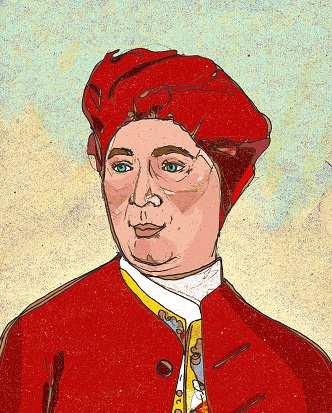
Image of Hume in the article commissioned from artist Francesca Elettra.