
Autism/Asperger Test
You are here because one of your friends linked you to their Autism/Asperger Test result:
Take the TestYour friend's results:
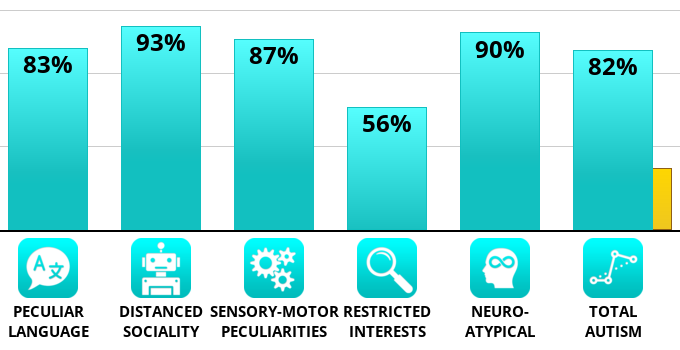
Your friend's autistic/Asperger traits are very high (82.29%).
Your friend has significant autistic/Asperger traits according to the RAADS diagnostic criteria.
Take the TestExplanation of Elements:
Peculiar Language: Relates to a tendency toward literal language interpretation and difficulty with metaphor comprehension, e.g., idioms, irony, and sarcasm. Moreover, it focuses on an individual’s inability to interpret information on a semantic level, using semantic integration to interrelate information from different sources to comprehend non-concrete information and abstractions. It also measures Echolalia, i.e., a pattern of repeated behaviors such as repeating noises and phrases picked up from movies, television, etc.
Distanced Sociality: Measures how individuals perceive themselves in social contexts — how they manage situations and associated stimuli, social cues, behavioral signals, social dynamics, etc. It focuses on the ability to understand the mental state of oneself or others in relation to socialization, feelings of sticking out in a group or being different or an outsider in comparison to others, as well as being perceived as rude or “too straightforward.” This element also investigates a possible lack of social boundaries or social skills, difficulty recognizing social consensus or “rules” associated with turn-taking in conversation, difficulty recognizing romantic interest or flirtatious behavior, and so on.
Sensory-Motor Peculiarities: Denotes sensitivity toward certain stimuli (touch, sound, etc.), motor control issues, and voice volume challenges. It also includes the tendency to talk very loudly or not loudly enough, fluctuating between monotonous speech or abnormal use of one’s voice, as well as the tendency to be clumsy or uncoordinated when exposed to external stimulation.
Restricted Interests: Measures detail orientation, the tendency to maintain focus for long periods, and how a person structures their engagement and engages in routines. A high score indicates special interests or obsessions, distress sensitivity to disruption in patterns and routines, and detail preference in terms of understanding detail and ability to conceive a larger picture. A lower score indicates the absence of these tendencies.
Neuroatypical: The neurologically atypical category reflects non-normative behaviors that indicate a divergent neurological makeup. A low score thus indicates neurotypical personality facets and features, while a higher score indicates neurological divergence.
Total Autism: Your overall score reflects how well your responses correlate as measured against statements related to autism symptomatology. A low score indicates few if any autistic traits. A higher score may indicate several autistic personality traits or (subclinical) Asperger’s or Autism Spectrum Disorder(s).
References
- Ritvo, R. A., Ritvo, E. R., Guthrie, D., Yuwiler, A., Ritvo, M. J., & Weisbender, L. (2008). A Scale to Assist the Diagnosis of Autism and Asperger’s Disorder in Adults (RAADS): A pilot study. Journal of Autism and Developmental Disorders.
- Andersen, Lisa & Naswall, Katharina & Manouilenko, Irina & Nylander, Lena & Edgar, Johan & Ritvo, Riva Ariella & Ritvo, Edward & Bejerot, Susanne. (2011). The Swedish Version of the Ritvo Autism and Asperger Diagnostic Scale: Revised (RAADS-R). A Validation Study of a Rating Scale for Adults. Journal of Autism and Developmental Disorders.
Take Next





GET THE FULL STORY
Become a lifetime member with a one-time payment

$11.99
WHAT YOU GET
Access to members-only tests
Ability to track and save test results
Access to all of our eBooks (value $44.94)
Access to premium type assessments and infographics
Become a memberGET THE FULL STORY
Living Autistic
$7.99
WHAT YOU GET
78-page manual, explaining the typical challenges and paths to growth experienced by people with autistic traits.
Presented in an easy-to-read style and written by people who have grappled with these challenges themselves.
14-day, no-questions-asked, money-back guarantee.
Order NowSave and monitor your results over time
Become a member today
Sign Up