
Big Five Personality Test
You are here because one of your friends linked you to their Big Five Personality result:
Take the TestYour friend's Big Five scores are:
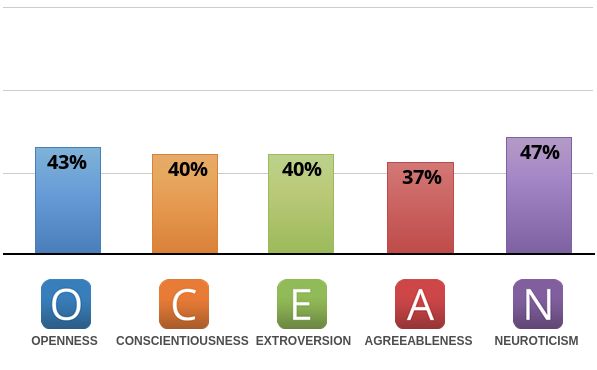
Explanation of Traits
Openness
High: Imaginative, intellectual, artistic, seeks adventure, thinks in symbols and abstractions.
Low: Practical, realistic, factual, sensible, down-to-earth, prefers familiarity and routine.
Your Friend's Score: Average
Conscientiousness
High: Organized, reliable, self-controlled, orderly, cautious, disciplined, strong sense of duty.
Low: Disorganized, spur-of-the-moment, impulsive, procrastinating, finds rules constraining.
Your Friend's Score: Average
Extroversion
High: Extroverted, outgoing, gregarious, enthusiastic, action-oriented, excitable, social.
Low: Introverted, reserved, low-key, quiet, disengaged, deliberate, needs time alone.
Your Friend's Score: Average
Agreeableness
High: Considerate, altruistic, friendly, generous, sympathetic, modest, trusting, helpful.
Low: Critical, confident, self-interested, skeptical, stubborn, unfriendly, uncooperative.
Your Friend's Score: Average
Neuroticism
High: Anxious, fearful, tense, nervous, self-conscious, susceptible to anger and depression.
Low: Serene, calm, stable, composed, tranquil, poised, unfazed, few intense emotions.
Your Friend's Score: Average
Statistics
Political Orientation
Though correlations between personality and political opinions are modest, your friend is statistically most likely to be politically Libertarian. (Source: Iyer et al. 2012)
Gender
Based on your friend's personality scores, your friend is statistically more likely to be Male than Female. (Source: Vecchione et al. 2012; Mondak 2010)
Personality Type
According to John A. Johnston, professor of psychology at Pennsylvania State University, your friend's Big Five scores suggest that your friend is a(n)... (WARNING: Not all of Dr. Johnston's descriptions are positive. Expand at your own risk.)
Personality Type
According to studies by Gerber and associates (Yale University), Raso and associates (Stanford), and others, your friend's scores indicate that he or she is:
- Less likely than the general population to let their commitment be guided by the issues that are likely to yield concrete personal payoffs in their life (as opposed to abstract ideological ones).
- More likely than the general population to watch and enjoy late-night satire that ridicules politics and politicians.
- More likely to keep informed on politics because they feel it is fun or exciting than because they feel it is a type of obligation or social duty.
- Likely to take more risks with their health, diet, and lifestyle than the general population.
- Likely to spend less time than the general population striving for career achievements, devoting themselves to hobbies and extra-professional activities as well.
- Likely to waste more time procrastinating with internet games, social media etc. than the general population.
- Less likely than the general population to attend political campaign events and meetings.
- Less likely than the general population to voice support for their political views by writing to elected officials or for the opinion pages of newspapers and magazines.
- More likely than the general population to stay constant in their level of political engagement (i.e. as opposed to mostly following politics in conjunction with elections, etc.).
- Likely to spend less time reading newspapers than the general population.
- Less likely to watch political talk shows than the general population.
- More likely than the general population to sign political petitions when asked to do so by friends.
- Less likely than the general population to vote in each and every election.
- More likely than the general population to make arguments to the speakers when attending political rallies and debates.
- Likely to be more strategic and calculating than the general population in the presentation of their political views (i.e. what they disclose and how they disclose it; tailoring their message to their audience, etc.).
- More likely than the general population to take an economics-oriented approach to environmental issues (i.e. growing the economic pie with fossil fuels now in order to be better able to pay for environmental policies in the future, instead of windmills, carbon restrictions, and taxes on industry now.).
- Likely to be less swayed by a politician’s personality, interpersonal dealings, and prosocial behavior than by his actual politics.
References
The calculations in this test were conducted on the basis of data discerned from the following studies:
- Gerber, A.S., Huber, G.A., Doherty, D., Dowling, C.M.: Personality Traits and the Consumption of Political Information American Politics Research 39(1), 2010
- Gerber, A.S., Huber, G.A., Doherty, D., Dowling, C.M., Raso, C., Ha, S.E.: Personality Traits and Participation in Political Processes Journal of Politics, Volume 73, Issue 03, July 2011
- Gerber, A.S., Huber, G.A., Doherty, D., Dowling, C.M.: Personality and the Strength and Direction of Partisan Identification Political Behavior 34, 2012
- Iyer R., Koleva S., Graham J., Ditto P., Haidt J.: Understanding Libertarian Morality PLoS ONE 7(8), 2012
- Mondak, J.J.: Personality and the Foundations of Political Behavior Cambridge University Press, 2010
- Vecchione, M., Alessandri, G., Barbaranelli, C., Caprara, G.: Gender Differences in the Big Five Personality Development Personality and Individual Differences, Volume 53, Issue 6, October 2012
Take Next







GET THE FULL STORY
Become a lifetime member with a one-time payment

$9.99
WHAT YOU GET
Access to members-only tests
Ability to track and save test results
Access to all of our eBooks (value $44.94)
Access to premium type assessments and infographics
Become a memberSave and monitor your results over time
Become a member today
Sign Up