
Nietzsche Aphorism Test
What is your Nietzsche Aphorism?
Friedrich Nietzsche wrote some of philosophy's most memorable prose: compressed observations about morality, knowledge, struggle, character, power, suffering, and the task of becoming oneself. A few lines can sound immediately clear, only to become more unsettling the longer they are examined.
This is part of Nietzsche's peculiar force. His aphorisms rarely behave like isolated maxims with a single lesson. They provoke and shift perspective.
The Nietzsche Aphorism Test compares your philosophical temperament with a curated set of Nietzsche aphorisms. Your answers reveal the saying whose underlying pattern most closely resembles your own. One philosopher. Many possible aphorisms.
What is your aphorism? To take the test, enter your input below.
Question 1 of 36
I would rather transform suffering into strength or meaning than organize my life around avoiding it.
| Disagree | Agree |
BACK NEXT
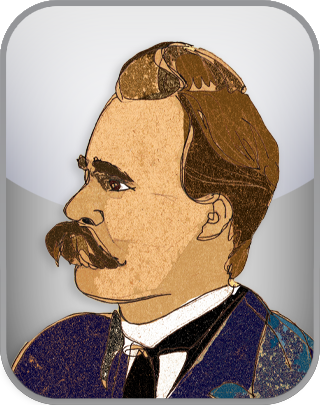
Friedrich Nietzsche (1844-1900) was a German philosopher and classical philologist whose works range across morality, religion, psychology, art, knowledge, culture, and the possibilities of human self-transformation. Many of his books make extensive use of aphorisms and short numbered sections, allowing a single idea to be approached from several angles rather than presented as part of a conventional philosophical system.
The Nietzsche Aphorism Test approaches these sayings as expressions of different philosophical temperaments. It does not simply ask which quotation you like best. Instead, your responses are compared across six broad facets: Self-Overcoming, Value Independence, Power Orientation, Agonistic Orientation, Perspectivism, and Life Affirmation. Together, these dimensions describe whether you tend toward transformation or self-preservation, inherited or self-examined values, adaptation or active agency, ease or productive struggle, singular certainty or perspectival interpretation, and rejection or affirmation of life as it is.
The test contains 36 statements, with six items devoted to each facet. Some items are phrased in the opposite direction to reduce automatic agreement and produce a more balanced profile. Your answers generate six scores. Each aphorism included in the scoring set is coded on the same six dimensions, allowing the system to compare your overall pattern with the philosophical pattern expressed by each saying.
No facet should be reduced to a caricature. A high score on Power Orientation, for example, does not necessarily imply a wish to dominate other people; it may instead reflect agency, self-command, expansion of capacity, or the drive to overcome resistance. Perspectivism likewise does not mean that every interpretation is equally good. Nietzsche repeatedly ranks interpretations, asks what conditions produced them, and challenges claims to a view from nowhere.
Your result is the aphorism whose profile most closely resembles your own. This does not mean that the quotation summarizes your entire personality, nor that Nietzsche would have classified people in this way. Nietzsche did not design a personality system, and his aphorisms can be deliberately provocative, ironic, provisional, or dependent on their surrounding context. The matching procedure is therefore interpretive: it uses the aphorisms as lenses through which different orientations toward life and thought can be viewed.
The result page presents the matched aphorism together with several short scholarly pointers explaining its immediate sense, its place within Nietzsche's wider thought, and an important nuance or caution. The source work and section are identified so that readers can return to the surrounding text rather than treating a detached quotation as a complete doctrine.
The test is best understood as a meeting point between personality reflection, intellectual history, and philosophical play. It is not a clinical assessment and does not measure mental health, intelligence, moral worth, or philosophical sophistication. Its purpose is to offer a memorable starting point for reflection: a Nietzschean aphorism that may illuminate how you approach transformation, values, agency, struggle, interpretation, and the affirmation of life.
References
- Nietzsche, F. (1996). Human, all too human: A book for free spirits (R. J. Hollingdale, Trans.; R. Schacht, Intro.). Cambridge University Press. (Original work published 1878)
- Nietzsche, F. (1997). Daybreak: Thoughts on the prejudices of morality (R. J. Hollingdale, Trans.; M. Clark & B. Leiter, Eds.). Cambridge University Press. (Original work published 1881)
- Nietzsche, F. (2001). The gay science (J. Nauckhoff, Trans.; B. Williams, Ed.). Cambridge University Press. (Original work published 1882/1887)
- Nietzsche, F. (2002). Beyond good and evil: Prelude to a philosophy of the future (J. Norman, Trans.; R.-P. Horstmann & J. Norman, Eds.). Cambridge University Press. (Original work published 1886)
- Clark, M. (1990). Nietzsche on truth and philosophy. Cambridge University Press.
- Leiter, B. (2002). Nietzsche on morality. Routledge.
- Nehamas, A. (1985). Nietzsche: Life as literature. Harvard University Press.
- Reginster, B. (2006). The affirmation of life: Nietzsche on overcoming nihilism. Harvard University Press.
Frequently Asked Questions
What six facets does the Nietzsche Aphorism Test score?
It compares your philosophical temperament to Nietzsche aphorisms by scoring responses on six facets: Self-Overcoming, Value Independence, Power Orientation, Agonistic Orientation, Perspectivism, and Life Affirmation.
How is my result chosen from the aphorisms?
Your result is the aphorism whose six-facet profile most closely matches the pattern of your answers.
How does the test avoid simply asking which quote I like best?
It scores 36 statements across the six facets rather than asking which quotation you like best, then matches your overall pattern to coded aphorisms.
Does a matched aphorism summarize my entire personality?
No, the matching is interpretive and does not mean any quotation summarizes your entire personality or that Nietzsche designed a personality system.
What information does the result page give me about the matched aphorism?
The result page shows the matched aphorism with short pointers on its meaning, place in Nietzsche's thought, and a caution, plus the source work and section for further reading.
Why Use This Test?
1. Six-dimensional matching. This test measures your orientation toward Self-Overcoming, Value Independence, Power Orientation, Agonistic Orientation, Perspectivism, and Life Affirmation. Your resulting profile is compared with the unique six-dimensional profile assigned to each Nietzschean aphorism in the scoring set, allowing the test to identify the saying that most closely resembles your overall philosophical temperament.
2. Free. This online test is delivered to you free of charge and allows you to discover which Nietzschean aphorism most closely corresponds to your way of approaching self-transformation, values, agency, struggle, interpretation, and existence.
3. Many possible results. Unlike tests that sort respondents into a small number of broad categories, the Nietzsche Aphorism Test matches respondents against a large curated set of individual sayings. Every aphorism has its own combination of scores, making the matching process unusually specific and allowing for considerable variation between individual results.
4. Grounded in academic scholarship. The aphorisms and their interpretations are reviewed with reference to standard editions of Nietzsche and major scholarly work from Cambridge University Press, Harvard University Press, Routledge, and other academic publishers. Each result identifies the source work and section and includes short interpretive pointers intended to preserve context.
5. Balanced item construction. The test consists of 36 statements, with six items devoted to each of the six dimensions. Four items on each scale are scored normally, while two are reverse-scored. This structure helps reduce automatic agreement and produces a more balanced representation of the respondent's philosophical orientation.
6. Made by experienced test developers. The authors of this free online test have worked professionally with personality assessment, typology, and online test construction. The test is intended for philosophical reflection and educational use rather than clinical assessment, and its results should be understood as interpretive matches rather than psychological diagnoses.