
Psychopathy Symptoms Test
You are here because one of your friends linked you to their Psychopathy Symptoms Test result:
Take the TestResults:
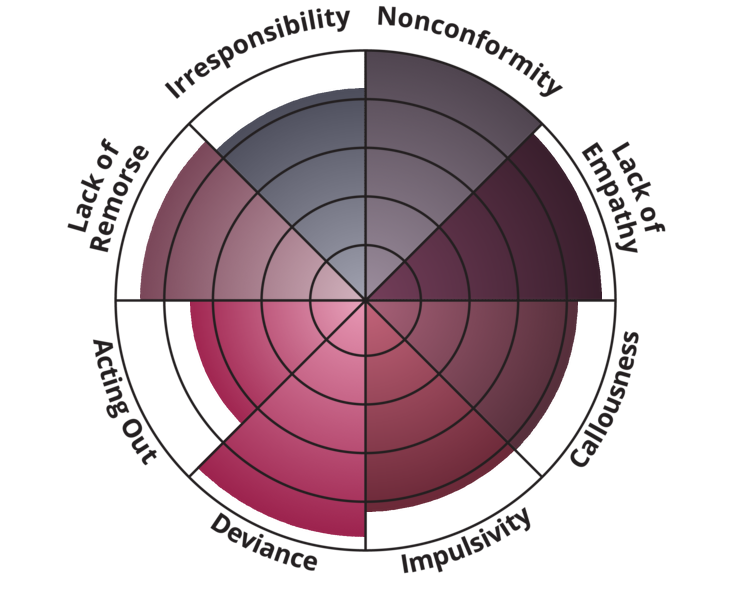
Your friend's psychopathy symptoms are very high.
Take the TestExplanation of Facets:
Nonconformity: People with psychopathic symptoms see situations and relationships in accord with their own unorthodox principles. They generally do not agree with traditional beliefs and often dislike conforming to social norms; indeed, they may even be contemptuous of conventional beliefs.
Lack of Empathy: Neurological research suggests that some individuals with psychopathic symptoms do not experience empathy when they see others suffer; in fact, some may even take pleasure in it. People who are high in this symptom don’t usually care much about others’ feelings as they tend to think only of their own happiness. Many have no genuine desire to help others.
Callousness: One indication of psychopathy is having a callous mood. This is characterized by insensitivity, irritability, aggression, and deficit in social charitableness. Individuals who are high in this trait are therefore often inconsiderate and prone to coarse incivility. They may easily offend others and have a reckless disregard for the safety of other people (and possibly even themselves).
Impulsivity: Individuals on the psychopathy spectrum may have poor behavioral controls as manifested by overly spontaneous and sensation-seeking behavior. Some such individuals may therefore evince a pattern of impulsivity accompanied by the failure to plan ahead. Consequently, such people’s lives are often characterized by lots of sudden changes in jobs, relationships, residences, and the like.
Deviance: One essential feature of psychopathy is a pervasive pattern of disregard for the rights of others. Individuals on the psychopathy spectrum may repeatedly violate rules, lie, deceive, manipulate, con, or harass others. People high in deviance are likely to pursue illegal activities and may have been in trouble with school or work authorities, as well as law enforcement.
Acting Out: Some individuals with psychopathic tendencies have trouble venting their frustration in socially accepted ways; they are therefore inclined to express their negative emotions through raw anger, aggression, or the menacing belittlement of others. Consequently, their direct discharge of aggressive emotions can often seem intimidating or threatening to others.
Lack of Remorse: Individuals with psychopathic features often have little remorse concerning the hurtful consequences of their actions. Such individuals are likely to rationalize why they have hurt or mistreated others, telling themselves that everything was really the other person’s fault or that life is just simply unfair. Alternatively, they may be completely indifferent to the suffering of others or the moral standards that usually bind people.
Irresponsibility: One symptom of psychopathy is the tendency to be consistently irresponsible. This may be indicated by the abandonment of jobs without a realistic plan for getting another job, or the shirking of duty and neglect of social commitments. Financial irresponsibility and the failure to support others may also be taken as indications of this symptom.
References
- Hare, R. D. (1991). The Hare Psychopathy Checklist—Revised. Toronto: Multi-Health Systems
- Hare, R. D. (2003). The Hare Psychopathy Checklist— Revised (2nd ed.). Toronto: Multi-Health Systems
- Hart S.D., Hare R.D., Harpur, T.J. (1992) The Psychopathy Checklist—Revised (PCL-R). In: Rosen J.C., McReynolds P. (eds) Advances in Psychological Assessment. Advances in Psychological Assessment, vol 8. Springer, Boston, MA.
- Brazil, Kristopher & Forth, Adelle. (2016). Hare Psychopathy Checklist (PCL). 10.1007/978-3-319-28099-8_1079-1.
- Forth, A. E., Kosson, D. S., & Hare, R. D. (2003). The Hare Psychopathy Checklist: Youth Version. Toronto: Multi-Health Systems.
Take Next










GET THE FULL STORY
Become a lifetime member with a one-time payment

$11.99
WHAT YOU GET
Access to members-only tests
Ability to track and save test results
Access to all of our eBooks (value $44.94)
Access to premium type assessments and infographics
Become a memberGET THE FULL STORY
Manual of Personality Styles
$6.99
WHAT YOU GET
71-page manual, explaining the make-up of all personality styles, their hidden drives, and the theory behind the system.
Presented in an easy-to-read style and backed up by solid academic references.
14-day, no-questions-asked, money-back guarantee.
Order NowSave and monitor your results over time
Become a member today
Sign Up