“No one before Plato [nor anyone] since has managed the extremely difficult art of dramatic debate on philosophic topics with such … fascinating art, aided by the union of dialectical subtlety with mystical yearnings, a subtlety which seems to give a hope to mysticism, and a warrant to transcendentalism.” – G.H. Lewes: Aristotle, Smith, Elder & Co. 1864 ed. p. 19
By Ryan Smith
This article proposes to discuss why Plato is INFJ. There are many lines of argument that one could pursue in an attempted demonstration of Plato’s type and not all of them will be covered here. More precisely, this article will focus on why Plato had dominant Ni and inferior Se, as well as why he had a preference for Ti over Te. That means that this article will lack any direct discussion of why Plato had Fe and not Fi (though such a discussion is certainly possible and will be forthcoming in a future article).
This article assumes the standard model of function orders, which means that someone with dominant Ni and a preference for Ti can only be INFJ. This means that classical Jungians who believe that a function order of Ni-Ti-Fe-Se is possible will not find that assessment refuted in this article.
With these reservations out of the way, let’s get started.
Definition: The Theory of Forms
Before we proceed, let us quickly recap the Theory of Forms. Readers already familiar with this theory can skip to the next heading.
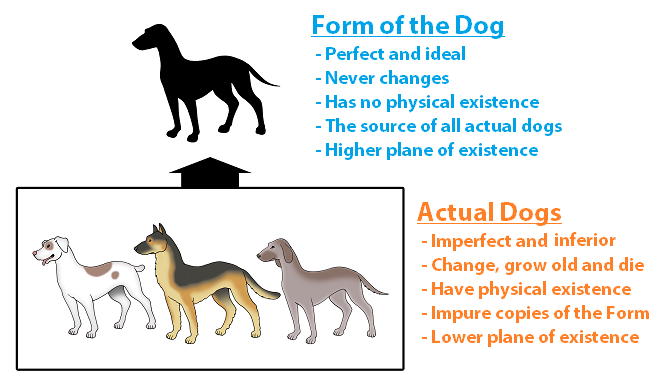
Furthermore, the Forms belong to a higher plane of existence than physical objects. As said, the ideal Form of the Dog is more real than actual, physical dogs. Likewise, even if there were no physical dogs, the Form of the Dog would still exist, as what goes on in the realm of Forms is wholly separated from the realm of matter and physical experience.
Here is Plato explaining his Theory of Forms, only here he is describing the Form of Beauty instead of the Form of the Dog:
“The culmination of beauty … [is to] catch sight of something of unbelievable beauty … which gives meaning to all previous encounters [with beauty]. … [It is] something eternal; it doesn’t come-to-be or cease-to-be, and it doesn’t increase or diminish. … It [has] no physical place … [but is] in itself and by itself, constant and eternal … and every beautiful physical object somehow partakes in it, but in such a way that their coming-to-be and ceasing-to-be don’t increase or diminish it at all, and it remains entirely unaffected. … [It is] beauty itself, in its perfect, immaculate purity – not beauty tainted by human flesh and coloring and all that mortal rubbish, but absolute beauty, divine and constant.” – Plato: Symposium §211a-e
How the Theory of Forms indicates Ni and Ti
It is not hard to see how Plato’s Theory of Forms is a mode of thinking that lends itself well to Ni dominant modes of thought. That the internal representation is more real than the actual physical object reeks of introverted perception. However, unlike Si, which is concerned with the internal representation of specific objects, Ni is chiefly concerned with the representation of generalized and abstracted classes of objects.
The resultant attitude to specific physical objects can be readily seen in your average INJ: The specific differences between one physical object and another are readily and unconsciously downplayed in the Ni psyche. Where the Si type may notice subtle and elegant differences between drinking his coffee from one mug and not another, all cups will fundamentally be the same to the Ni type, as long as they are able to fulfill their basic function of containing hot liquids that the Ni type means to consume.
Now if we wish to go further and understand why Plato’s Theory of Forms indicates not just Ni, but also Ti, we should note that where Te sees the empirical facts as undeniable and the abstract ideas as insubstantial, Ti sees the abstract idea as the crux of any matter and simply coerces or ignores the empirical facts that don’t fit the idea. (Myers & Myers: Gifts Differing, CPP Books 1993 p. 78 and here.)
Put another way, Ti is not empirically nimble. Plato’s idea that Forms exist and do not change according to what goes on in the physical world betrays a psychological yearning for beautiful ideas that can be cognized for all eternity with great fullness and certitude. But the pursuit of such a preference has the effect of shutting the actual, physical world out from one’s cognitions. That is why Nietzsche, from the point of view of Te, mocked the Ti user’s preference for pure ideas thus:
“Merely one Certainty grant me, ye Gods … let there be over the sea of uncertainty one small plank, just wide enough to lie on! Everything that exists … all that is full of life, all this you can have; just give me just one single, poor, empty certainty!” – Nietzsche: Philosophy in the Tragic Age of the Greeks §11
In other words, yes, we can pursue the beautiful eternal and unchanging ideas, but if we do, we end up describing nothing but ideas. We end up with an empty certitude about something that has no connection to the real world – as slightly comical figures that seek refuge in an empty fantasy-land because we lack the strength to stomach this world in all its noisy and ever-changing chaos.
Thus we should assume that – all other things being equal – an INTJ would at the onset sympathize with Plato’s idea of Forms but then grow increasingly discontented with it as he learned of Plato’s yearning to keep the Forms entirely distinct from the actual, physical world. Like Nietzsche, an INTJ would as a rule prefer for his ideas to have a bearing on the physical world because of his preference for Te, which is a function that prefers to organize objects by an outer standard in order to achieve results in the real world.
Even Immanuel Kant, who had only overcome his own nascent preference for empty abstractions against great inner resistance, could glance back at Plato and see that:
“Plato abandoned the world of the senses … [and ventured] upon the wings of ideas beyond it, into the void space of pure intellect. He did not reflect that he made no real progress by all his efforts; for he met with no resistance which might serve him for a support.” – Kant: Critique of Pure Reason §A5/B8-9
Plato’s Inferior Se
“About the acquirement of pure knowledge, is the body a hindrance or not? … We neither hear nor see anything accurately … and if these two physical senses are not accurate or exact, the rest are not likely to be either.” – Plato: Phaedo §65ab
Then we have the matter of why Plato had inferior Se. As Jung’s student Marie-Louise von Franz says, the inferior Se of INJs is characterized by being extremely intense and has an ‘all or nothing’ manner to it. (Von Franz, in von Franz & Hillman: Lectures on Jung’s Typology, Spring Publications 1984 p. 25 cf. pp. 34-36.)
With regards to Plato, we have some dubious testimony that he was decadently sense-indulgent when he was young (Sextus Empiricus: Against the Professors §1.258). But the overarching picture of both Plato’s life and thought is that he was extremely world-denying, and he actually speaks directly of “starving the senses” in more places than one. (Republic §514a–520a; Theaetetus §184-186)
In fact, as the scholar John D. Turner has pointed out, once we place Plato in his proper historical context among his peers, we see that he was even more world-denying than is usually thought: Up until Plato, almost everything about Greek philosophy and religion had consisted in accepting the world through the ordinary human experience of sensory corporeality. (Turner: Sethian Gnosticism and the Platonic Tradition, Les Presses De L’Universite Laval Quebec 2006 ed. p. 448 and also n2.)
Plato then comes along and flips the notion of what is real on its head: What was formerly real (concrete sensory experience) is now deemed unreal by him – as mere illusions that cloud mortal judgment. What is real to Plato, is only the incorporeal, immaterial, and unchanging Forms that exist in a realm of pure Being that stands apart from material and sensory experience of the cosmos.
Thus Plato’s denying stance towards the physical and sensible world was even more radical than is usually assumed. Once we place Plato in his proper historical context, we see that Plato’s world-denying stance had no intellectual, cultural, or social predecessor and that it can only be explained by Plato’s personal volition – something that may in turn be traced back to his psychological disposition.
Historiographical Note on Plato’s Type
At the time of this writing (2014), it appears that INFJ is the most predominant assessment of Plato’s type in the community, closely followed by INTJ.
- David Keirsey has said that Plato was an NF type in Please Understand Me II (1998).
- J.H. van der Hoop has said that Plato was an INJ in Conscious Orientation (1939).
- In The Question of Psychological Types (1916), Jung’s collaborator, Hans Schmid-Guisan, claimed that Plato was an EF type on account of Plato’s seeming preoccupation with love and beauty (and Jung did not protest).
- In Psychological Types (1921), Jung does not assess Plato’s psychological type, but he does strongly insinuate that Plato is introverted while Aristotle is extroverted.
- In a private letter dated 1953, Wolfgang Pauli cast Plato as his “trinitarian thinker type,” which corresponds to T and possibly also S.
- Furthermore, in a private letter dated 1939, Jung cryptically and unhelpfully suggests that Plato’s “world of ideas” corresponds to ST “on the mystical level.”
- In Archetype and Character (2012), W.V. Odajnyk, who is a classical Jungian, suggested that Plato was an “introverted Power type” in his addition to Jung’s typology (which you can read more about here).
- In Jung’s Compass of Psychological Types (2011), James Graham Johnston, who is also a Jungian, assessed Plato to be an Ni-Ti type (though in the classical Jungian manner of conceiving functions, Johnston believed Plato’s two uppermost functions to be Ni and Ti.)
- In Science and Sanity (1933), Alfred Korzybski, who is not a Jungian, assesses Plato to be introverted, Aristotle to be extroverted.
- In Jung’s Four and Some Philosophers (1999), Thomas M. King, going by MBTI letters and not Jungian functions, assesses Plato to be INTJ.
- In Plato at the Googleplex (2014), Rebecca Goldstein, likewise going by MBTI letters and not functions, also assesses Plato to be INTJ. (More precisely, her method is to try and fill out a Jungian Type Test ‘as if’ she were Plato.)
- In his books Personality (1977) and Consciousness (1989), C.A. Meier, who succeeded Jung as president of the C. G. Jung Institute in Zurich, assessed Plato to be an introvert, Aristotle to be an extrovert.
- In 2009, CelebrityTypes assessed Plato to be an INFJ although we did not provide any actual explanation of this assessment until now (2014).
Like with our assessment of Aristotle as ENTJ, we were not the first to suggest any of the components of Plato’s type, but we were the first to propose the whole type code of INFJ (although one could argue that if one converted James Graham Johnston’s classical Jungian assessment of Ni-Ti-Fe-Se into the standard model, that would also amount to INFJ).
At any rate, we are the first writers in the field to argue the claim that Plato was INFJ. Insofar as the claim is wrong, then, the blame belongs on our shoulders, and insofar as the assessment of Plato as INFJ will go on to win increased acceptance, the credit should go to van der Hoop, Korzybski, Meier, Odajnyk, Keirsey (possibly to Johnston) and to us.
***
Why Plato is INFJ © Ryan Smith and CelebrityTypes International 2014.
Images in the article commissioned for this publication from artist Georgios Magkakis.