
In his early work, Jung spent a great deal of energy exploring the nature of introversion and extroversion “in themselves,” i.e. as pure E and I. Ironically, though, most contemporary psychodynamic interpretations of Jung’s typology *do not* focus on E and I in this manner, but regard them as properties of the cognitive functions.
In Psychological Types, introversion is equated with a fearful attitude towards the outer world, individualism, and a propensity for seminal creativity, whereas extroversion is equated with blind adaptation, resilience, and group instinct.
However, these correlations do not carry over to function-based approaches to Jungian typology. For example, ISFJs are not thought to be more individualistic and seminally creative than ENTPs. So function-based approaches to Jungian typology would reject this cluster of original assertions by Jung, focusing instead on the arrangement and orientations of the cognitive functions.
In this essay, CelebrityTypes guest writer Michael Pierce presents a reading of Psychological Types that explores “the road not taken” with regards to Jung’s early conceptions of E and I.
By Michael Pierce
One subject that was of particular interest to Jung as he wrote Psychological Types was Nietzsche’s duality of the Apollonian and the Dionysian. In this article, I will explore the similarities and contrasts between Jung’s concepts of extroversion and introversion and Nietzsche’s concepts of the Apollonian and the Dionysian.
 Before we begin, however, let us note an interesting difference between Jung’s and Nietzsche’s conceptions of psychological functioning: To Nietzsche, psychological impulses are instinctive, thrilling, and blindly compelling. They are primitive and uncontrollable impulses, even as their functioning may be highly advanced and resourceful.
By contrast, Jung conceives of psychological impulses as more or less servile, passive, and obedient to the commands of the psyche, lending themselves to it as willing instruments.[1] To Jung, psychic impulses are of a kind that lend themselves well to tranquil contemplation.
This contrast in the perception of psychological functioning, where the INTJ conceives of psychic forces as sweeping, overwhelming, and forceful while the INFJ considers them subtle, soothing, and gentle, is one that we have also covered in the articles on The Aesthetics of INTJ versus The Aesthetics of INFJ, as well as in Another Look at INFJ.
With this initial observation out of the way, let us move on to this article’s main business of comparing Jung’s concepts of pure E and I with Nietzsche’s concepts of the Apollonian and the Dionysian.
Introversion and the Apollonian
In Psychological Types, Jung points to a passage in Nietzsche’s The Birth of Tragedy that describes the origin of the Apollonian mental state among the Greeks. According to Nietzsche, the Greeks knew and felt the terror and awfulness of existence: to be able to live at all they had to interpose the shining vision of a dream-borne Olympian world between themselves and that dread.[2] This conception is remarkably similar to Jung’s description of introversion, in which the introvert reserves a subjective view that he interposes between himself and the objective, external fact.[3]
Throughout Psychological Types, Jung imbues introversion with this character of fear and defense. The introvert, according to Jung, feels as though the outer world is always about to overtake him and that he must constantly rise to defend himself against the external environment’s attempts to encroach upon his personal existence.[4]
The introvert and the Apollonian thus share an aversion towards the real world with its uncontrollable and unpredictable workings. As a response, they fortify themselves against it by retreating into an inner world of perfect fantasies and subjective illusions.[5]
To the introvert, as well as to the Apollonian, the unpredictability and imperfection of the outer world is like a raging stormy sea that raises and drops mountainous waves, while the individual is like a sailor who sits tight in his boat and trusts in its frail frame. So, in the midst of the world, the introvert sits quietly, trusting in his differentiated, personal, and subjective viewpoint while the waves come crashing down around him.[6] If he cannot control the outer world, then at least he can control his thoughts about how it ought to be.
Because the purpose of the subjective fantasy is to fortify the introvert against the dread of outer existence, the subjective vision necessarily consists of all of the things that the introverted person would like to see in the outer world: Perfection, predictability, and neatness of an order that does not naturally exist in the world.
For this reason, Nietzsche considers sculpture the Apollonian art of choice. When a sculptor gives form to a block of marble, he shapes it in accordance with the perfect images that reside in the sculptor’s own imagination. His internal dreams of splendid bodies and superhuman beings of timeless perfection are manifested in marble, as static objects that came into being slowly and entirely on his own conditions.[7] By giving shape to a sculpture, the introvert transposes his internal idea of perfection onto the outer world.
Extroversion and the Dionysian
In Nietzsche’s duality, the Dionysian forms the opposite of the Apollonian. According to Nietzsche, the Dionysian state arises when there is a rupture in the process of internal, critical reasoning so that the notion of a personal self is dissolved into one’s surroundings. It is in this state that the individual loses himself in the outer world as a whole.[8]
Just as Jung’s extrovert is constantly tempted to relinquish his personal identity in favor of external objects, and to lose himself in them, so the Dionysian man is a member of a communal order where everything pertaining to his personal identity – everything subjective, every self-aware critical musing and distance to the outer world – vanishes in an orgy of complete self-forgetting.[9]
If the Apollonian’s art form of choice was sculpture, then the Dionysian finds his ecstasy in music and dance. Dance, in particular, where the dancer does not use form and image to create any perfect illusion, but rather gives himself unquestioningly away and turns his concrete, actual body into a work of art, signifies the Dionysian principle as well as the extroverted inclination to lose oneself in the outer world. The extrovert does not sculpt a beautiful dream, critically, slowly, and from a distance, but gives his whole body away to reality as it exists in the here and now, adapting himself to the external conditions of the music.
Unlike sculpture, music is not concerned with the static image or with how things should be, but with how they are. The dancer does not attempt to impose his commands on the orchestra as it is playing. He adapts and makes the most of the opportunity while it is there. Extroversion dances to the music while introversion stands on the sidelines, criticizing it, pointing out how it could have been better.
The Bias Against Extroversion
A controversial corollary of this early view of introversion and extroversion is that seminal creativity becomes the sole domain of introversion. This conception amounts to an early Jungian bias against extroversion in the same way that later non-Jungians have propounded a bias against sensation.
Under this mode of thought, as extroversion is content to dance to the music that already is it thus never generates anything truly new. Extroversion is innovative, yes, finding newer and better ways to express itself to the music that is already playing. But according to this early Jungian view of E and I, true invention and seminal creativity is the exclusive prerogative of introversion. Ever discontented with the external environment, the introvert continuously generates illusions and beautiful dreams about how reality should be by bringing his subjective biases to bear upon his understanding of reality.
While both Jung and von Franz bought into this bias against extroversion from time to time, van der Hoop, Myers, and Briggs did not. And while this early-Jungian bias against extroversion may still be found among some modern-day Jungians, there are nevertheless some cogent arguments against that position:
- Though modern research uses a somewhat different conception of extroversion than the one advanced by Jung, it has generally been found that while extroverts are indeed happier than introverts on average, a better predictor of happiness is a person’s degree of Neuroticism: People who are low in Neuroticism are generally happier than people who are high in Neuroticism. Statistically speaking, a person’s degree of extroversion does have some bearing on how happy he is bound to be, but Neuroticism is where the show is really at. Hence it would appear that Jung, writing as early as 1921 and breaking entirely new ground, confounded aspects of Neuroticism with aspects of Extroversion. (In the same way one could point out that where Jung had originally thought that all introverts were controlling and all extroverts were laid back, this original conception later evolved into a more flexible schema where there could be spontaneous introverts [IPs] and structured extroverts [EJs].)
- In Psychological Types, Jung himself identifies Freud and Darwin as extroverts. These assessments are hard to marry with the assertion that extroverts never invent anything truly new. (Of course at CelebrityTypes, we think that Freud and Darwin were introverts, but on the other hand we think Aristotle, Feynman, and Pauli were extroverts, so either way there would seem to be some pretty inventive extroverts out there.)
- According to the standard model of the functions (which Jung admittedly did not subscribe to) extroverts are equipped with an auxiliary introverted function while introverts are equipped with an auxiliary extroverted function. Even if one grants that extroversion lacks a facility for true invention, then, actual extroverted types can still use their auxiliary function to break new ground, just as actual introverted types can use their auxiliary function to adapt to their surroundings.
References
Jung: Psychological Types Princeton University Press 1971
Nietzsche: The Birth of Tragedy, in The Basic Writings of Nietzsche Modern Library 2000
Notes
[1] Jung: Psychological Types p. 141
[2] Nietzsche, quoted in Jung: Psychological Types p. 136
[3] Jung: Psychological Types p. 334
[4] Jung: Psychological Types p. 332, 333
[5] Nietzsche: The Birth of Tragedy p. 35
[6] Schopenhauer, quoted in Nietzsche: The Birth of Tragedy p. 35-6
[7] Nietzsche: The Birth of Tragedy p. 35, 33
[8] Nietzsche: The Birth of Tragedy p. 37
[9] Jung: Psychological Types p. 337, cf. Nietzsche: The Birth of Tragedy p. 37, 36
***
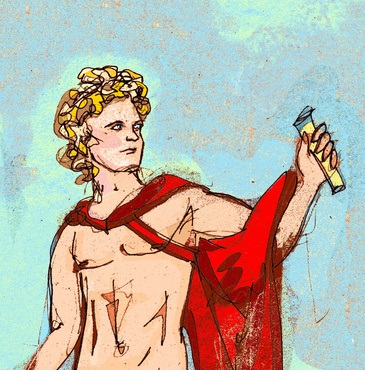
Image of Apollo in the article commissioned from artist Francesca Elettra.