
Greek Gods Test
You are here because one of your friends linked you to their Greek Gods Test result:
Take the TestResults:
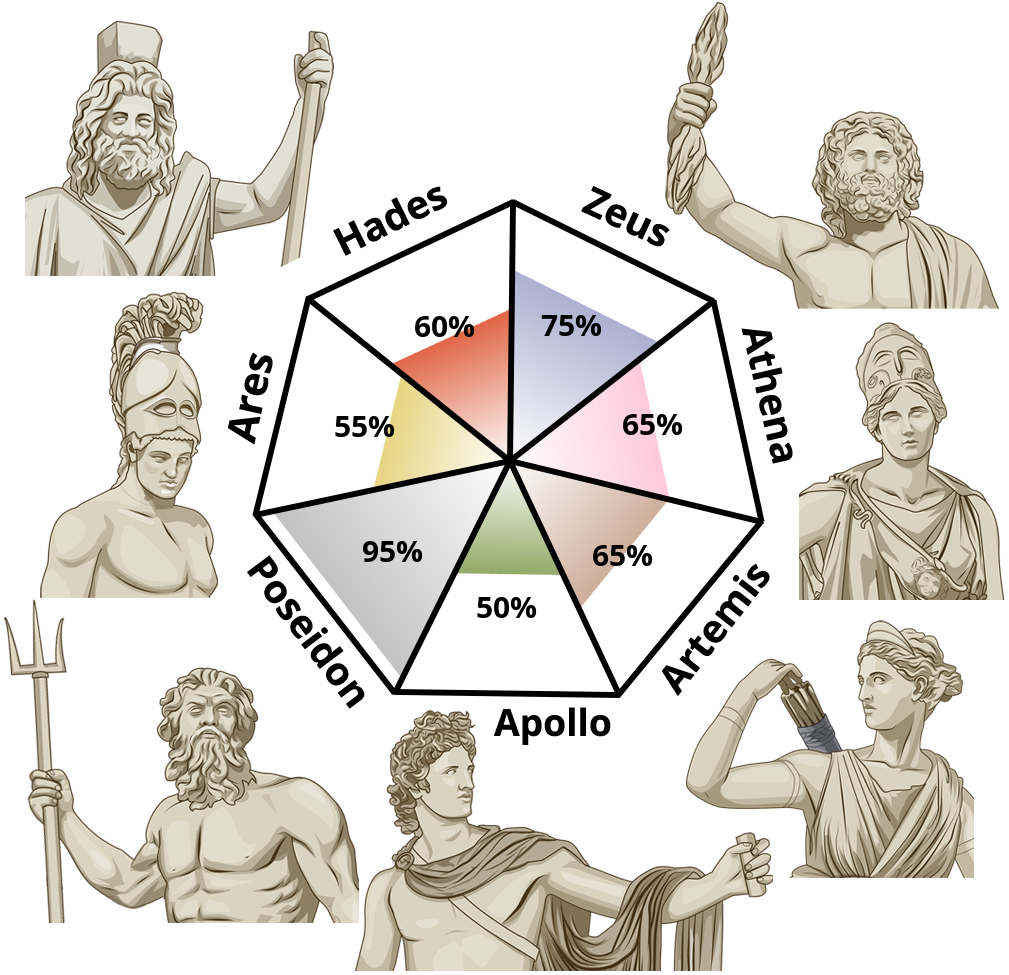
Your friend is the most like Poseidon (95%).
Take the TestPoseidon: Poseidon, one of the Twelve Olympians in Greek mythology, was the god of the sea, earthquakes, and horses. He was known for his formidable power, tempestuous nature, and impulsive actions, often depicted with a trident that he used to shake the earth, shatter rocks, and summon waves. Despite his volatile temperament, Poseidon valued loyalty and was venerated for his role in sustaining marine and equine life, maintaining a crucial balance within the world's ecosystems. His ethical stance was complex; he could be benevolent and protective, particularly towards seafarers and cities he favored, yet he was also capable of profound wrath and vengeance when dishonored or deceived. As a figure ruling over realms often characterized by their unpredictability and rawness, Poseidon personified the awe-inspiring majesty and unfathomable depths of the ocean, commanding respect but also a healthy distance. His unpredictable moods served as a metaphor for the vicissitudes of life and the untamed forces of nature.
Take Next






GET THE FULL STORY
Become a lifetime member with a one-time payment

$11.99
WHAT YOU GET
Access to members-only tests
Ability to track and save test results
Access to all of our eBooks (value $44.94)
Access to premium type assessments and infographics
Become a memberGET THE FULL STORY
Parmenides Priest of Apollo

$7.99
WHAT YOU GET
Comprehensive study of Parmenides’ fragments 2-8, offering an in-depth exploration of his metaphysical philosophy, the nature of being, the way of truth, and the way of seeming, presented in a clear style with connections to ancient and modern philosophical traditions.
Authoritative analysis grounded in canonical translations and enriched with references to scholarly works, providing a robust interpretation of Parmenides’ enigmatic poem, ideal for students, philosophers, and enthusiasts of Pre-Socratic thought.
Unique initiatory perspective framing the poem as a sacred rite aligned with Apollonian mysteries, complete with a chantable rendition of fragments 2-8, designed to evoke the oral tradition of Parmenides’ time and deepen metaphysical understanding.
14-day, no-questions-asked, money-back guarantee.
Order NowSave and monitor your results over time
Become a member today
Sign Up