
 English
  Español
  Português
  Deutsch
  Français
  Italiano
  Polski
  Română
  Українська
  Русский
  Türkçe
  العربية
  فارسی
فارسی  日本語
日本語  한국어
한국어  ไทย
ไทย  汉语
汉语  Tiếng Việt
  Filipino
  हिन्दी
  Bahasa
 Sadistic Personality Spectrum Test
You are here because one of your friends linked you to their Sadistic Personality Spectrum Test result:
Take the TestResults:
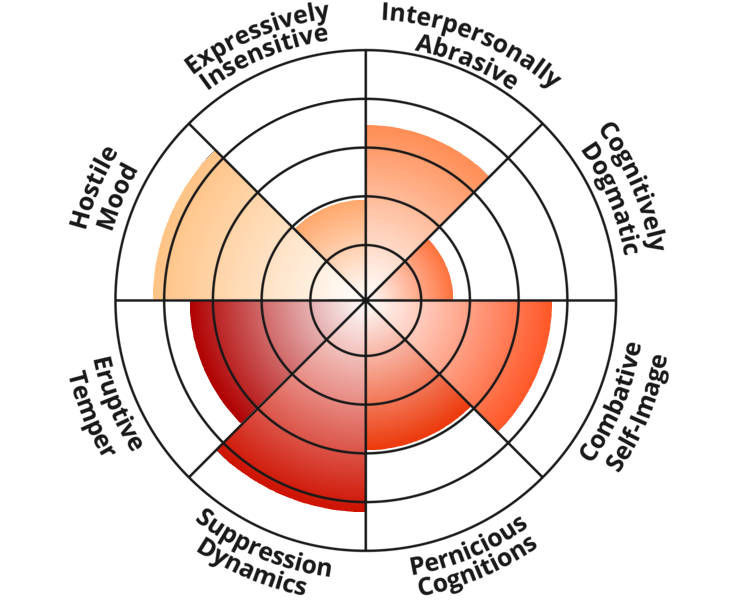
Your friend's sadistic traits are high (65%).
Take the TestExplanation of Facets:
Expressively Insensitive: People with sadistic traits are often seen by others as coarse and insensitive, inclined to pass harsh judgments on everyone around them, and unaffected by the usual standards of diplomacy and politeness or “keeping a good mood.” The condemnatory outbursts of sadists may be seen as a way to announce social dominance, thus functioning as an implicit warning not to mess with them or oppose their will.
Interpersonally Abrasive: Sadistic individuals often get satisfaction from coercing, intimidating, and/or humiliating others. They rarely feel anguish about being verbally abusive to others and may spontaneously express their derisive social commentaries and judgments. Also, sadists have often been described as manifesting vicious or brutal behaviors. Consequently, it is difficult for them to maintain friendly relationships and an amicable reputation.
Cognitively Dogmatic: People with sadistic tendencies are often seen by others as close-minded and obstinate in holding onto their preconceptions. This is perhaps scantly surprising since sadists often perceive exchanges with others as a battle of wills over who is going to have their way. As a consequence, many people with sadistic tendencies are hesitant to change their opinion or to give ground in discussions. Instead, they tend to employ authoritarian and bossy behaviors and are quick to perceive how others’ weaknesses can be used against them so that they themselves might come out ahead.
Combative Self-Image: One feature of a sadistic personality is having a combative self-image. Those who are high in this trait tend to proudly describe themselves as assertively competent and highly energetic. As a result, they are often seen as militantly hardheaded since they present themselves as domineering and power-oriented. Others often describe them as antagonistic and aggressive due to the quarrelsome or combative way in which they see themselves.
Pernicious Cognitions: One sadistic trait is the tendency to have a number of vivid, harmful thoughts and feelings involving malicious or wicked things happening to others. Similarly, many people with sadistic traits find that, when thinking back on past relationships, their interactions were mostly distinguished by malicious content and aggressive energy. By contrast, these individuals tend to have only a few memories of sentimental or tender moments with others. Hence, individuals with sadistic personalities tend to approach others with a tough and unsentimental frame of mind.
Suppression Dynamics: Sadistic people tend to be remarkably detached regarding the negative impact of their aggressive, inconsiderate, and destructive behavior. Many sadists cope with the hurt that they create around them by isolating themselves from the fact that it was really their doing. Hence, sadists with high suppression dynamics scores can go on hurting or inflicting pain on other people without feeling particularly remorseful or responsible for doing so. As a consequence, sadists are often seen by others as cold-blooded, since the sadist can apparently view the victims of their behavior factually and impersonally, as if the sadist had nothing to do with their hurt.
Eruptive Temper: Individuals with sadistic traits tend to have an explosive energy about them. They may have sudden episodes of aggressive or violent outbursts during which they throw objects, threaten others, and vent their anger in intimidating ways. With high scorers, these eruptive energies may turn into actual assaults on people or animals, violent temper tantrums, and perhaps even slapping or shoving. The eruptive architecture of sadists typically causes distress for the people around them.
Hostile Mood: People with sadistic traits tend to have a cantankerous and irritable temper. Because of their antagonistic dispositions, others often experience them as cruel, inconsiderate, and grouchy. When people who are high in this trait feel wronged, they are often willing to harm, intimidate, and mercilessly persecute others just to get what they want. Their unfriendly and unsympathetic attitude often makes the atmosphere around them tense and turns relationships sour.
References
- Millon, T. (1996). Disorders of Personality DSM-IV and Beyond. New York: Wiley-Interscience Publication.
- Millon, T., Millon, C., & Meagher, S. ( 2012). Personality Disorders in Modern Life. Seth Grossman, Rowena Ramnath. John Wiley & Sons. pp. 512–515. ISBN 978-1-118-42881-8.
- Millon, T. (2017). Personality Subtypes: Sadistic Personality Subtypes. Institute for Advanced Studies in Personology and Psychopathology.
- Millon, T. (2011). Disorders of Personality: Introducing a DSM/ICD Spectrum from Normal to Abnormal. John Wiley & Sons, Inc.
- Davis, R., Millon, T. (2000). Personality Disorders in Modern Life. Canada: John Wiley & Sons, Inc.
Take Next











GET THE FULL STORY
Become a lifetime member with a one-time payment

$11.99
WHAT YOU GET
Access to members-only tests
Ability to track and save test results
Access to all of our eBooks (value $44.94)
Access to premium type assessments and infographics
Become a memberGET THE FULL STORY
Manual of Personality Styles
$6.99
WHAT YOU GET
71-page manual, explaining the make-up of all personality styles, their hidden drives, and the theory behind the system.
Presented in an easy-to-read style and backed up by solid academic references.
14-day, no-questions-asked, money-back guarantee.
Order NowSave and monitor your results over time
Become a member today
Sign Up