
“Appellation ceases with the absence of the objects of thought: The absolute as the essence of all things is not born, nor does it cease to be.” – Nagarjuna: Fundamental Verses on the Middle Way, XVIII.7
By Ryan Smith
The Buddhist philosopher Nagarjuna (ca. 150-250 CE) is commonly held to be the most important philosopher in Buddhism and is called the “second Buddha” by some. Nagarjuna’s principal philosophical work is called the Fundamental Verses on the Middle Way (or the Mulamadhyamakakarika). It is one long dialectical criticism on the follies of holding positions, be they empirical or philosophical.
 The closest Western analogy to Nagarjuna’s philosophy is Immanuel Kant’s critique of reason. Like Kant, Nagarjuna is out to show how our normal empirical consciousness is inadequate when it comes to apprehending the true nature of the world. Also like Kant, Nagarjuna is not just out to discredit empirical consciousness as a means of knowledge of the absolute, but seeks to show the inherently antinomical character of reason as well.
As David Hume would discover some 1650 years after Nagarjuna, almost any position that can be inferred through reason will inevitably be accompanied by the thought of a counterposition, even if we do not place any credence in the counterposition.[1] For example, if you think “the weather is hot today,” there must be some counterthought of cold weather present somewhere in your mind or the statement would be nonsensical. In the same way, if you think it is early in the day, there must be some counterthought of it being late to make sense of the position.
Not just empirical claims, but philosophical and metaphysical positions as well, tend to be accompanied by positions that affirm their opposite. One position affirms that there is life after death, another denies it. One position affirms that man has free will, another denies it. One position affirms that all is matter, another affirms that all is consciousness, and so on and so on. Despite some 3000 years of discussion, these issues are still unresolved and belong to the domain of metaphysics where one claim is as good as another.
To Nagarjuna, the ubiquitous opposition between claims, be they empirical or philosophical, is proof of their hollowness. Because all claims are antinomical in nature, they depend upon each other and are thus only relatively true. Like Hume and Kant, Nagarjuna’s analysis is a critique of the underlying psychological apparatus that leads us not just to form claims and positions, but to believe that they are absolutely true. According to Nagarjuna, every conceivable claim falls short when applied to the absolute. His dialectic therefore aims to expose the false nature of claims in order to leave only a supreme intuitive apprehension of the world that is entirely beyond claims and positions.
The central device of Nagarjuna’s dialectic is the four-fold negation of propositions or the tetralemma. The tetralemma holds that (a) all claims are antinomical in nature and therefore require two or more parts and (b) that for any relation between two parts, there are four modes of conceiving their association. They can be (1) the same (2) different (3) both the same and different (4) neither the same nor different.
To illustrate the predicament of the tetralemma, Nagarjuna applies his dialectic to a series of propositions in order to show how all of the claims that can be asserted between two parts are inadequate to make sense of the whole. Take, for instance, the example of boiling water. What is the relation between water and hotness?
- If water and hotness are the same: Then why will the water cool off? Why is there cold water elsewhere? Why do we need to speak of hot water if water and hotness are always the same? They must be different.
- If water and hotness are different: Then why can’t you interact with the water without interacting with the hotness? E.g. why can’t you stick your finger in the ‘water’ part of the boiling water without also sticking your finger into the ‘boiling’ part? They must be the same.
- If water and hotness are both the same and different: Then the combination is subject to both of the reservations listed above. Furthermore, we have introduced a contradiction. How can two entities be both “the same” and “different” at the same time? Their true relation must be other than “both-and.”
- If water and hotness are neither the same nor different: Then how can consciousness know “boiling water” as a phenomenon? Their true relation must be other than “neither-nor.”
Thus, if the premise is granted that there is no fifth mode of conceptualizing the relation between water and hotness, Nagarjuna will posit that his fourfold dialectic has shown that none of the modes in which empirical consciousness can conceptualize the relation between two parts can sufficiently describe the true nature of the whole. The real mode of perceiving is by a non-dual supra-mundane intuition that does not conceptualize or cut the absolute into neat empirical slices where it thinks it can isolate “hot” from “cold,” “wet” from “dry” and so on.[2]
The two concepts that are fundamental to Nagarjuna’s analysis of positions are emptiness and dependent arising. By emptiness, Nagarjuna refers to the fact that every phenomenon and philosophical position, when examined, will be found to be devoid of inherent characteristics. You may say that water is wet, for example. But as we have seen, the concept of wetness depends on the opposing concept of dryness. In the same vein, you may refer to an object, such as a cup, that exists as a delineated object in opposition to its surroundings which are defined as “not-the-cup.” But in doing so, the analysis relies on the opposition between cup and non-cup in order to make sense of its position. We cannot think of the cup in isolation; there is always some reference to something “outside” the cup. According to Nagarjuna, this ubiquitous reference from object to something beyond the object that is not itself the object showcases that the cup is empty of characteristics that can be applied exclusively to the cup. This allusion simultaneously illustrates the principle of dependent arising: When viewed from the standpoint of the absolute, reality is really an undivided whole in which everything refers to everything else.
The purpose of Nagarjuna’s dialectic, however, is not to establish some ultimate position that is characterized by the twin principles of emptiness or dependent arising (or anything else for that matter). His dialectic is almost entirely refutative, its purpose being to lay bare the inadequacies of every conceivable position. To that end, Nagarjuna even takes care to nullify his own position by asserting that emptiness itself is empty and dependently arisen, just as dependent arising is itself dependently arisen and empty.[3] The resulting state is a condition of supra-mundane intuition that clings neither to empirical, nor rational, nor philosophical, nor metaphysical baggage of any kind, leaving the subject entirely free to apprehend reality without dualisms and concepts. It is a content-less position that by its own understanding is not even a position.
Though Nagarjuna has been known in the West for some 150 years (if not more so), and though some Indian scholars have tried to instruct us in the proper understanding of Nagarjuna’s dialectic, some grave misunderstandings still prevail in the Western understanding of Nagarjuna’s work. So before we proceed with the article, let’s just take some time to clear up a few of the slips.
Popular Misunderstandings of Nagarjuna #1: Is Nagarjuna a Nihilist?
Since Nagarjuna seems to be saying that there are no objects, no principles, and no positions that are true in the ultimate sense of the word, several scholars have labelled him a nihilist. To take but one example, let us look at the standard textbook, Buddhist Thought, as published by the prestigious publishing house Routledge. Here the authors say:
“[The] literature [in the tradition of Nagarjuna] constantly asks what is referred to by the term x, what dharma this is, with the response that nothing can be found, nothing can be grasped … Nothing must be grasped. All things are empty. On the level of what is an ultimate, primary existent there is nothing, for there are simply no ultimate primary existents. On such a level therefore there is an endless absence, an endless emptiness. … It certainly looks like nihilism …” – Williams, Tribe & Wynne: Buddhist Thought (Routledge 2011 ed.) p. 110
The authors commit multiple mistakes here:
- First, there is the identification of emptiness with literal or physical emptiness. As we have seen, the point of emptiness in Nagarjuna’s philosophy is not to assert that reality is literally empty, but to make clear to the initiate that objects and concepts are empty of abiding characteristics. In this way, the cup itself is not emptiness, as the authors would seem to imply; it is a non-definable part of an undifferentiated whole that has been erroneously singled out as “cup” by the empirical mind. In reality, whatever occurrence we refer to as “cup” is still there; it simply has no self-existence as a cup and it should not be conceptualized as such. According to Nagarjuna, no objects, concepts, or phenomena should be singled out or differentiated from the sum-total of ultimate reality.[4] But this injunction does not entail the claim that ultimate reality is therefore nought.
- Next, the authors say that according to Nagarjuna and his followers, “nothing must be grasped.” Their phrasing implies that Nagarjuna is an ontological nihilist who thinks that anything out there which can seemingly be apprehended is pure illusion. But as we have seen, the real intention behind Nagarjuna’s instruction that nothing must be grasped is that nothing must be grasped as individual objects. As I mentioned above, the totality of the real can still be grasped through supra-mundane intuition without this intuition conceptualizing the real. When this mode of perception takes place, everything is really perceived, but without the false dualisms and concepts that the mind normally imposes on the real. The authors seem to confuse the idea of grasping (which refers to an active mental state of the conceptualizing mind) with the idea of supra-mundane perception (which refers to a passive mental apprehension devoid of dualisms but which perceives the real).[5] So while it is true that nothing must be actively grasped by the conceptualizing mind, that injunction does not entail that one must withdraw from phenomena or deny the reality of the real.
- Thirdly, the authors state that on the ultimate level “there is nothing, for there are simply no ultimate primary existents.” As we saw above, it is true that there are no conceptual ultimate existents in Nagarjuna’s philosophy. He deploys the tools of emptiness and dependent arising to expose the relative and contradictory nature of concepts, phenomena, and positions. But once the analysis is done, Nagarjuna deploys the dialectic against the tools themselves, showing how emptiness and dependent arising are also relative and contradictory and only relatively true. Therefore Nagarjuna also says that a person who attaches to emptiness, reifies emptiness, or conceives of emptiness as something literally empty is really worse than someone who hadn’t understood anything about his philosophy at all (a point for the authors of Buddhist Thought to consider, perhaps).[6] It is true, as the authors say, that on the ultimate level there are no primary existents, concepts, or principles. However, it is desperately wrong to say that on the ultimate level there is only “an endless absence, an endless emptiness.” The interpretation advanced by the authors is the result of confusing the tool of emptiness with the job that the tool was meant to do (to allow the subject an unhindered and non-conceptual intuitive apprehension of the real).[7]
Besides the causes that I have outlined above, one reason that scholars often mistake Nagarjuna’s teachings for nihilism is because most scholars have no first-hand experience of the mental state that is the zenith of Nagarjuna’s teaching. Having never experienced the supra-mundane intuitive apprehension of the real, they are left with the ordinary empirical or philosophical consciousness which is precisely the thing that Nagarjuna deems to be inadequate for apprehending ultimate truth. From that position, then, it is true that Nagarjuna is a nihilist, but that is only so because the scholars who call him a nihilist are ignorant of the non-dualistic mode of consciousness that Nagarjuna posits as the end goal of his dialectic.
To illustrate, let us say that all people are born wearing a pair of blue-tilted glasses that are almost impossible to remove. Having never known any other mode of perception than through the blue-tilted glasses, most people are ignorant of the fact that they are even wearing blue-tilted glasses at all. Living a life where everything is seen through blue-tilted glasses, and talking mostly to people who are also seeing the world through blue-tilted glasses, these people ultimately conclude that there is no other mode of perception besides through blue-tilted glasses. Then along comes a person who has miraculously managed to remove those blue glasses. Formulating a philosophy based on his new vision, he tries to tell his fellow man that everything that is perceived through blue-tilted glasses is only relatively real. “To see things are they ultimately are, you need to remove your blue-tilted glasses, too,” he tells his fellow men.
But his fellow men have never been close to removing their glasses and hence they cannot fathom that there is a mode of perception that is not conditioned by the blue tint. They therefore conclude that since this person is saying that everything that is perceived through blue glasses is illusory, and since perception through blue glasses is the only possible mode of perception, this person must then be a nihilist.
Of course it is debatable whether the supra-mundane state of intuitive apprehension that Nagarjuna identifies as the mode of perception conducive to the perception of ultimate truth exists. E.g. maybe Nagarjuna was just delusional, like someone on drugs who thinks he’s seen the meaning of life. But whether or not one agrees with Nagarjuna regarding the possibility of such a mode of perception, it is evident that Nagarjuna did not see himself as a nihilist and did not mean to teach a nihilistic doctrine. It is by denying that the supra-mundane mode of perception championed by Nagarjuna is possible, and then superimposing that denial on Nagarjuna’s philosophy, that Western scholars can arrive at the conclusion that Nagarjuna is a nihilist. In doing so they are not so much elucidating Nagarjuna’s philosophy to the public as they are conducting their own polemic against it.
Popular Misunderstandings of Nagarjuna #2: Nagarjuna’s 4th Mode of Conception Is Superfluous
That Nagarjuna isn’t a nihilist is furthermore made clear by the inclusion of the fourth stage of his dialectic, which we will now examine. Western scholars have often wondered at the inclusion of the fourth mode of perception in Nagarjuna’s tetralemma: Nagarjuna said that the relation between two parts is (1) not the same (2) not different (3) nor both (4) nor neither. Why is the fourth option included in this chain of refutations? If we have already said that the relation between two parts is not the same, not different, and not both, why is the fourth denial necessary? Isn’t it just re-asserting what has already been said?
One Western scholar who has remarked on the seemingly puzzling inclusion of the fourth denial in Nagarjuna’s dialectic is Jan Westerhoff. In his Nagarjuna’s Madhyamaka, published by Oxford University Press, he says:
“It is fairly common in the Western commentarial literature to express the tetralemma in prepositional form … It is easy to see, however, that on this understanding the final two alternatives come out as logically equivalent. Given the prominent place which the tetralemma occupies in Madhyamaka literature, we would have to charge both Nagarjuna and later Madhyamaka authors with remarkable logical naivety for not realizing that instead of considering four possibilities they were in fact dealing with only three.” – Westerhoff: Nagarjuna’s Madhyamaka (Oxford University Press 2009) p. 75
Westerhoff proposes a solution to the inclusion of the fourth denial in the tetralemma which is perhaps closer to Nagarjuna’s meaning than the multitude of traditional Western solutions, but which is also somewhat bewildering: He proposes the fourth option (“nor neither”) to mean: I do not assert that that I do not assert (A or not-A) (p. 79).
So on Westerhoff’s reading, Nagarjuna seems to be saying that he reserves the right to assert that the truth lies somewhere within the first three modes of conception after all. On Westerhoff’s understanding, this would be like saying that the truth is still somewhere within the empirical mode of conception, it just refuses to be pinned down and conform to any one neat option. As I said, this reading is probably closer to Nagarjuna’s meaning than many traditionally Western attempts to elucidate it. But if we refer to the Indian source material itself, it still seems somewhat off. According to Westerhoff, Nagarjuna seems to be saying that the truth is somewhere within the blue-tilted mode of perception, but that it just doesn’t conform to any of the categories that exist within that mode of apprehension. However, Nagarjuna himself says, the supra-mundane mode of apprehension that he champions is entirely beyond our ordinary empirical and conceptual mode of perception.[8] So Nagarjuna’s own elucidation of his philosophy seems incompatible with Westerhoff’s interpretation.
To understand why the fourth stage of the dialectic is necessary, let us see what Nagarjuna himself says about the inclusion of the fourth negation of the tetralemma: Here Nagarjuna rhetorically asks:
“If [a thing] is neither existent nor non-existent, then how could you know it?”[9]
So if a thing was neither existent nor non-existent, it would be entirely incomprehensible. In the same way, if the true relation between two parts was neither the same nor different, you could never know the real, not even through the mode of supra-mundane perception that Nagarjuna advocates as the end goal of his dialectic. E.g. if the true relation between hotness and water was “neither the same nor different,” then, applying this same logic to the remainder of the real, there would be nothing “real” to apprehend and Nagarjuna would truly be a nihilist.[10]
As I have already hinted above, by the inclusion of the fourth refutation in his dialectic, Nagarjuna himself shows us that he is not an ontological nihilist. Nagarjuna is perhaps a nihilist with regards to concepts, philosophies, metaphysics, and empirical phenomena – he does not believe that any of the entities that present themselves to us through the lens of the blue-tinted glasses are any more than relatively true.[11] But again, that does not make him an ontological nihilist unless you sever him from the very mode of consciousness that his dialectic is trying to assert.[12]
The Three Phases of Buddhist Philosophy and Their Relation to Jungian Typology
Finally, we end by calling attention to Nagarjuna’s place in the history of Buddhist philosophy and by relating the three periods of Buddhist philosophy to Jung’s typology. Most Westerners tend to think that Buddhism is just one system, but as asserted by the renowned Indologist F. Th. Stcherbatsky, there has probably never been a religion that has turned itself more on its head in the process of its development than Buddhism.[13] Buddhism is thus not one philosophy, but a network of philosophies that find between them almost all of the basic philosophical orientations repeated in Buddhist form.[14] Here are the three phases that constitute the main nodes in the network:
- In the first phase of Buddhist philosophy (ca. 500 BCE – 200 CE), the apprehension of the absolute rests upon conceptualizing the real as mode, rather than as substance. In this mode, the absolute resembles that of Heraclitus and David Hume. The falsehood that man imposes upon the real is the feigned unity and continuity that our consciousness imposes upon the real which is really a radical plurality.[15] By this view of the absolute, the real is constantly in flux and no objects or people are really the same from one moment to the next. Both the Buddha and Heraclitus, in their various ways, give the example of likening everything in the cosmos to a fire, as even the flames of a mundane fire present us with a radical plurality of modes which we erroneously reduce to the continuous conception of ‘fire.'[16] Within the framework of Jungian typology we would say that this mode of apprehending the absolute corresponds to Ne with its intrinsic need for deciphering the untapped potential of outer objects as well as going beyond the immediate in the objects (but not the concepts) that are presented to us. (We say this, however, without asserting that Buddha’s or Heraclitus’ personal types were therefore Ne.) With regards to the classical metaphysical questions, such as whether there is life after death, whether the universe had a beginning and so on, the Buddha, like David Hume, left these questions unanswered as he considered that no certain answers were attainable. In the style of Ne this group of thinkers posited that when the answer was not given anywhere in observation or experience, then all imagined possibilities were equally cogent.
- In the second phase of Buddhist philosophy (ca. 200 CE – 700 CE), the ontology undergoes a change from the radical plurality of Buddhism’s first phase to a radical monism. Rather than the Buddha’s original goal of personal enlightenment, the soteriological goal of second-phase Buddhism becomes the universal salvation of man, the animals, and all sentient beings. While first-phase Buddhism had thus corresponded to Ne, second-phase Buddhism corresponds more closely to Ti. The ideal of universal salvation, achieved through personal deliberation, might here be interpreted as an instance of Ti grasping for its own inferior Fe. Epistemologically, Nagarjuna is the most important philosopher of second-phase Buddhism, and here his affinity with Kant becomes clear: Both are concerned with the legitimate criteria for establishing true knowledge, independently of the observer’s mode of perception, his likes and dislikes, and other personal biases that might cloud the apprehension of the pure knowledge. This preoccupation we should take to be symptomatic of the Ti mode of consciousness. Where the Buddha and the first phase of Buddhist philosophy had left the grand metaphysical questions open because they considered all of the possible answers equally cogent, the second phase of Buddhist philosophy analyses the propositions concerning the questions in order to show by exposition that knowledge of these questions will never be possible.[17] Thus both Kant and Nagarjuna end up in a position where they restrain unsubstantiated speculation and guard against the assertion of absolute knowledge on a false basis. In the second phase of Buddhist philosophy, true reality is assumed to stand detached from the individual himself, attesting again to Ti with inferior Fe. It stands to Nagarjuna’s credit that he recognizes the opposition between the observer and the observed as yet another dualism to a greater degree than Kant.
- The third phase of Buddhist philosophy (ca. 700 CE – 1100 CE) postulates subjectivity or consciousness to be the primary component of the real. The idealist phase of Buddhist philosophy agrees with the second-phase Buddhists (including Nagarjuna) that there are no discernible entities that can be meaningfully applied to the description of the real. But unlike the Buddhists of the second phase, the third phase of Buddhist philosophy maintains that consciousness itself is real, even if everything that is perceived by that consciousness is illusory or unreal. The third phase of Buddhist philosophy might therefore be called solipsistic and loosely compared to the philosophy of Berkeley in the West.[18] As such, the third phase is far more speculative and metaphysical than either of the preceding phases. Everything is postulated to be unreal, except for the personal consciousness. Thus, even to say that there is an indescribable absolute “outside” of consciousness that is real (in the way Kant and Nagarjuna had done) becomes a delusion in the third phase of Buddhism – the notion of a thing-in-itself being merely the most primal of a long range of subjective projections.[19] At this point it will perhaps not be surprising to the reader if I say that this third phase of Buddhism, with its emphasis on the mind’s own perceptions at the expense of external reality, corresponds to Ni.[20] What is more surprising is that one can trace the same pattern of philosophical development in European thought from Hume (Ne) to Kant (Ti) and then to Hegel (Ni).[21] (Though again the Europeans were lagging behind by some 1100 years.) The basic conflict between Ti and Ni where Ti asks: “What are your objective and impersonal criteria for asserting that claim?” and Ni answers: “I have found it to be true by introspection,” stood at the heart of the schism between the second and the third phase of Buddhist philosophy. And true to form, the second-phase Buddhists hit back, claiming that the third-phase Buddhists exhibited a form of special pleading: They relied on Nagarjuna’s analysis to show that nothing external can meaningfully be perceived as a discrete entity, but then turned around and held human consciousness exempt from this very same analysis. As with Hegel, Plato, and Jung, the conclusion was assumed as necessary prior to the analysis and for that reason alone, the two parties were never going to reach agreement. From the Ti point of view, the third phase of Buddhist philosophy is therefore bound to seem opportunistic and intellectually dishonest, but to its credit, it was remarkably rich in intellectual creativity and its leading thinkers thought far more freely than did the successors of Nagarjuna, whose intellectual freedom had been fettered to his mercilessly comprehensive dialectic.[22]
Such are the three main phases of Buddhist philosophy. Philosophically, we call them the realistic phase (Ne), the critical phase (Ti) and the idealistic phase (Ni).[23] It is important to stress that these names are philosophical, not colloquial names (certainly, in the colloquial sense of the words, Se is more realistic than Ne, just as Fi is more idealistic than Ni).
NOTES
[1] Hume: Enquiry Concerning Human Understanding 4.2
cf. Nagarjuna: Fundamental Verses on the Middle Way XXI.2
[2] Nagarjuna: Fundamental Verses on the Middle Way XVIII.5
[3] Nagarjuna: Fundamental Verses on the Middle Way XIII.7
[4] Nagarjuna: Fundamental Verses on the Middle Way XXII.3
[5] Nagarjuna: Fundamental Verses on the Middle Way XXVI.7
[6] Nagarjuna: Fundamental Verses on the Middle Way XIII.8
[7] Nagarjuna: Fundamental Verses on the Middle Way XXII.11
[8] Nagarjuna: Fundamental Verses on the Middle Way XXV.22-24
[9] Nagarjuna: Fundamental Verses on the Middle Way XXV.16
[10] The mode of perception where the real, which ultimately cannot be differentiated, is nevertheless perceived as boiling water is of course erroneous. Nagarjuna’s point here is that if there weren’t something out there that was real, then you wouldn’t perceive anything at all, not even erroneously.
[11] Nagarjuna: Fundamental Verses on the Middle Way XXII.12
[12] A further indication that Nagarjuna is not a nihilist can be seen when we enquire as to why Nagarjuna called his system the ‘Middle Way.’ Every Buddhist system has called itself the middle way, harking back to the Buddha’s original words (Murti: The Central Philosophy of Buddhism [Munshiram Monoharlal 2013] p. 7). However, the Buddha used these words mundanely, with reference to the balance that he struck between living in opulence as a prince in a palace and living in asceticism, starving himself and sleeping on the ground. But according to Nagarjuna, the middle way is to be understood as the non-conceptual middle between “is” and “is not” – between a world of eternally unchanging entities and the complete rejection or denial of the real, a nihilism. (Nagarjuna: Fundamental Verses on the Middle Way XXI.14) Hence nihilism is one of the ontological assertions explicitly rejected by Nagarjuna.
[13] Stcherbatsky: The Conception of Buddhist Nirvana (Motilal Banarsidass 2003) p. 42
[14] Murti: The Central Philosophy of Buddhism (Munshiram Monoharlal 2013) p. 15n1
[15] Hume: Treatise on Human Nature I.III.IV
[16] Heraclitus: Fragment DK B30
[17] Katsura, in Silk (ed.): Wisdom, Compassion, and the Search for Understanding (University of Hawaii Press 2000) p. 206
[18] Albeit this analogy to Berkeley should not be overstated. For example, Berkeley thought that he could delineate consciousness and ascribe an ontological status to what is outside of it, whereas the third phase of Buddhist philosophy envelops everything, internal and external, everything but the bedrock of consciousness itself, in the womb of the one thing that is real, namely consciousness itself. Likewise, Berkeley, being a Christian, posited the idea that the spirit, which leads man to god, is cognized differently than mere ideas. Conversely, the third phase of Buddhism would maintain that everything that is contained within the womb of consciousness is but an equally subjective idea.
[19] Chatterjee: The Yogacara Idealism (Motilal Banarsidass 1999) p. 12
[20] Jung: Psychological Types §656-657
[21] Jung, too, seemed to subscribe to such an essentially idealistic-solipsistic view early on, concluding that we can never know anything about external reality, except for what our own psychic life tells us about reality. In his mature thought, this youthful commitment to idealism carries over into the justification for how all of the eight functions can be equally valid modes of cognition. (Nagy: Philosophical Issues in the Psychology of C. G. Jung [State University of New York Press 1991] p. 32)
[22] Stcherbatsky: Buddhist Logic vol. I (Motilal Banarsidass 1993) p. 14
[23] Chatterjee: The Yogacara Idealism (Motilal Banarsidass 1999) p. 2
***
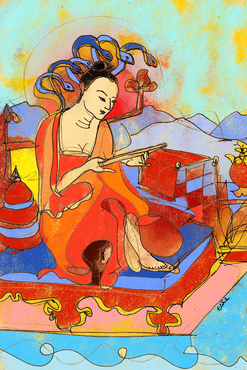
Image of Nagarjuna in the article commissioned from artist Francesca Elettra.