
“Gradually it has become clear to me what every great philosophy so far has been … the confession of its author and a kind of involuntary and unconscious memoir…” – Nietzsche: Beyond Good and Evil §6
By Jesse Gerroir
The inferior function remains, even when integrated, largely unconscious. We never become fully aware of its impact on us – we can recognize it intellectually, yes, but we don’t seem to realize it when we are in its grip. It is only after the episode that we are able to take stock of what has happened. However, when the inferior function is integrated more into the psyche, its influence becomes less pernicious, and while it is still unconscious, it flows more conductively into our other three conscious functions where the inferior function can help direct the other three functions and the other three functions can help unblock the inferior function.
 A wholesome integration of the inferior function into the overall structure of the psyche is essentially how we can avoid burnout. We all have things that we are fond of doing and that we are good at and we often make careers out of them. But after a while, even though we are still good at doing these things, we begin to feel the sore of burnout and begin to lack the motivation for what we do. Our ability and skills are still there; we just feel blocked.
Conversely, this is also why we don’t realize the contribution of the inferior function to the totality of psychic life when we aren’t feeling blocked. We don’t realize that we’re using our inferior function because it resides in the unconscious, so to us it feels like we’re simply using our dominant and secondary functions exceptionally well. But in fact, the reason that things flow so smoothly is because the inferior function has been allowed its due. Because the inferior function is not shut out from our psychic life, we notice that raw motivation and energy seems to flow into everything we do, but we do not know exactly where it came from. That is because it comes out of the unconscious where it bolsters the other three functions and allows them to function at their full potential.
Jungian Typology as a System of Opposites
Jungian psychology is a system of opposites at heart. Its basic premise is that life is a dynamic flow of these opposites, that is, the continual tension and release formed by these opposites coming together and drifting apart, and even at times warring with each other. It is by from those interactions that psychic energy and will to live arise. If we weren’t the subject of such dynamics, if we were not comprised of opposites, we’d almost be automatons for whom growth and development were impossible. We’d simply live a certain way, and continue to live in that way, no matter what happened, regardless of success or failures.
In the case of the INTJ, the most prevalent opposites are the dominant function of Ni and the inferior function of Se. The most intellectually clear example I can give of this dynamic is the opposition between the Apollonian and the Dionysian, as described by Nietzsche in The Birth of Tragedy and expanded on by Jung in chapter 3 of Psychological Types. In The Birth of Tragedy, Nietzscheis basically discovering his inferior function, going: “Hey guys! It’s kind of wacky but there is power and delight in it!”
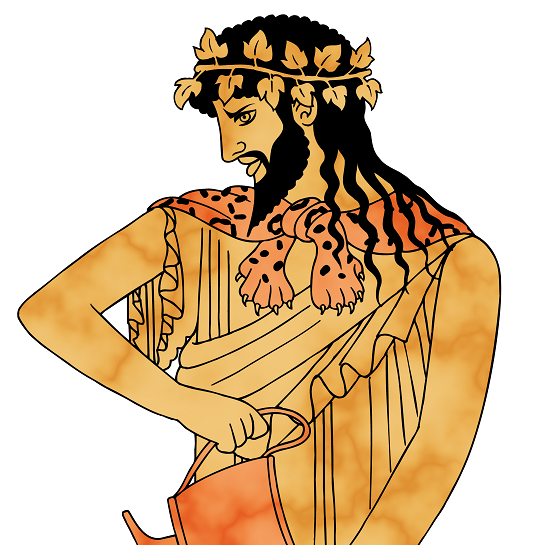
The Birth of Tragedy deals a lot with Nietzsche’s analysis of Greek tragedy. Nietzsche starts by postulating an opposition between Apollo, god of reason, and Dionysius, god of wine. The ancient Greeks did not perceive Apollo and Dionysius as rivals, but Nietzsche appropriates them for his own use and postulates them as opposites nevertheless. Jung then added his commentary to Nietzsche’s commentary as follows:
|
Apollo |
Dionysius |
|
|
Qualities ascribed by the Greeks |
Sun, dreams, reason, future |
Wine, intoxication, ecstasy, madness |
|
Qualities ascribed by Nietzsche |
Creativity, logical thinking, individuality, measurement, restraint, strong sense of self |
Chaos, emotions, instinct, frenzy, |
|
Qualities ascribed by Jung |
Dominant Ni with T |
Inferior Se with F |
According to Nietzsche, both the Apollonian and the Dionysian are necessary for the creation of a work of art. Without the Apollonian, the Dionysian lacks the form and structure to produce anything coherent, and without the Dionysian, the Apollonian lacks the vitality and passion to make it genuine. Although the two forces are diametrically opposed, they are at the same time intimately intertwined.
Nietzsche suggests that the people of ancient Greece were unusually sensitive to the maladies of the world and that they refined the Apollonian aspect of their culture to ward off suffering. By Nietzsche’s reading, the primal unity of the Dionysian – the sense of the breaking down of boundaries between self and non-self – brings us directly into contact with the suffering that lies at the heart of existence. By contrast, the Apollonian advances its essence by ideal images and dreams of the future, in other words by mental machinations rather than the apprehension of immediate reality.
As Nietzsche’s analysis progresses, he begins to see not just the tension between these two forces, but also the hidden interplay that goes on between them. In Nietzsche’s view, the opposition between the Apollonian and the Dionysian is fundamental in the creation of tragedy. But once he has established that he begins to talk as much about his own psychology as he talks about the historical circumstances of ancient Greece.
Nietzsche begins to read his own psychology into what he has found and starts to recognize the conflict between these two opposing forces in himself. He begins to see that the Dionysian element of existence can be life-affirming.
INTJ and the Necessity of the Dionysian
Prior to discovering the Dionysian in himself, Nietzsche had appraised life dualistically, seeing pain and suffering as detractors while seeing pleasure and joy as the positive qualifiers of life. But what he learned from Dionysus was that the strong man constantly seeks to affirm life, whether he is met with pleasure or pain, suffering or joy. The revelry with which he meets the good and the defiance with which he meets the bad are just two sides of the same coin – it is the reference that Dionysus has for life itself that is the template for a healthy psychological outlook.
In this manner Nietzsche begins to see positive aspects of both the Apollonian and the Dionysian forces. He begins to recognize that the source of tragedy is not when one element is unable to overcome its opposite, but when that element is unable to overcome itself to embrace the other.
In this manner Nietzsche comes to revere his inferior function. He even becomes entranced by it, which is showcased in his conclusions about the dynamic interplay between the Apollonian and the Dionysian: The reflecting mind, which instills in us a self-critical distance and separates us from the immediate reality of our instincts and emotions, has its origin in the Apollonian ideal.
Where the Apollonian ideal separates us from our surroundings, the Dionysian impulse causes us to embrace the pervasive chaos of immediate reality. The Dionysian magnifies the self, but if it is not merged with the Apollonian, all it creates is a series of ecstatic orgies with nothing of lasting value left behind. The Dionysian must be integrated into the Apollonian to leave something of lasting value, and the Apollonian must be integrated with the Dionysian to imbue it with intensity and application.
It is by this analysis that Nietzsche begins to see that the Dionysian is necessary for a vital life. Yes, the Apollonian forms ideals and thoughts and is capable of good judgments and great refined thinking. But it also separates man from his essential self; it falsifies the INTJ type, making it try to live the life of an INTP.
Contrary to the INTP, who has neither Se or Fi, it occurs to Nietzsche that the Dionysian might be a being of great passion and emotion, a being who exists in strength in the midst of a sensual chaos. There is great energy and vitality to be found in such a life. Indeed, rather than standing on the sidelines grumbling about how life is flawed, the Dionysian shows the way to the life-affirming stance that can only be achieved by integrating Se and Fi into the totality of psychic life.
It is like Nietzsche, who has been a prodigious master student up to this point in his life, is saying: “Yes, it seems chaotic, yes, even pointless at times. Yes, it is overly passionate and it may be utterly unrefined and base at certain points, but you know what? The Dionysian seems to lead to a certain happiness that I just can’t find in my Apollonian nature. And in that sense, yes, it is necessary for my creativity to flow freely.”
Approaching the Inferior
For most types, the inferior function is best approached through the tertiary. In the case of the INTJ, that means approaching Se through Fi, accepting the Sensation function emotionally, and becoming aware of it through emotion, before we indulge directly in it. Otherwise, if you try to engage Sensation directly, all you get is an egotistical indulgence – a divisive Se that corrupts the objects that it perceives, as everything is perceived on the basis of what it can do for the self.
Now all of this being said, there still comes the question: “Okay, all this theory is great, but how is it going to help me be more at ease with my inferior function?” In the case of the INTJ, instead of getting caught up in inferior Se binges like overeating, drinking, drugging and so on, the INTJ needs to adopt a more emotional attitude towards these things.
It is when you do not just indulge your Sensation compulsively, like a chore to be taken care of or a binge to retain balance, that you are on the path to approaching the inferior. When you actually check in on yourself and recognize emotionally what you are doing. When you start to think: “Hey, what am I doing? Why am I treating my body as if it were a machine? Why don’t I acknowledge my feelings about it?” that you have engaged your Fi.
Now the path is open to approach the matter more wholesomely with Fi: “Why do I feel this way? What is causing all this emotion? What is lacking in my life? What can I do about it?”
Once the problem has been formulated in this way, the path is now open for Te to take over: “What activities can I do in my life to leave me feeling more emotionally fulfilled? Which activities provide the biggest bang for the buck? How can I experiment with stepping out of my comfort zone in a cost-efficient way? How can I re-organize my life?”
And finally, the problem bubbles up to Ni: “How can I integrate these insights into the overall pattern of my life? How can I re-think my overall plan in life to make sense of what I have found? How can I get a better, more wholesome sense of identity? What will I perceive as the essential meaning of having done so, if I make these changes? How will it change the way I see things?”
In this way, the “problem” that began in the inferior has now been integrated into the entire psyche. By this process, the inherently negative character of the inferior function has been replaced by a positive attitude that allows unconscious energy to rush into the other three functions and allows unconscious insights to bubble up into the conscious part of the personality. What originally looked like a problem turned out not to be a problem at all, but rather something that, properly recognized, becomes a driving force towards self-improvement and integration.
***
Growth and integration are not easy, and it may take several prompts or ‘cycles’ of this whole process before the upper functions are finally able to recognize what goes on in the lower ones – to map out a solution that truly satisfies the lower functions. It is when we learn to satisfy the lower functions in more conscious and healthy ways that we truly stand to gain from them. The interplay between the functions will become less and less disjointed and more and more swift as a guide to sure action. It is then that a true sense of confidence and depth of character begins to emerge.
***
Image of Dionysus in the article especially commissioned for this publication from artist Georgios Magkakis.