
By Ryan Smith and Sigurd Arild
This article requires Greek characters to be displayed on your screen.
In 2012, the classical Jungian and former professor of political science V.W. Odajnyk published the book Archetype and Character (see our review here). In this book, Odajnyk proposes a new typology of four basic archetypes: Power, Love, Spirit, and Matter.
Just like Thinking and Feeling are opposites in Jung’s typology, Power and Love are opposites in Odajnyk’s typology, and just like Intuition and Sensation are opposites in Jung’s typology, so Spirit and Matter are opposites in Odajnyk’s typology.
In the popular parlance, hate is commonly thought of as the opposite of love. But as Odajnyk takes great care to point out, there is a long string of psychological thinkers who have posited that the opposite of love isn’t hate, but the will to power.
Odajnyk’s book was well-researched, but it contained a grave omission: That of Irving Singer’s The Nature of Love from 1966. In this work, Singer proposes a similar typology, only his Power type is called Eros, his Love type called Philia, his Spirit is Agape, and his Matter is called Nomos.
Now, it would perhaps be tempting to speculate as to whether Odajnyk simply stole his ideas from Singer. But based on our reading of both works we have come to the conclusion that Odajnyk was genuinely unaware of Singer’s ideas when he wrote his book. And as we shall see, the optimum utility of these two lines of thought is achieved by a synthesis of their ideas.
The Singer-Odajnyk Typology
In our reading of both works, we basically find that Singer was right in the main. All of his four types were well-researched and espoused with a degree of psychological thinking that is a rarity in philosophy. But Singer had one big drawback: His types correspond to Keirsey’s NT, NF, SJ, and SP temperaments, and like Keirsey, Singer failed to make his SJ (Nomos) and SP (Agape) types palatable to intelligent individuals, thus perpetuating the bias against sensation.
 This is where Odajnyk comes in. Where Singer’s four types correspond to Keirsey’s four temperaments, Odajnyk’s four types correspond to Jung’s four functions. On Odajnyk’s view, Love is the archetypical root of the Feeling function, Power of the Thinking function, Spirit of the Intuitive function, and Matter of the Sensing function.
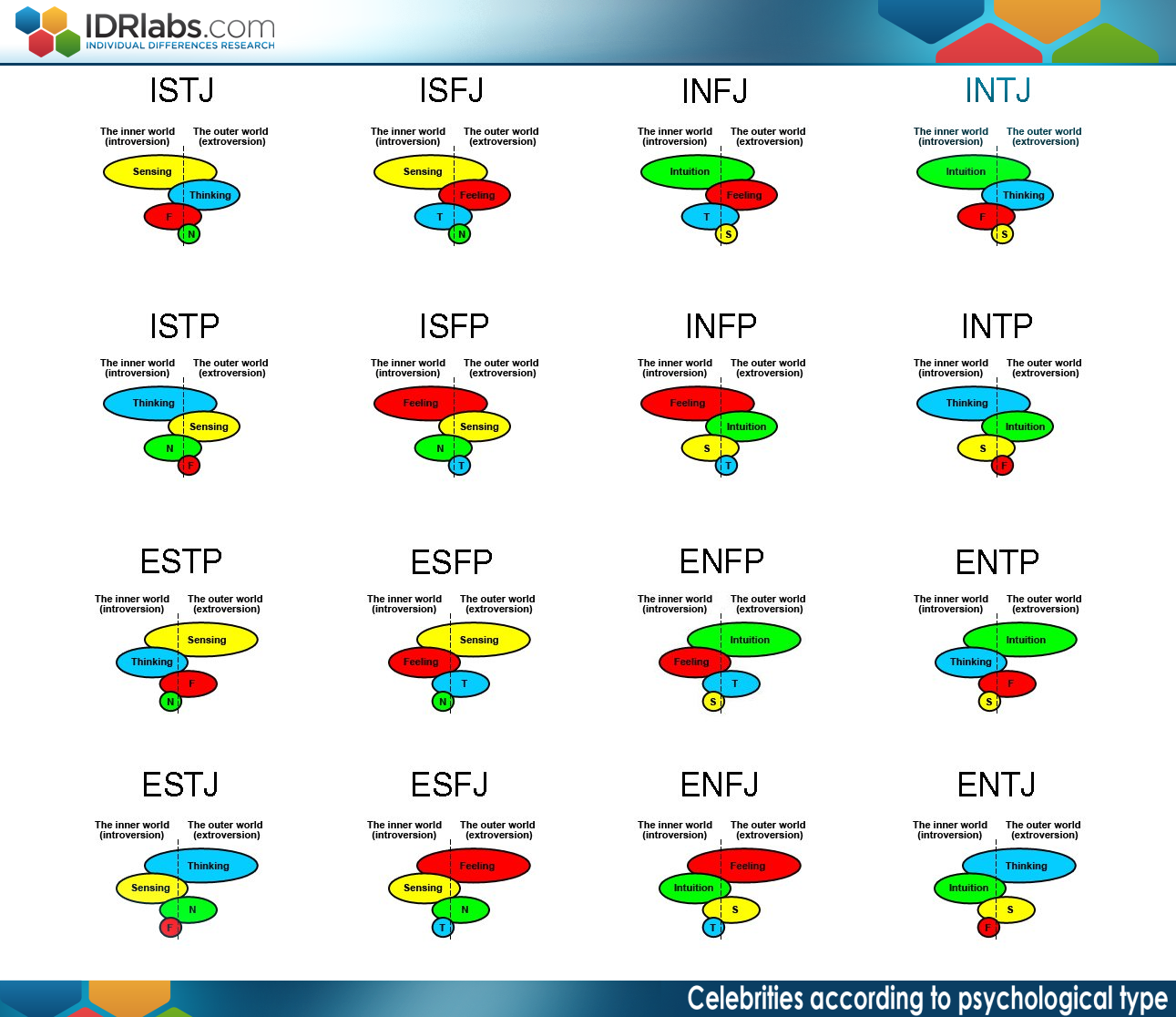
Thus if we fuse Singer and Odajnyk, we get four types, namely: Kratos, Philia, Pneuma, and Physis, or Power, Love, Spirit, and Matter types. Any of these types may be added as the fifth letter in a type code as an archetypical motivation. For example, an ENTP who is motivated by Love and unity (such as Socrates) would be an ENTP-φ whereas an ENTP who is motivated by Power and control (such as Machiavelli) would be an ENTP-κ.
Archetypical Motivation
Postulating a fifth letter as an ‘archetypical motivation’ naturally prompts questions regarding the scientific and epistemological status of such a dimension. And knowing that empirical evidence for such a dimension will probably be scarce, Odajnyk has placed the ‘archetypical motivational’ dimension in the realm of the Collective Unconscious along with the rest of the Jungian archetypes.
In Jung’s view, the Collective Unconscious is a vast storehouse of civilizational archetypes and symbols that are shared amongst all members of a civilization (possibly also all members of the human race in the case of archetypes). On this view we may say that the individual’s relation to the Collective Unconscious is like the following: If you hold out your hand, you will see five different fingers. These are five different individuals. The nail on each finger corresponds to the ego-consciousness, which contains each person’s conscious memories as well as acknowledged thoughts and feelings. The rest of the finger corresponds to the personal unconscious, which contains each person’s personal complexes, repressed memories, unacknowledged thoughts and feelings, as well as the workings of that person’s inferior function.
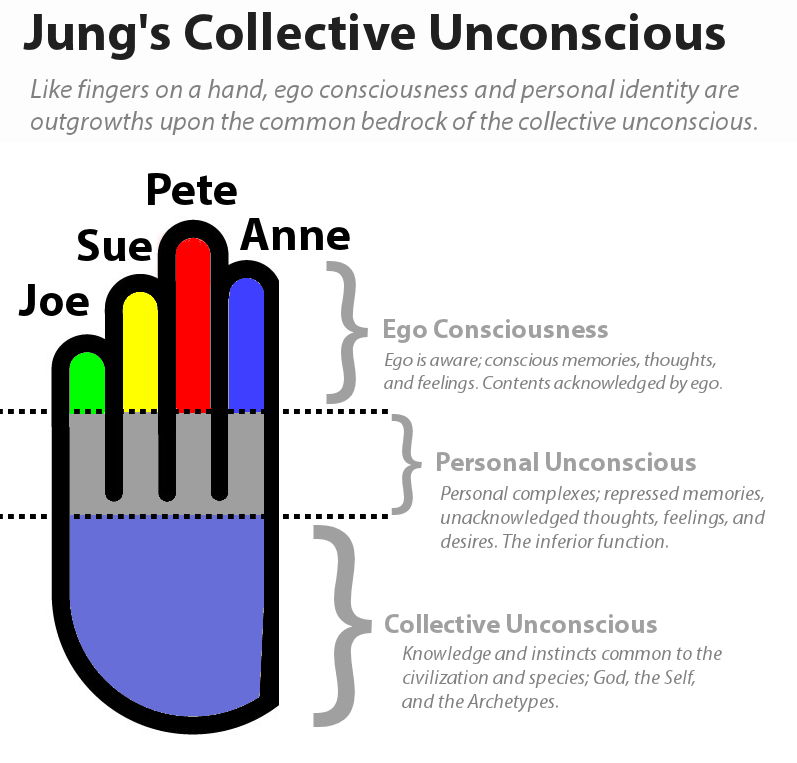 But all five fingers are sitting on the hand itself. In this example, the hand itself corresponds to the Collective Unconscious and it contains that which Jung thought was common to all of us, regardless of our ego psychology, our personal memories and upbringing, and our psychological type: God, the Self, the Mother, and so on. In Odajnyk’s view, the fifth letter in our type code is one of the four archetypes – Power, Love, Spirit, or Matter – that wells up from the Collective Unconscious in order to guide our motivations in life.
The fifth letter does indeed capture a dimension of the personality that is not established by the other four letters: Why do some people, from a very young age, just know that they want to be philosophers, physicists, or psychologists? We simply don’t know. The social sciences do not give us any answers. The Singer-Odajnyk typology purports to give us an answer (archetypes influence the individual through the Collective Unconscious), but the answer is plainly metaphysical and should not be read as giving an empirical solution to the problem.
Jungian Metaphysics
People who are Jungians tend to just assume that the Collective Unconscious exists. They rarely bother to offer any kind of empirical or epistemological evidence as to why this should be the case. At the other end of the table, people who are not Jungians tend to just discard the notion of the Collective Unconscious as overly speculative and vague.
Luckily, the four types of the Singer-Odajnyk typology can be employed even if one does not believe in the Collective Unconscious. For example, a Power type can be explained by a penchant for narcissism. Similarly, a Love type can be explained by a deficiency of empathy in childhood, thus leaving the individual preoccupied with unity and love in adulthood.
Even if one does not accept Odajnyk’s (and Jung’s) metaphysics, then, one can still derive value from the Singer-Odajnyk typology. But as a heuristic, not as an empirical device.
Examples of the Types: Matter and Spirit
To give us an idea of how the four types work in practice, Odajnyk proposes to solve the age-old question of what went wrong between Freud and Jung. In Odajnyk’s view, the two men were destined to clash because they were opposites in terms of the motivational influence that the archetypes exerted on each. Freud, being a Physis type, always wanted to trace everything psychological back to its physical basis. What happened in the psyche was basically a sort of report card about what went on further down in the body. Thus, the sexual impulse and the constitution of the various human organs came to hold great sway over Freud’s view of the psyche, just as he thought that a person’s personality could be deduced from his physical characteristics.
Jung, on the other hand, represented an extreme Pneuma type. Even if a patient came to Jung’s practice complaining of somatic symptoms, Jung could not leave it at that, but had to involve fairy tales, UFOs, and ancient Egyptian papyrus scrolls. Jung was famous for always wanting to find a religious or philosophical ‘solution’ to the patient’s problem, no matter what the problem was or how the patient felt about it.
Where Freud was attentive to the individual case, Jung ignored the individual case and followed his own fancy. Where Freud wanted psychology to be a hard science, Jung forged ahead with wild and unsubstantiated speculations (though he did pay lip service to being an empiricist). Where Freud regarded entities in the world as distinct physical objects, Jung always chased some perspective on how everything was connected to everything else.
 Freud wanted to find a sensible and factual basis for everything, which he could regard as non-speculative and settled in stone (but which was, in the final instance, his own personal experience that he erroneously gave universal form). Jung, for his part, was overly imaginative and poor with routine to the point of not doing his job properly. In their own ways, then, both Freud and Jung exemplified both the best and the worst of Physis-Sensation and Pneuma-Intuition, respectively.
Granted, some of these differences can be explained simply by the fact that Freud was a Sensation type where Jung was an Intuitive type. But on the other hand, not all Sensation and Intuitive types who work together end up as enemies the way Freud and Jung did. The cognitive functions describe ways of processing information in the psyche, but something more is needed to explain the break between Freud and Jung.
In the classical version of events, power is usually thought to be the overriding motive on both men’s part: Freud could not have Jung ‘stealing the glory’ and Jung was not satisfied with being Freud’s ‘crown prince’. But on Odajnyk’s view of events, none of the two were actually motivated by power! Under Odajnyk’s typology, their split was provoked by the fact that Freud was motivated to craft a psychology that traced everything back to Matter, whereas Jung’s inner drive was towards a spirited vision of psychology that stood in close connection to everything mystical and even encompassed the religious drive.
Examples of the Types: Love and Power
We have now given examples of Spirit and Matter types, but we still need to explore the Love and Power types. In the book, Odajnyk gives us Adler as an example of a Love type, but he doesn’t give us any examples of an outright Power type.
Regarding Adler, it is not hard to see how his primary motivation was not anything intellectual, but unity, bonding, and love. As we have previously explored on the site, Adler’s main interest in psychology was not to get the theoretical suppositions right, but to actually help people get better. Where both Freud’s and Jung’s works can be read as philosophical monuments to their psyches, Adler zapped eclectically from one “cure” to the next, always depending on the situation and the person at hand. Where Freud and Jung were interested in getting their own theories right, Adler was interested in making friends. He did not write his own books, or stay in one place to jockey for power, but preferred to travel far and wide, speaking to large audiences and turning strangers into friends on a daily basis.
In the Singer-Odajnyk typology, Adler is a Philia-Feeling type. His opposite is a Kratos-Thinking type who is motivated by power, control, and dominance. And indeed, Adler was famously unwilling (or unable) to dominate and control his followers the way Freud and Jung did, preferring to “let a thousand flowers bloom.” On the Singer-Odajnyk view of Adler’s psyche, Adler’s reluctance to dominate or control was due to him being a Love type, which crowded out his Power propensity in the same way that Feeling crowds out Thinking.
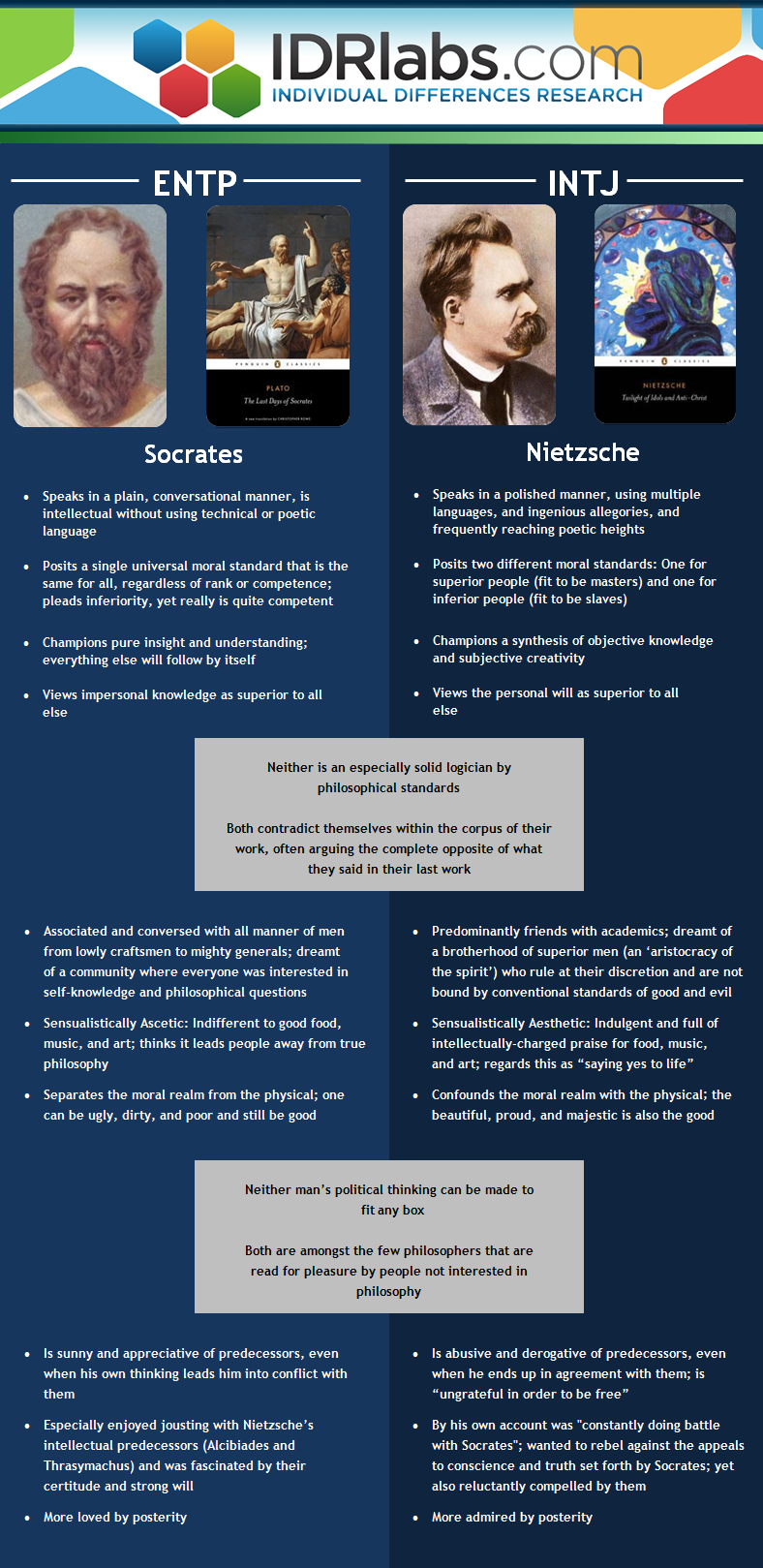
Only one type now remains for us to define: The Kratos-Thinking type, who yearns for power, control, and dominance. Odajnyk does not provide us with an example of a pureblood Power type in his book, but it shouldn’t be too hard to find an instance of the Power type in the philosophy of Friedrich Nietzsche.
Under a Nietzchean morality, the Overmen hold all the power and dominate the rest of the earth. The Overmen are a radically talented aristocracy who are not bound by the same moral rules as the non-Overmen. The Overmen rule at their discretion, lauding it over the inferior men who are fit to be no more than slaves. As a Kratos-Thinking type, Nietzsche is the opposite of Adler’s Philia-Feeling, and so it is hardly surprising to find that to Nietzsche, exerting any type of altruism or helping hand is a sign of weakness that renders one unfit to rule.
Being the recipient of mercy or alms is on Nietzsche’s view a degrading humiliation that stings far worse than the malady itself. Even in the midst of acute suffering, one must endure in proud solitude, consoling oneself that one is better than other men, and that one has the strength to go through what they cannot. Likewise, to discover that one is loved in return ought to disgust the lover with his beloved: For if the beloved is so puny as to love me back, that must mean that she is not superior to me and I will therefore gain no Power from entering into a relationship with her.
Thus, from a Kratos-Thinking perspective, even romantic love is assessed through the lens of weaker and stronger, better or worse.
***
By using Freud as his Physis-Sensation type, Odajnyk has actually obscured one of the greatest merits of his typology: Where Sensation has so often been defined as the mere absence of Intuition, Physis-Sensation is here brought into its own right as a motivational interest in the natural universe that supersedes mere cognition. Under the Singer-Odajnyk typology, for example, prominent scientists like Richard Feynman and Albert Einstein would have to be classified as Physis-Sensation types (i.e. Feynman ENTP-ύ and Einstein INTP-ύ) – as Matter types who are interested in the natural universe on its own terms before they are interested in Power, Love, or the entertainment of their own Spirit. Odajnyk has finally made Sensation types look good.
***
The Singer-Odajnyk Addition to Jung’s Typology © 2014 Ryan Smith, Sigurd Arild, and CelebrityTypes International.
Image of Freud and Jung in the article commissioned from artist Darwin Cen.
V.W. Odajnyk died of throat cancer in 2013. He left behind an unpublished manuscript on Jungian typology. He identified himself as INFJ-κ.
A physicist like Wolfgang Pauli would still have to be classified as an ENTP-π.