
Multidimensional Perfectionism Test
You are here because one of your friends linked you to their Multidimensional Perfectionism Test result:
Take the TestYour friend's results:
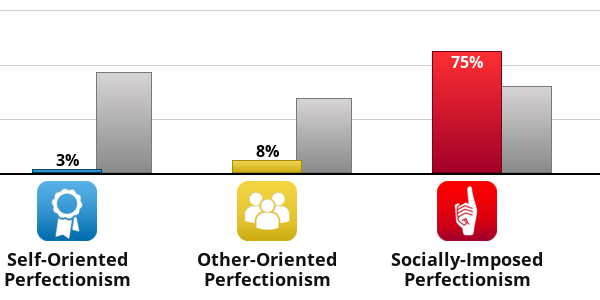
Your friend struggles:
- 59.3% less with self-oriented perfectionism than the average person.
- 38.2% less with other-oriented perfectionism than the average person.
- 21.6% more with socially-oriented perfectionism than the average person.
Explanation of Facets:
Self-oriented Perfectionism measures the tendency to impose strict personal standards on oneself, due to a strong motivation to achieve perfection. People who are high in this trait may have a tendency to set unrealistically high standards for themselves and to feel that failure and errors in their work must be avoided at all times. Those with extremely high scores may also grapple with anxiety and have difficulties sleeping when they feel that they are not living up to their exceptionally high expectations and lofty individual goals.
Other-oriented Perfectionism is the tendency to impose excessively high standards on others (e.g. friends, family, and coworkers). People who are high in this trait often feel that others are not doing enough to strive for perfection and success. It is personally upsetting to them to witness those close to them making mistakes, and for this reason they rigorously evaluate others to ensure optimum performance. As a result, they may criticize others for giving up before top-quality work has been achieved, just as it is common for them to expect that those in their social circle are consistently seeking self-improvement.
Socially-imposed Perfectionism denotes the tendency to feel that others are imposing high standards and expectations on oneself, often so high that one feels unable to live up to them. Friends, family, and significant others are perceived as overly demanding, intolerant of shortcomings, and excessively critical of any mistakes or flaws. People who are high in this trait may experience a constant feeling of pressure and critical evaluation from others, as well as a fear of being rejected and denied acceptance or human worth.
References
- Cox, B. J., Enns, M. W., & Clara, I. P. (2002). The multidimensional structure of perfectionism in clinically distressed and college student samples. Psychological Assessment, 14, 365-373.
- De Cuyper, K., Claes, L., Hermans, D., Pieters, G., & Smits, D. (2015). Psychometric properties of the Multidimensional Perfectionism Scale of Hewitt in a Dutch-speaking sample: Associations with the Big Five personality traits. Journal of Personality Assessment, 97, 182-190.
- Hewitt, P. L., Flett, G. L., Turnbull-Donovan, W., & Mikail, S. F. (1991). The Multidimensional Perfectionism Scale: Reliability, validity, and psychometric properties in psychiatric samples. Psychological Assessment, 3, 464-468.
- Hill, A. P., & Curran, T. (2016). Multidimensional perfectionism and burnout: A meta-analysis. Personality and Social Psychology Review, 20, 269-288.
Take Next












GET THE FULL STORY
Become a lifetime member with a one-time payment

$11.99
WHAT YOU GET
Access to members-only tests
Ability to track and save test results
Access to all of our eBooks (value $44.94)
Access to premium type assessments and infographics
Become a memberGET THE FULL STORY
Manual of Personality Styles

$6.99
WHAT YOU GET
71-page manual, explaining the make-up of all personality styles, their hidden drives, and the theory behind the system.
Presented in an easy-to-read style and backed up by solid academic references.
14-day, no-questions-asked, money-back guarantee.
Order NowSave and monitor your results over time
Become a member today
Sign Up