
 English
  Español
  Português
  Deutsch
  Français
  Italiano
  Polski
  Українська
  Русский
  Türkçe
  العربية
  فارسی
فارسی  日本語
日本語  한국어
한국어  ไทย
ไทย  汉语
汉语  Tiếng Việt
  Filipino
  Bahasa
 Big Tent Dark Traits Test
You are here because one of your friends linked you to their Big Tent Dark Traits Test result:
Take the TestResults:
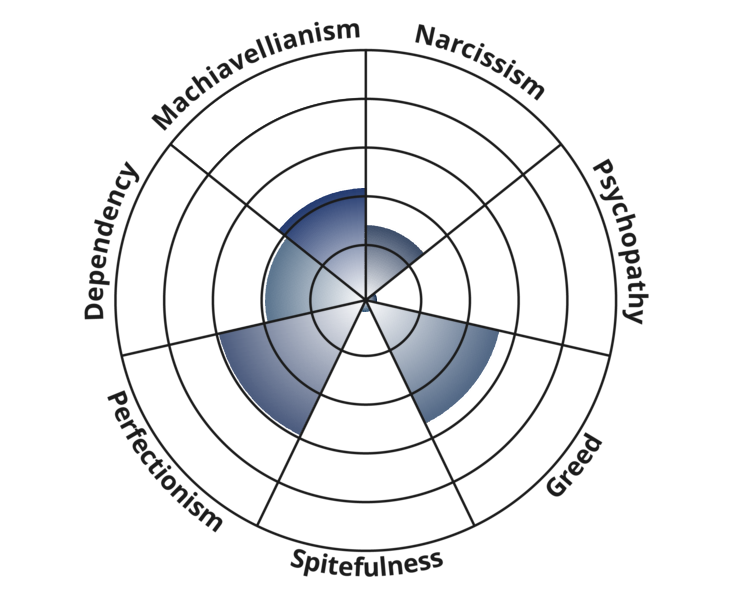
Your friend's Big Tent Dark Traits are low (34.29%).
Take the TestExplanation of Facets:
Machiavellianism is the tendency to pursue one’s self-interest by engaging in long-term oriented social manipulation, deception, and exploitation.
Narcissism is the pronounced and egotistical interest in, or admiration of, one’s self, as well as an inflated sense of self.
Psychopathy denotes deficits in affect and self-control (i.e., callousness and impulsivity), as well as antisocial behavior, volatility, and lack of remorse.
Spitefulness is the tendency to engage in behavior that would harm one’s enemies, even when doing so would also entail harm to oneself.
Greed is the excessive desire for power, wealth, and other manifestations of perceived social value, as well as the tendency to be envious of others’ gains.
Perfectionism is the tendency to set unreasonably high standards for oneself, often accompanied by the belief that one’s work must be flawless.
Dependency is the inclination to rely on others to act passively and defer to others for one’s direction in life.
References
- Hart S.D., Hare R.D., Harpur T.J. (1992) The Psychopathy Checklist—Revised (PCL-R). In: Rosen J.C., McReynolds P. (eds) Advances in Psychological Assessment. Advances in Psychological Assessment, vol 8. Springer, Boston, MA.
- Lambie, G., & Haugen, J. (2019). Heintzelman greed scale.
- Marcus, D. K., & Zeigler-Hill, V. (2015). A Big Tent of Dark Personality Traits. Social and Personality Psychology Compass, 98, 434–446.
- Marcus, D. K., Zeigler-Hill, V., Mercer, S. H., & Norris, A. L. (2014). The psychology of spite and the measurement of spitefulness. Psychological Assessment, 26, 563–574.
- McHoskey, J. W., Worzel, W., & Szyarto, C. (1998). Machiavellianism and psychopathy. Journal of Personality and Social Psychology, 74, 192–210.
- Pincus, A. L., Ansell, E. B., Pimentel, C. A., Cain, N. M., Wright, A. G. C., & Levy, K. N. (2009). Initial construction and validation of the Pathological Narcissism Inventory. Psychological Assessment, 21, 365–379.
- Schoenleber, Michelle & Roche, Michael & Wetzel, Eunike & Pincus, Aaron & Roberts, Brent. (2015). Brief-Pathological Narcissism Inventory (B-PNI).
- Stoeber, J. (2015). How other-oriented perfectionism differs from self-oriented and socially prescribed perfectionism: Further findings. Journal of Psychopathology and Behavioral Assessment, 37(4), 611-623.
Take Next












GET THE FULL STORY
Become a lifetime member with a one-time payment

$11.99
WHAT YOU GET
Access to members-only tests
Ability to track and save test results
Access to all of our eBooks (value $44.94)
Access to premium type assessments and infographics
Become a memberGET THE FULL STORY
Manual of Personality Styles

$6.99
WHAT YOU GET
71-page manual, explaining the make-up of all personality styles, their hidden drives, and the theory behind the system.
Presented in an easy-to-read style and backed up by solid academic references.
14-day, no-questions-asked, money-back guarantee.
Order NowSave and monitor your results over time
Become a member today
Sign Up