
Aggression Test
You are here because one of your friends linked you to their Aggression Test result:
Take the TestResults:
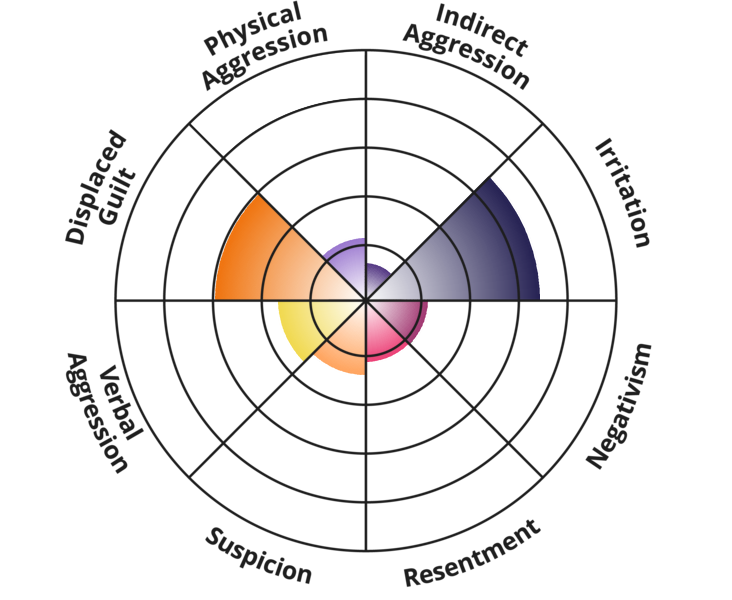
Your friend's aggressiveness is low (35.63%).
Take the TestExplanation of Factors:
Physical Aggression covers the tendency to physically harm others and/or destroy their possessions. People high in Physical Aggression are, for good reason, often perceived by others as threatening.
Indirect Aggression involves manipulating others obliquely by spreading rumors, excluding them, breaking confidences, and so on. Indirect Aggression often targets the self-esteem of the recipient and/or leaves them as undesirable for others to forge bonds with.
Irritation a common trigger for aggressive behavior, is the annoyance that precedes it and is often fostered by the person’s vulnerability to disappointments, criticisms, or perceived threats. Moreover, anger can also be expressed as irritation, causing others to experience the irritated individual as aggressive.
Negativism is skepticism regarding almost everything that is affirmed by others. Negativistic people resist others’ suggestions or beliefs and often express their opposition through passive-aggressive acts.
Resentment covers the anger, fear, and disappointment that is often triggered when individuals feel that they are being treated unfairly. This multi-layered emotion leads to aggressive behavior when the harbored bitterness is expressed through hurtful words, irritation, and negativism toward others.
Suspicion is linked to aggressiveness, in that general distrust leads to social conflict and ill feelings. Seeing others as dishonest or dangerous makes suspicious individuals constantly on guard and antagonistic.
Verbal Aggression includes derogatory name-calling, screaming, or swearing at others, and similar acts that involve the use of speech to inflict psychological harm.
Displaced Guilt is the tendency to direct anger or aggressiveness at other people as a way to deal with internal feelings of embarrassment, guilt, or shame.
References
- Lutkova, N., Makarov, Y., Minkin, V., & Nikolaenko, J. (2016). Game aggression rating method driven by vibration imaging technology.
- Teoriya. RU. (2018). The relationship between behavior, aggression and the character of the adolescent. Psychology and Psychological Research International Journal.
- Fedorenko, M., Belosouva, M., & Chetyrchinskaya, T. (2019). Emotional intelligence, anxiety, and aggression as predictors of destructive behavior and offences of teenagers. International Forum on Teacher Education.
Take Next









GET THE FULL STORY
Become a lifetime member with a one-time payment

$9.99
WHAT YOU GET
Access to members-only tests
Ability to track and save test results
Access to all of our eBooks (value $44.94)
Access to premium type assessments and infographics
Become a memberGET THE FULL STORY
Manual of Personality Styles
$6.99
WHAT YOU GET
71-page manual, explaining the make-up of all personality styles, their hidden drives, and the theory behind the system.
Presented in an easy-to-read style and backed up by solid academic references.
14-day, no-questions-asked, money-back guarantee.
Order Now