
Ambivalent Sexism Test
You are here because one of your friends linked you to their Ambivalent Sexism Test result:
Take the TestYour friend's sexism results:
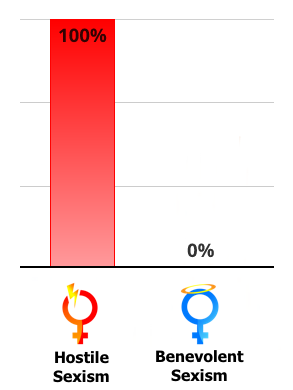
Hostile Sexism: Overtly negative beliefs about women as well as negative stereotypes about them. For example, the belief that women are entitled and egotistical; that women seek unearned privileges in society; or the belief that women seek to tease or control men sexually may all be seen as forms of Hostile Sexism.
Benevolent Sexism: Attitudes towards women that may seem positive on the surface, but also serve to perpetuate gender stereotypes and gender inequality. For example, the belief that men should protect women; that women thrive better in nurturing roles; or that women are somehow “purer” than men may all be seen as forms of Benevolent Sexism.
Please Note
The Ambivalent Sexism Inventory is rooted in Liberal Feminism. As such, its authors define positive female stereotypes and behaviors that give preferential treatment to women on account of their gender as sexism (i.e., the Benevolent Sexism scale). Someone who sees gender issues from the perspective of Cultural Feminism or Intersectional Feminism would not necessarily regard Benevolent Sexism as a form of sexism.
References
- Bohner, G., Ahlborn, K., & Steiner, R. (2010). How sexy are sexist men? Women’s perception of male response profiles in the Ambivalent Sexism Inventory. Sex Roles, 62, 568-582.
- Christopher, A. N., & Mull, M. S. (2006). Conservative ideology and ambivalent sexism. Psychology of Women Quarterly, 30, 223-230.
- Cross, E., and Overall, N. C. (2018). Women's attraction to benevolent sexism: needing relationship security predicts greater attraction to men who endorse benevolent sexism. Eur. J. Social Psychol. 48, 336–347. doi: 10.1002/ejsp.2334.
- Glick, Peter & Fiske, Susan. (1996). The Ambivalent Sexism Inventory: Differentiating Hostile and Benevolent Sexism. Journal of Personality and Social Psychology. 70. 491-512. 10.1037/0022-3514.70.3.491.
- Viki, G. T., Abrams, D., & Hutchison, P. (2003). The “true” romantic: Benevolent sexism and paternalistic chivalry. Sex Roles, 49, 533-537.












GET THE FULL STORY
Become a lifetime member with a one-time payment

$9.99
WHAT YOU GET
Access to members-only tests
Access to all of our eBooks (value $44.94)
Access to premium type assessments and infographics
Become a member