
 English
  Español
  Português
  Deutsch
  Français
  Italiano
  Polski
  Română
  Українська
  Русский
  Türkçe
  العربية
  日本語
日本語  한국어
한국어  ไทย
ไทย  汉语
汉语  हिन्दी
  Bahasa
Academically reviewed by Dr. Jennifer Schulz, Ph.D., associate professor of psychology.
WingGuesser Test
WingGuesser is a fun and educational game that puts your political perception to the test. In each round, you're shown a photo of a politician. Your task is to guess whether lean right-wing (RW) or left-wing (LW).
Studies show both humans and machines can infer others' political orientation from facial images at rates better than chance. For example, one study published in Nature, found that a facial-recognition algorithm could correctly classify whether someone was liberal or conservative 72% of the time, far above the random-chance baseline of 50%.
Question 1 of 20

Guess the political orientation:
NEXT
Photos sourced from Riksdagen, Stortinget, and Folketinget. WingGuesser is not affiliated with or endorsed by these institutions.
WingGuesser is an engaging online game where players try to guess a politician's political orientation based solely on their photo. Each round presents a new image of a public figure along with two choices: left wing or right wing. Your goal is to guess correctly and see how many right answers you can rack up. It's a lighthearted but surprisingly insightful way to explore how visual cues and human intuition intersect with politics.
You can play different modes-like a daily quiz that refreshes every 24 hours or a challenge mode with a broader selection of political figures. Some players treat WingGuesser as a fun way to sharpen their intuition about political cues in faces, trying to beat their high scores or challenge friends. Other players enjoy discussing which features made a politician look more left wing or right wing and comparing results with peers.
What makes WingGuesser surprising is that it feels random, yet there's evidence you may be picking up on real patterns. In one large study, a facial‑recognition algorithm applied to over one million profile images correctly classified political orientation (liberal vs. conservative) in about 72% of cases, far above the 50% chance level of random guessing and higher than typical human accuracy (~55%). This finding held true across samples from the U.S., the UK, and Canada, and across different online platforms like Facebook and dating sites. Importantly, even when age, gender, and ethnicity were controlled for, the algorithm's accuracy remained high (~69%).
In another study using carefully standardized, expressionless facial images and controls for presentation factors, both human raters and algorithms were able to predict participants' scores on a political orientation scale better than chance. The human predictions correlated modestly with actual orientations, while the algorithm performed slightly better. Additionally, when the predictive model was applied to a dataset of over 3,000 real politicians' naturalistic images, it still demonstrated above‑chance prediction.
These findings suggest that even when obvious contextual cues (such as clothing, background, or pose) are minimized, certain facial features and expressions may subtly correlate with political orientation. Whether it's differences in facial structure, expression tendencies, head orientation, or other visual signals, these patterns appear robust enough to be detectable by both humans and machines-even if they're not always consciously recognized.
WingGuesser doesn't claim to be a scientific tool, nor does it imply that political orientation is determined by facial appearance. What it does highlight is how people's perceptions and judgments can sometimes align with patterns found in controlled research. Players often notice that some guesses feel intuitive-perhaps because they're responding to subtle visual cues-while others leave them scratching their heads. It's this blend of intuition, chance, and real psychological research that makes WingGuesser both entertaining and thought‑provoking.
Whether you're fascinated by politics, psychology, or just enjoy quirky quizzes, WingGuesser offers a unique way to engage with how people perceive political orientation-and invites reflection on the nature of those perceptions.
References
- Kosinski, M. (2021). Facial recognition technology can expose political orientation from naturalistic facial images. Scientific Reports, 11(1). https://doi.org/10.1038/s41598-020-79310-1
- Kosinski, M., Khambatta, P., & Wang, Y. (2024). Facial recognition technology and human raters can predict political orientation from images of expressionless faces even when controlling for demographics and self‑presentation. American Psychologist, 79(7), 942-955. Stanford Graduate School of Business.
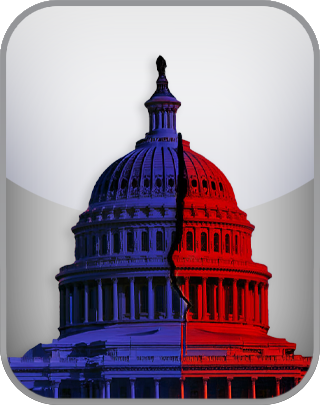
Why Use This Test?
WingGuesser is a playful way to explore how perception, politics, and faces intersect. It puts your skills to the test while connecting to real research showing people can identify ideology from faces at levels above sheer guessing. Whether you love politics, psychology, or quirky quizzes, this is a unique experience that's both entertaining and thought-provoking.