
 English
 Español
 Português
 Deutsch
 Français
 Italiano
 Polski
 Українська
 Русский
 Türkçe
 العربية
 日本語
 한국어
 ไทย
 汉语
 Tiếng Việt
 Bahasa

Based on the research of Marilyn C. Welsh on the Tower of Hanoi as a measure of planning.
Tower of Hanoi Test
How few moves will you need?
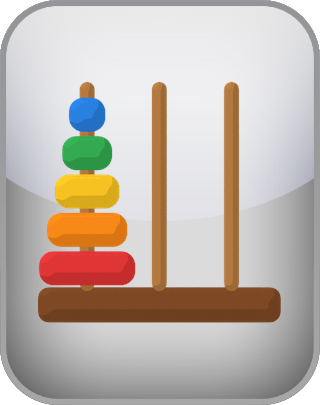
The Tower of Hanoi Test measures how well you plan a sequence of moves; the Number Memory Test and the Sequence Memory Test measure how much you can hold in mind, and the Reaction Time Test how quickly you respond. Move the stack to the right peg, one disk at a time. A larger disk can’t go on a smaller one.
Play three rounds with 3, 4, and 5 disks. Select a peg to pick up its top disk, then select a different peg to place it. Your score compares your moves with the fewest possible. To take the test, press Start below.
Round 1 of 3
Why does the puzzle take so many moves?
The first move can look obvious. You can take the smallest disk off the left peg and place it on the right one, where the tower eventually has to go. Depending on the size of the stack, though, that move can put the smallest disk exactly where a larger one will need to land. A bit of reflective thinking helps here. Before you move a disk, look at what the move frees up and what it blocks. That gives you a way to judge a move even when the board looks further from the goal afterward.
The fewest possible moves are 7 for three disks, 15 for four, and 31 for five. The numbers grow so quickly because you have to clear every smaller disk off the largest one before you can move it. In the shortest solution, you first move the smaller stack onto the spare peg, move the largest disk to the goal, and then move the smaller stack back on top of it. Every extra disk doubles the work of moving the smaller stack and adds one move for the largest disk. The three shortest solutions add up to 53 moves.
How to read your results
In the results, compare the Moves and Minimum columns for the same round. If the four-disk puzzle took you 19 moves, the minimum of 15 tells you that there were four moves beyond the shortest solution. A move counts when the disk lands legally, even when it reverses your previous move. Trying to place a larger disk on a smaller one increases the rule violation count. The disk stays where it was, so you can choose a different destination. Selecting an empty peg with no disk picked up leaves both counts as they were.
Your elapsed time includes the time you spend looking at the board before the first move and the pauses between moves. The clock stops as soon as the stack is complete, so you can take a break between rounds. Comparing the clock with the move count can tell you something about how you played. On a second try, you might use fewer moves after spending more time at the start. If your attention was elsewhere or you had to step away mid-round, keep that in mind when comparing times.
What does the puzzle tell you?
Researchers use versions of this puzzle to study how people plan a sequence of actions and adapt when a move creates a problem. In a study with four disks and many different starting positions, Marilyn Welsh and Mariëtte Huizinga found that people who described more elements of a strategy also tended to perform better. They also observed improvement across problems in the group that received them in random order. The browser test here uses the same starting layout each time, so a repeat attempt gives you a chance to use what you learned the first time.
If you try again, look for the same smaller puzzle inside a larger one. Once you have moved a stack of three disks, look for occasions to move a stack of three again during the four-disk round. That kind of pattern recognition can help you decide what to do next without trying every possible move. You can compare your two attempts one round at a time and see where you saved moves. You may find that the smallest round stays the same while your move count drops on the largest one.
References
- Welsh, M. C., & Huizinga, M. (2001). The development and preliminary validation of the Tower of Hanoi–Revised. Assessment, 8(2), 167–176.
- Welsh, M. C., & Huizinga, M. (2005). Tower of Hanoi disk-transfer task: Influences of strategy knowledge and learning on performance. Learning and Individual Differences, 15(4), 283–298.
Frequently Asked Questions
What is the goal of the puzzle?
Move the full stack to the right peg one disk at a time, keeping larger disks underneath smaller ones.
How is my score calculated?
Your score is the fewest possible moves for the three rounds, 53, divided by the moves you used, times 100. Solving every round in the fewest moves scores 100; using twice as many moves as needed scores 50. Time and rule violations are shown for each round but do not change the score.
What happens if I choose an illegal move?
The disk stays in place, the rule violation is counted, and you can select a different destination.
Is there a time limit on each round?
Each round lasts until you solve the puzzle or restart, and the results show the elapsed time for each completed round.
Can I play without using a mouse?
Use Tab to move between pegs and Enter to select one, press 1, 2 or 3 for the left, middle and right peg, or tap the pegs on a touchscreen.
Why Use This Test?
1. Free. The Tower of Hanoi Test is free, runs in your browser and works with a mouse, a keyboard or a touchscreen.
2. A clear score. Every round has a known shortest solution, so your score says exactly how close you came to it.
3. Built on research. The puzzle is a classic task in the study of planning and problem solving.