
 English
  Español
  Português
  Deutsch
  Français
  Italiano
  Polski
  Română
  Українська
  Русский
  Türkçe
  العربية
  日本語
日本語  한국어
한국어  ไทย
ไทย  汉语
汉语  Tiếng Việt
  Filipino
  हिन्दी
  Bahasa
 Chad or Chud Test
Are you built for the world, or compelled to understand it?
Between the man who simply acts and the man who needs to know what is really going on lies the Chad-Chud divide.
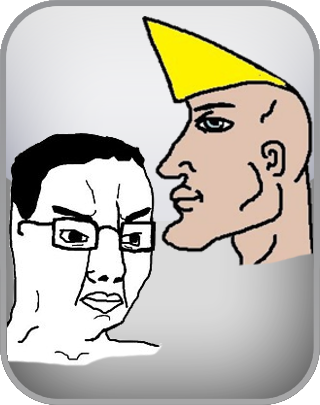
At one end stands the Chad: physical, instinctive, socially fluent, and immune to intellectual rabbit holes. He does not need a theory of the party. He is already at the party.
At the other sits the Chud: cerebral, obsessive, suspicious of easy answers, and several layers deeper into the internet than is advisable. Somewhere on his hard drive is a PDF that would make dinner conversation noticeably worse.
Instinct or analysis, action or interpretation, surface or depth - not who is running the story. Which has more control over you? Enter your input below.
Question 1 of 24
I have read long documents that most people would consider a waste of a weekend.
| Disagree | Agree |
BACK NEXT
'Chad' and 'Chud' both began as insults, and neither stayed where it started. Chad was Chicago slang in the 1990s for a certain kind of affluent young man, reached Urban Dictionary in 2006, and hardened in 2013 into 'Chad Thundercock' on 4chan's /r9k/ board - the effortlessly successful figure that forum defined itself against. What loosened it was the Virgin vs Chad drawings of March 2017, which set the two side by side over trivial daily business: how each one walks into a room, orders a coffee, answers a message. Once the joke was about posture rather than conquest the word drifted, and it is now used with a kind of affection for someone who is simply not worried about it.
Chud travelled further. It is an acronym from a 1984 creature feature, C.H.U.D., short for Cannibalistic Humanoid Underground Dwellers, and it surfaced online as a plain insult: Urban Dictionary carried it in 2003 as a word for someone stupid and unpleasant, with no politics attached. Only from late 2019, by way of political compass memes, did it fasten onto the online right, which is where most of its present heat comes from and where spin-offs such as Chudjak and GigaChud sit. This test does not ask about any of that. It asks about temperament: whether you are the kind of person who has to know what is really going on, or the kind who does not need to.
Framed that way the contrast becomes ordinary and testable. The Chad end describes someone who trusts a first impression, is easy in a room, does the thing rather than reading about it, and takes the obvious explanation because it is usually correct. The Chud end describes someone who has to understand the mechanism, whose interests are too specific for most dinner tables, who knows a great deal about subjects he has never practised, and who assumes there is a layer underneath the one being shown. Almost nobody is purely one, which is why the result is a position on a line rather than a label in a box.
Each facet has a real research literature behind it. Instinct is close to the rational-experiential distinction described by Pacini and Epstein, who found that people differ stably in how far they reason a thing through rather than simply knowing it. Ease and Action both touch the need for cognition described by Cacioppo and Petty: a durable appetite for effortful thinking, which predicts who reads the footnotes and who gets on with it. Face Value relates to work on illusory pattern perception, where a tendency to see connections in noise predicts belief in hidden explanations. That tendency is a genuine trait rather than a fault, and like every trait it is right some of the time.
Your answers are combined into a single Chadness score from 0 to 100, together with a breakdown across the four facets. A high score reflects the instinctive, socially fluent, action-first, take-it-at-face-value end of the continuum, and a low score reflects the analytical, absorbed, interpretive, what-is-really-going-on end. The result is shown on a two-pole chart that divides your habits between the Chud side and the Chad side, so you can see at a glance which way you lean and by how much. The small comparison markers are estimated references rather than standardized clinical norms.
It is worth saying plainly that a high score is not a compliment and a low score is not an accusation. The Chud end is where most of the noticing happens: somebody had to read the document, and it was not the man already at the party. The Chad end is where most of the doing happens, which is why so much of the world runs on it. Each end is blind in roughly the place the other is watching, and the cost is real on both sides - one pays in time and in company, the other in things it never found out about.
This test is for entertainment and self-reflection. It is not a diagnostic instrument, it measures no clinical condition, and it makes no claim about anyone's politics, values, or worth. The terms are internet slang, used here for the postures they describe rather than for any group they have been aimed at, and the facets are ordinary thinking habits rather than validated subscales.
References
- Cacioppo, J. T., & Petty, R. E. (1982). The need for cognition. Journal of Personality and Social Psychology, 42(1), 116-131.
- Pacini, R., & Epstein, S. (1999). The relation of rational and experiential information processing styles to personality, basic beliefs, and the ratio-bias phenomenon. Journal of Personality and Social Psychology, 76(6), 972-987.
- van Prooijen, J.-W., Douglas, K. M., & De Inocencio, C. (2018). Connecting the dots: Illusory pattern perception predicts belief in conspiracies and the supernatural. European Journal of Social Psychology, 48(3), 320-335.
Frequently Asked Questions
What does the Chad or Chud Test measure?
It measures where you fall on a spectrum between instinctive action and social ease at one end and analytical digging into details at the other.
What does my Chadness score mean?
The score from 0 to 100 shows how much your habits lean toward quick impressions and doing versus needing to understand mechanisms, with a breakdown across four facets on a two-pole chart.
How does the test describe different thinking styles?
It looks at four facets including instinct, ease in social settings, preference for action over reading, and taking things at face value versus looking for hidden layers.
How should I interpret the limits of my result?
The score reflects a position on a line rather than a fixed type, since almost nobody fits purely at either end and the markers are only rough references.
How might this test help in daily life?
It offers a way to notice whether you tend to act on first impressions or pause to analyze, which can clarify patterns in how you handle situations.
Why Use This Test?
1. Free. The Chad or Chud Test is completely free to take and gives you your full scores the moment you finish.
2. One clear spectrum. Instead of a personality box, you get a single position between two internet archetypes, broken down across four ways of moving through the world.
3. Grounded, not clinical. The four facets draw on real research into thinking style, need for cognition, and pattern perception, while staying a test you take for fun.